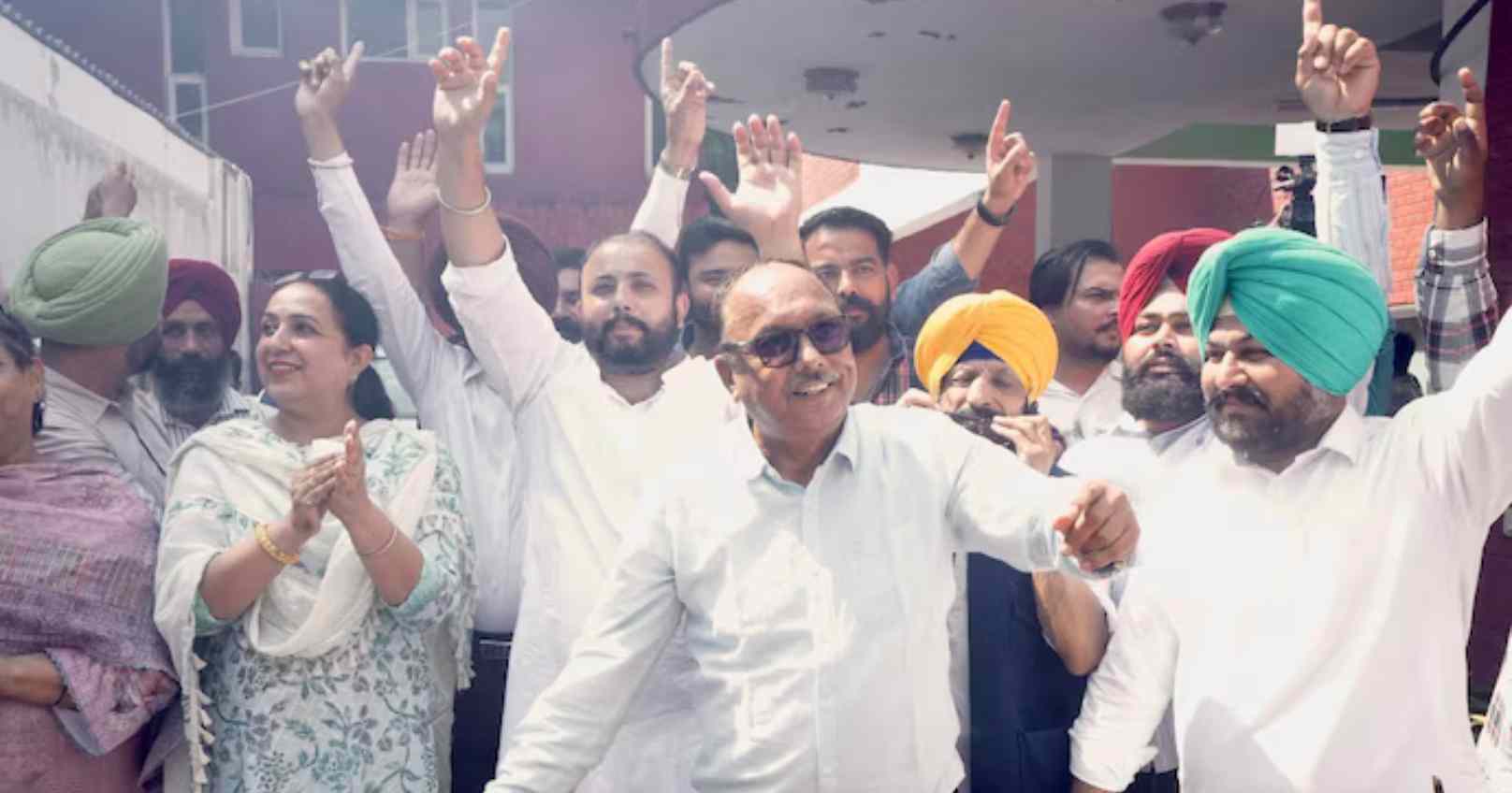
The ruling Aam Aadmi Party (AAP) delivered a commanding performance in Punjab’s municipal elections, securing a majority of seats across urban local bodies and reinforcing its position ahead of the 2027 Assembly elections.
AAP won 958 out of 1,977 municipal wards contested across the state, comfortably outperforming its rivals. However, the results also highlighted pockets of resistance, with the Congress and BJP registering significant victories in a few key urban centres.
Among the eight municipal corporations that went to the polls, AAP captured control of five—Mohali, Barnala, Batala, Moga and Bathinda. The Congress achieved a notable success in Kapurthala Municipal Corporation, while the BJP emerged victorious in Abohar and became the largest party in Pathankot.
The civic polls came at an important time for AAP, which had recently faced political turbulence, including the departure of several leaders and concerns about internal divisions within its Punjab unit. The election outcome is likely to boost the party's confidence after those setbacks.
Across the state, Congress secured 397 wards, while Independent candidates won 251 seats. The Shiromani Akali Dal (SAD) claimed 192 wards, BJP secured 172, and the Bahujan Samaj Party (BSP) won seven seats.
AAP also dominated elections to municipal councils and committees. Out of 75 municipal councils, the party won 40, while Congress secured 18 and SAD claimed 10. BJP won four councils and other parties accounted for the remaining three. In the 20 municipal committees, AAP emerged victorious in 11, followed by Congress with five, SAD with two, and one each for BJP and other groups.
The elections covered eight municipal corporations, 75 municipal councils and 20 municipal committees, attracting more than 7,500 candidates. Voting took place on May 26 through ballot papers, with voter turnout recorded at nearly 64 percent.
Despite AAP's overall dominance, Congress delivered one of the biggest surprises of the election by securing a clear majority in Kapurthala Municipal Corporation, winning 31 of the 50 wards. The BJP, meanwhile, strengthened its urban footprint through its victory in Abohar and strong performance in Pathankot.
Punjab Chief Minister Bhagwant Mann welcomed the results, describing them as a strong endorsement of his government's performance. He said voters had rewarded the developmental initiatives undertaken by the state government over the past four-and-a-half years and suggested that the outcome reflected growing public confidence in AAP.
Mann also argued that the civic election verdict offered an indication of the political mood heading into the next Assembly election, claiming that voters had rejected opposition parties.
The Chief Minister further criticised the BJP, alleging that central agencies had been used against AAP leaders but that Punjab voters had refused to be influenced by such tactics.
However, political observers urged caution in drawing direct conclusions from the municipal election results. Analysts pointed out that Punjab's political history has often shown a disconnect between local body elections and Assembly poll outcomes.
Experts noted that previous municipal election winners have not always succeeded in subsequent state elections. They also suggested that the results indicate the BJP continues to face challenges in expanding its influence in Punjab without support from traditional allies.
Meanwhile, opposition parties questioned the fairness of the electoral process. SAD leader Bikram Singh Majithia accused the ruling party of using government machinery to influence the polls and claimed that many voters continued to support the Akali Dal despite pressure.
Congress leaders also raised concerns over the counting process in certain areas, particularly in Gidderbaha, where AAP recorded an overwhelming victory by winning 17 of 19 wards.
While AAP celebrated its statewide success, the mixed results across major urban centres indicate that Punjab's political landscape remains competitive as parties begin positioning themselves for the 2027 Assembly elections.