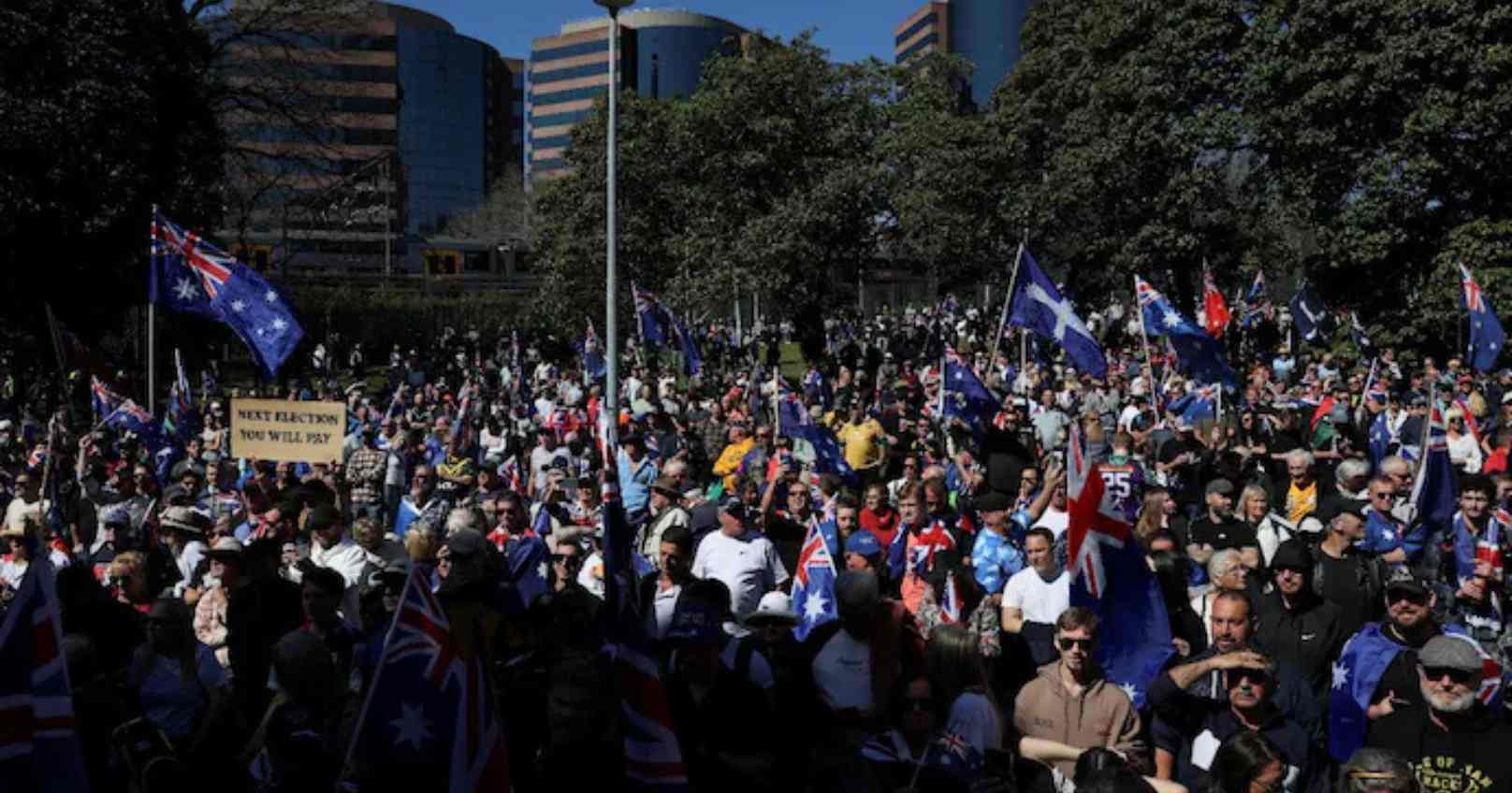
Thousands of people marched in coordinated anti-immigration rallies across major Australian cities on Sunday, with campaign material for the events singling out Indian migrants, sparking strong criticism from government leaders who linked the protests to far-right extremist groups.
The demonstrations, branded “March for Australia,” claimed mass migration was eroding national identity. Flyers circulated ahead of the protests highlighted the rising Indian-born population — now over 3% of Australia’s residents — and described the demographic shift as “replacement.” Posts on social media echoed similar themes, pointing to census data showing Indian arrivals more than doubled in the past decade to nearly 850,000.
Organisers portrayed the rallies as grassroots efforts aimed at halting large-scale immigration. But officials and advocacy groups noted neo-Nazi elements were present, particularly after known extremist Thomas Sewell addressed marchers in Melbourne.
Major Rallies and Counter-Protests
In Sydney, an estimated 5,000–8,000 participants gathered near the city’s marathon route, many carrying national flags. A counter-demonstration by the Refugee Action Coalition, attended by hundreds, denounced the march as advancing a far-right agenda. Police deployed hundreds of officers but reported no major incidents.
Melbourne saw a larger police operation, where clashes broke out between anti-immigration protesters and counter-groups. Officers used pepper spray and non-lethal munitions, arresting six people. Two police officers sustained injuries. Authorities estimated around 5,000 people were involved in combined protests.
Smaller rallies were held in Canberra and Townsville, Queensland. In Canberra, several hundred demonstrators gathered near Parliament House, joined by One Nation leader Pauline Hanson and Senator Malcolm Roberts. Independent MP Bob Katter appeared at the Townsville march, drawing large crowds days after he made headlines for threatening a journalist.
Political and Civil Society Response
The rallies drew swift condemnation from across the political spectrum. Labour ministers labelled the marches divisive and racist. Home Affairs Minister Tony Burke said: “There is no place in our country for people who seek to divide and undermine social cohesion.” Minister for Multicultural Affairs Anne Aly stressed that migrant communities would not be intimidated by “far-right activism grounded in racism.”
Federal opposition figures also distanced themselves. Shadow Attorney General Julian Leeser warned that even those who genuinely wanted migration reforms should be “wary of the anti-Indian and antisemitic sentiment” associated with the events. Deputy Liberal leader Sussan Ley said violence and racism could not be tolerated.
Civil society organisations echoed these concerns. The Australian Council of Social Services described the marches as dangerous and divisive, with CEO Cassandra Goldie emphasising that Australia’s diversity is “a strength, not a threat.”
Rising Far-Right Activity
Australia has seen an uptick in far-right mobilisations in recent years, with authorities introducing tougher laws against extremist symbols following a surge in antisemitic incidents since the Israel-Gaza conflict began in 2023. Displaying Nazi salutes or insignia now carries mandatory prison terms.
With nearly half the Australian population either born overseas or having a parent born abroad, political leaders stressed that the country’s multicultural identity remains central. Critics of Sunday’s rallies argued the events represented not grassroots activism, but a dangerous push to mainstream extremist narratives.