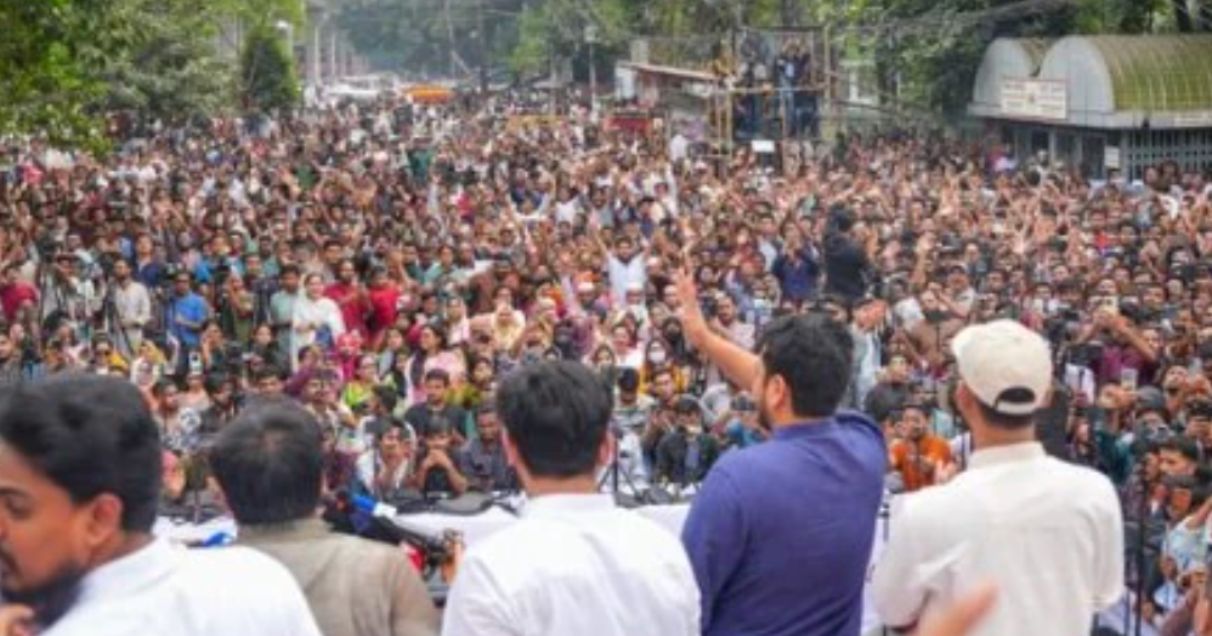
Anti-India slogans returned to the streets of Dhaka on Friday as Bangladesh witnessed fresh protests over rising prices, electricity shortages and the scarcity of fuel and gas. The demonstration, organised by the National Citizen Party (NCP), also saw its leaders target New Delhi, even as they demanded the resignation of Bangladesh’s home and energy ministers over the worsening economic situation.
NCP convenor Nahid Islam addressed a large gathering outside the National Museum in Dhaka, where protesters responded to leaders chanting “Dilli na Dhaka” with “Dhaka, Dhaka”. Videos of the rally circulated on social media, bringing the party’s anti-India rhetoric back into focus.
The protest was directed primarily at Prime Minister Tarique Rahman’s Bangladesh Nationalist Party (BNP) government, which has faced mounting public anger over the cost of living and an ongoing energy crisis. However, the speeches also included allegations against India and warnings over bilateral issues, including the sharing of Ganga waters.
Nahid Islam accuses India of interference
During his address, Islam alleged that the government was incapable of protecting Bangladesh from what he described as Indian conspiracies, according to a report by Prothom Alo.
The NCP leader also raised allegations of killings along the India-Bangladesh border, claimed that Muslims were facing persecution in Assam and West Bengal, and referred to alleged plans to demolish mosques in Delhi. He did not provide evidence to substantiate these claims.
Islam, who emerged as a prominent figure during the July 2024 uprising that led to the removal of former prime minister Sheikh Hasina, also warned that Bangladeshis would launch further protests if the Ganga Water Sharing Treaty was not renegotiated on fair terms.
He said the country would not accept a settlement that compromised its claimed share of the river’s water.
The 30-year agreement governing the sharing of Ganga waters is due to expire in December 2026, making its renewal a significant issue in bilateral relations. Bangladesh’s Water Resources Minister has pushed for a new agreement to be concluded by December 12.
The treaty regulates the distribution of water at the Farakka Barrage in West Bengal during the lean season, from January 1 to May 31. In Bangladesh, the Ganga is known as the Padma and supports livelihoods across the country, with nearly one-third of the population depending on the river system.
Hasnat Abdullah joins protest as anti-India rhetoric returns
The rally was also attended by NCP MP Hasnat Abdullah, who has previously made provocative remarks about India’s northeastern states.
In December 2025, Abdullah threatened that Bangladesh could provide shelter to separatist groups from India’s Seven Sisters if Dhaka continued to face what he described as destabilisation from across the border. He also referred to the Siliguri Corridor, a strategically important stretch connecting northeastern India with the rest of the country.
His remarks had drawn strong reactions in India.
Other figures in Bangladesh have also made inflammatory statements targeting New Delhi. Abdullahil Amaan Azmi, a retired brigadier general and son of former Jamaat-e-Islami chief Ghulam Azam, previously argued that lasting peace in Bangladesh would remain impossible unless India was broken apart.
The latest episode follows a period of heightened anti-India sentiment after Hasina was ousted in August 2024. During the interim administration led by Muhammad Yunus, several political and student leaders made statements accusing India of interference in Bangladesh’s affairs.
Before the 2026 elections, Islam had called for nationwide demonstrations against alleged Indian interference, while Abdullah issued threats involving India’s northeastern region.
Such rhetoric became less prominent after the BNP government led by Tarique Rahman came to power in February. The latest unrest, however, has once again brought anti-India messaging into domestic political mobilisation.
Power shortages and inflation fuel public anger
The immediate trigger for Friday’s demonstration was the worsening economic situation, particularly the shortage of electricity, gas and fuel.
Bangladesh relies heavily on imported energy, purchasing more than 90 per cent of its oil and around 30 per cent of its gas from abroad. Disruptions linked to turmoil in the Middle East have added pressure to supplies and increased import costs.
Power cuts have affected several parts of the country, disrupting businesses and production at garment factories, a crucial sector of Bangladesh’s economy. Higher gas prices have further strained households and industries.
Inflation has also remained elevated. World Bank figures cited in the report put inflation at around 8.5 per cent in 2026, with food and non-food prices rising while workers’ wages have struggled to keep pace.
Poverty has increased as well. According to the World Bank’s latest report cited in the coverage, approximately 2.1 million more people were living in poverty than in the previous year. Rising child deaths linked to measles have added to public frustration.
Together, these pressures have intensified discontent among middle- and lower-income households and placed the eight-month-old BNP government under growing scrutiny.
NCP demands resignations, threatens escalation
Islam demanded that Home Minister Salahuddin Ahmed and Energy Minister Iqbal Hassan Mahmood Tuku resign, accusing them of failing to address the crisis.
He warned that the NCP would organise demonstrations across Bangladesh if the ministers refused to step down. The party also threatened to surround Prime Minister Rahman’s residence to press its demands.
Islam extended his criticism to the prime minister, accusing him of presiding over corruption, extortion, political violence and the occupation of public space by political interests. He described Rahman as a potential new autocrat and said his party would oppose both the former regime and the current government.
NCP MP Akhter Hossen focused on the cost of liquefied petroleum gas (LPG), comparing prices in Bangladesh with those in neighbouring Kolkata. He claimed that a cylinder costing around Tk 1,000 in Kolkata was being sold for more than twice that amount in Bangladesh.
Hossen questioned why the energy crisis appeared to be affecting Bangladeshi consumers more severely and demanded an explanation from the energy minister.
Domestic crisis puts Dhaka-New Delhi ties back in focus
Friday’s rally brought together two sources of political tension: mounting dissatisfaction with the BNP government’s handling of domestic problems and persistent anti-India rhetoric among sections of Bangladesh’s political leadership.
While the NCP’s immediate demands concerned energy prices, power shortages and ministerial accountability, its leaders also used the platform to raise accusations against India and press for changes to the Ganga water-sharing arrangement.
The combination highlights the continuing role of India in Bangladesh’s political debate, even as the government faces pressure to respond to economic hardship at home. Whether the latest agitation leads to changes in the cabinet or escalates into wider protests remains to be seen.