Astronomers Discover Possible Largest Black Hole Ever, 36 Billion Times the Sun’s Mass
A dormant black hole in the Cosmic Horseshoe galaxy may be the most massive ever found, reshaping our understanding of galaxy evolution
12-08-2025

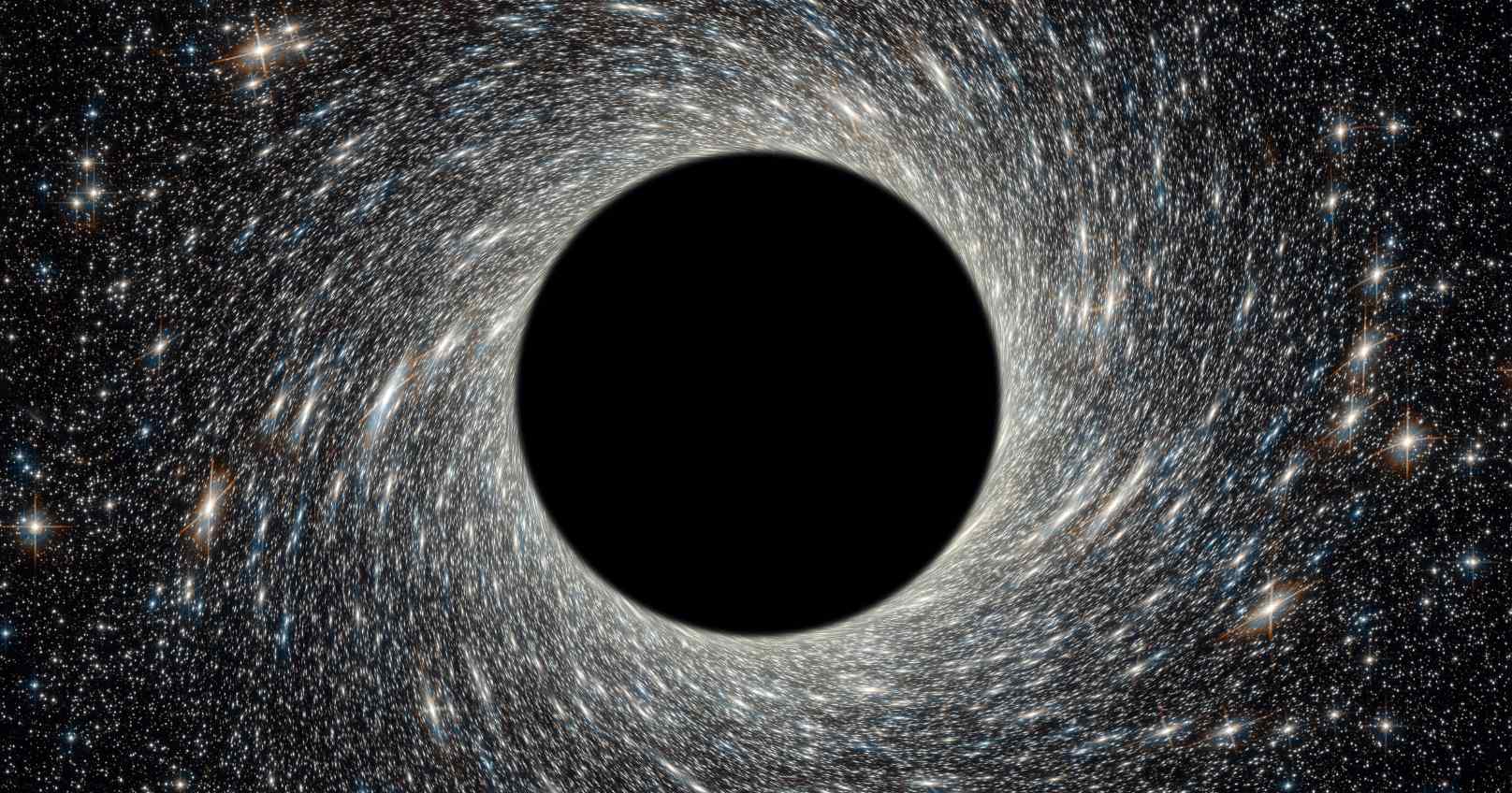
Astronomers have identified a cosmic giant that could be the largest black hole ever found, pushing the limits of what scientists thought possible.
This ultramassive black hole tips the scales at a staggering 36 billion times the mass of our Sun — roughly 10,000 times heavier than the supermassive black hole at the Milky Way’s centre.
It sits deep within the core of the Cosmic Horseshoe, one of the most massive galaxies known, located around 5 billion light-years from Earth. The galaxy’s immense mass bends the fabric of spacetime, curving light from a more distant galaxy into a distinctive horseshoe-shaped Einstein ring.
By combining gravitational lensing—the warping of light by massive objects—with stellar kinematics, or the motion of stars around the black hole, scientists were able to pinpoint its colossal size.
“This is among the ten most massive black holes ever recorded, and it could very well be the largest,” said Professor Thomas Collett of the University of Portsmouth, who led the research.
Unlike active black holes that blaze as quasars, this one is “dormant,” not actively devouring matter. Its existence is revealed purely through its powerful gravitational influence — speeding nearby stars to nearly 400 km per second and distorting light from background galaxies.
Carlos Melo from Brazil’s Universidade Federal do Rio Grande do Sul highlighted the method’s significance, noting that it allows astronomers to detect even silent black holes with precision.
The find offers crucial insight into the co-evolution of galaxies and their central black holes. Massive galaxies typically house massive black holes, and the Cosmic Horseshoe is what astronomers call a “fossil group” — a giant galaxy formed from multiple mergers, whose black holes likely combined into one gargantuan core.
By comparison, the Milky Way’s black hole is a lightweight at about four million solar masses, though it too has a history of quasar activity.
Researchers say the technique used here could revolutionise the hunt for ultramassive black holes in the distant universe. Future tools, such as the European Space Agency’s Euclid space telescope, may reveal many more of these cosmic behemoths — and help unravel their role in shaping galaxies.
This milestone discovery adds a new chapter to the science of black holes and our understanding of the universe’s most extreme objects.


CJP leaders Saurav Das and Ashutosh Ranka were released by a Special Executive Magistrate after furn
Read More
CJP leaders Saurav Das and Ashutosh Ranka will remain in judicial custody until October 21 after a S
Read More
Former India cricketer Yusuf Pathan is reportedly set to receive half of a disputed 1,000-square-met
Read More