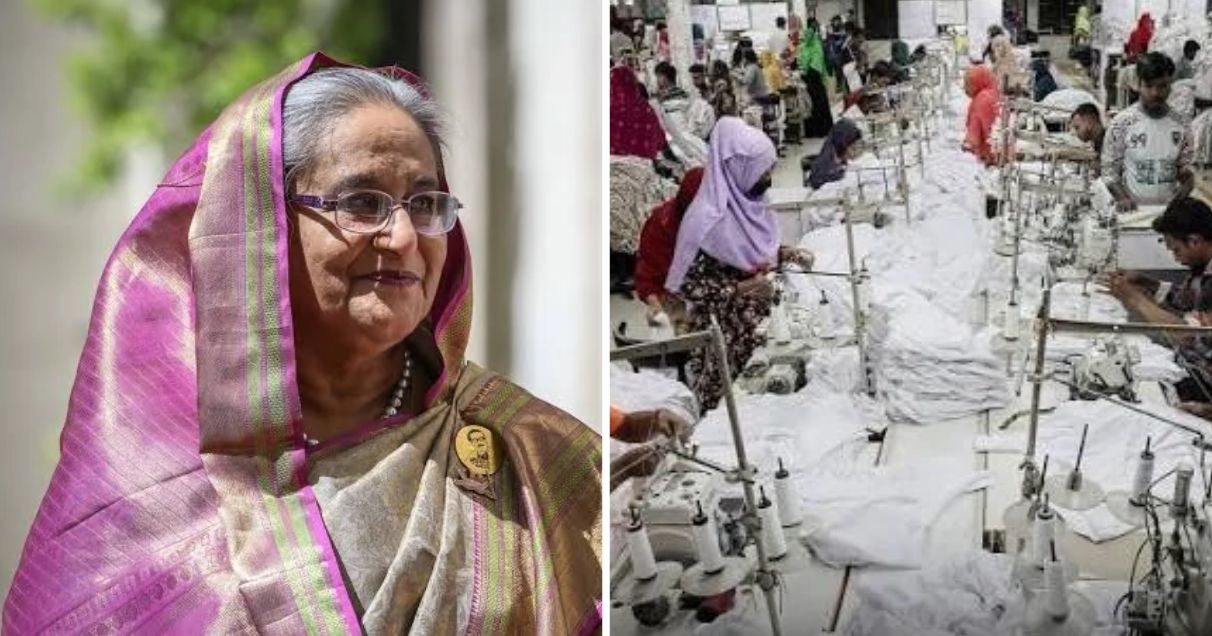
Bangladesh's interim government has accused former prime minister Sheikh Hasina and her supporters of instigating unrest among garment workers, as protests over wages entered their fourth day on Tuesday, disrupting production at nearly 1,000 factories and prompting the deployment of additional paramilitary personnel.
The demonstrations, which began on October 31, have spread across major industrial centres, including Dhaka, Gazipur, Ashulia, Mirpur, Narayanganj and Mymensingh. Clashes between workers and police, road blockades and attacks on security personnel have forced factories to suspend operations.
The Bangladesh Garment Manufacturers and Exporters Association (BGMEA) said another 300 factories shut following fresh violence, taking the total number of affected units to nearly 1,000.
WORKERS DEMAND MORE THAN DOUBLE THE MINIMUM WAGE
At the centre of the protests is the demand for a monthly minimum wage of 30,000 taka (around Rs 23,000), compared with the existing 12,500 taka (approximately Rs 9,507).
Workers say their earnings have failed to keep pace with the rising cost of food, housing, transport and healthcare. They have also pointed to a recent salary increase for government employees, arguing that private-sector workers face similar living expenses.
A workers' representative told a private television channel that garment employees pay the same prices for essential commodities as everyone else.
GOVERNMENT ALLEGES HASINA'S ROLE
Prime Minister Tarique Rahman's Information Affairs Adviser Zahedur Rahman accused Hasina of encouraging the unrest, alleging that she would continue to undermine the government as long as she remained alive.
He described the ousted leader as an architect of the protests, according to PTI. His remarks came after Home Minister Salahuddin Ahmed alleged that factory owners with links to Hasina's Awami League were helping fuel the agitation.
Labour and Employment Adviser Mahdi Amin also claimed that individuals linked to what he called "fugitive evil powers" had infiltrated the workers' movement. He warned that those responsible would be identified and face legal action.
The accusations mark a shift from earlier government statements suggesting that Hasina and the disbanded Awami League no longer had political relevance. The home minister had said in July that the party had been politically destroyed.
CLASHES SPREAD, MORE THAN 100 ARRESTED
Police have arrested more than 100 people in connection with the violence, officials told PTI. Around 50 of those arrested were allegedly associated with Awami League politics.
Workers reported injuries during confrontations with police, who used batons and tear gas to disperse demonstrators. Protesters allegedly retaliated by throwing bricks and stones at security personnel.
In Narayanganj, workers blocked a major road linking the port town with Dhaka and set discarded tyres on fire, newspaper Ittefaq reported. Police used tear gas and batons to clear the route.
Similar confrontations were reported in the Ashulia industrial zone and Mirpur, where security personnel used tear gas and sound grenades to disperse crowds.
The government has reinforced security in affected areas. Border Guard Bangladesh said it had deployed 12 platoons in Gazipur and two in Narayanganj. The force is also monitoring developments in Dhaka through a control centre, drones and body-worn cameras.
GARMENT INDUSTRY FACES EXPORT RISKS
The disruption has raised concerns for Bangladesh's ready-made garment sector, which employs around four million people and contributes more than 80 per cent of the country's export earnings.
Bangladesh is the world's second-largest garment exporter after China and supplies international brands such as H&M, Zara and Gap.
Manufacturers fear that continued factory closures during the peak production period for spring and summer orders could delay shipments, affect overseas buyers' confidence and lead to order cancellations.
The industry is already dealing with higher production costs, inflation and competition in international markets. Workers say inflation of around 8 per cent has further eroded their purchasing power.
WAGE BOARD YET TO BEGIN REVIEW
The government formed a six-member minimum wage board on Sunday to examine workers' demands and recommend a revised pay structure. However, the panel had not held its first meeting by Tuesday as protests continued.
Hasina fled to India after her government was ousted in a student-led uprising on August 5, 2024. A special tribunal established under the subsequent interim administration led by Chief Adviser Muhammad Yunus later sentenced her to death in absentia.
With factories still affected by the demonstrations and wage negotiations yet to begin, the government faces the challenge of restoring industrial activity while addressing workers' demands.