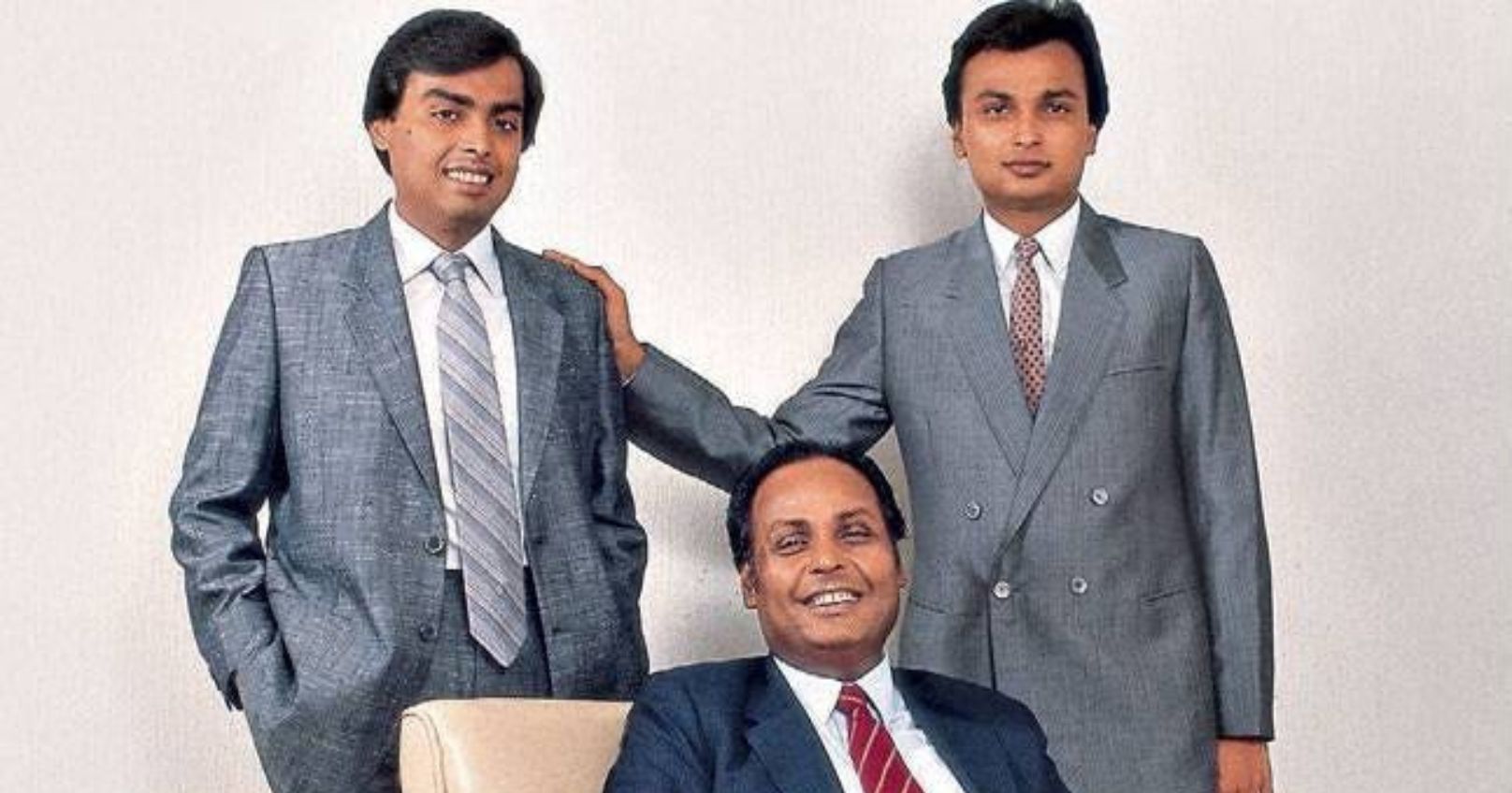
Brothers Under Siege
Can Mukesh and Anil Ambani walk out of their mounting legal troubles by drawing lessons from their father, Dhirubhai Ambani who survived an even more hostile political era and returned stronger?
02-08-2026

Can Mukesh and Anil Ambani walk out of their mounting legal troubles by drawing lessons from their father, Dhirubhai Ambani who survived an even more hostile political era and returned stronger?
02-08-2026From invincible to vulnerable? RIL’s mounting legal battles signal potential exposure of up to USD 35 billion, nearly ₹3 lakh crore.
For decades, the Ambani name represented more than industrial power.
It represented survival.
Dhirubhai Ambani built Reliance while battling licence raj controls, hostile market operators, political opposition and an entrenched establishment. His sons inherited not merely an empire, but the mythology of a business house that could enter any storm and emerge larger from the other side.
Today, however, both brothers find themselves under an extraordinary legal siege.
While Anil Ambani, his companies and senior executives are collectively facing close to 70 proceedings, investigations or cases involving agencies and institutions including the ED, CBI, SFIO and EPFO, the immediate focus of this bulletin is on Mukesh Ambani’s Reliance Industries Limited India’s largest private-sector corporate giant now confronting a convergence of enormously consequential energy disputes.
Once regarded as virtually untouchable in boardrooms and the corridors of power, Reliance Industries Limited presently finds itself defensive, embattled and exposed before the Supreme Court of India, the Delhi High Court and arbitral tribunals.
A company long perceived as legally astute, institutionally influential and almost impossible to corner is now facing claims and demands whose stated value could approach USD 35 billion, nearly ₹3 lakh crore.
These are disputed claims, not crystallised liabilities. But their sheer scale is impossible to ignore.
For years, Reliance carried an aura of inevitability.
Arbitration victories, negotiated settlements and favourable legal outcomes reinforced the impression that the conglomerate possessed not merely financial and legal firepower, but an almost unmatched ability to navigate the State.
That narrative is now visibly under strain.
Recent developments indicate a harder institutional environment one in which arbitral awards favouring even the largest corporations are being subjected to searching judicial scrutiny, and government departments appear willing to pursue massive claims despite aggressive corporate resistance.
The outcomes are still open.
But the assumption that matters involving Reliance will eventually be “managed” no longer appears as secure as it once did.
1. KG-D6 “migrated gas” dispute
Reliance Industries and its foreign partners had secured a major arbitral victory in the dispute concerning alleged migration of gas from adjoining ONGC blocks into the KG-D6 block.
The award, rendered in their favour in 2018, was upheld by a Single Judge of the Delhi High Court in 2023.
That legal victory was subsequently overturned.
On 14 February 2025, a Division Bench of the Delhi High Court set aside both the arbitral award and the Single Judge’s decision, ruling in favour of the Union of India. RIL and its partners have challenged that judgment before the Supreme Court.
The matter now rests before the country’s highest court, where Reliance is seeking restoration of the award.
The Supreme Court commenced final hearings in May 2026, with RIL and its partners strongly disputing allegations that they had unjustly extracted gas belonging to an adjoining block.
The Delhi High Court reversal punctured the perception of finality that large corporations once appeared to enjoy after succeeding in international commercial arbitration.
It also demonstrated that an arbitral award even one involving global energy majors and billions of dollars may not escape judicial scrutiny where courts perceive issues of public policy, public resources or contractual accountability.
2. Escalated government monetary demand
Following the adverse Delhi High Court ruling, the Union petroleum ministry raised a demand of approximately USD 2.81 billion against RIL and its partners in connection with the migrated-gas dispute.
The original government claim had been approximately USD 1.55 billion, but the subsequent demand increased significantly with interest and related components. Reliance has disputed the claim in its entirety and described both the demand and the High Court judgment as unsustainable.
The demand is not a final adjudicated liability.
Nevertheless, it reflects a new assertiveness on the part of the State one apparently less hesitant to pursue India’s largest private-sector conglomerate through the courts and enforcement mechanisms.
For a group accustomed to negotiating from a position of enormous institutional strength, the symbolism is almost as important as the amount.
3. D1/D3 under-production arbitration
The most financially significant threat arises from the D1 and D3 gas fields in the KG-D6 block.
The Union government is reportedly pursuing more than USD 30 billion from Reliance Industries and BP in an arbitration concerning alleged under-production from the two deepwater fields.
The government reportedly alleges that the fields produced only a fraction of the gas originally estimated to be recoverable and attributes the shortfall to operational and reservoir-management decisions. Reliance and BP deny that any amount is payable. Final arguments were completed in November 2025, and the award—whenever delivered could itself become the subject of further court proceedings.
It is reportedly the largest compensation claim ever pursued by the Indian government against a corporation.
The allegations go beyond an ordinary contractual disagreement.
Claims concerning under-production, well development and reservoir mismanagement strike at operational credibility and at the heart of the commercial assumptions on which one of India’s most important energy projects was developed.
An adverse award would almost certainly trigger prolonged litigation before Indian courts, keeping financial and strategic uncertainty alive for years.
The unfolding disputes raise a question now being whispered, not yet shouted, in legal and market circles:
Is Reliance’s once-formidable influence losing its edge?
Government departments appear less inclined to compromise and more willing to litigate aggressively.
Courts are demonstrating institutional confidence in testing arbitral outcomes, even where the parties include India’s largest conglomerate and major global energy companies.
The once-common belief that “matters involving Reliance will eventually get managed” no longer looks assured.
This does not mean RIL lacks legal firepower.
It remains among the best-resourced and most heavily represented corporate entities before Indian courts. In the Supreme Court gas proceedings, some of India’s most formidable senior counsel have appeared for the corporate parties.
But legal firepower does not guarantee legal victory.
The outcomes are no longer predictable, and the apparent margin for manoeuvre has become narrower.
A potential aggregate exposure approaching USD 35 billion nearly ₹3 lakh crore would represent far more than a courtroom risk.
It could become a material issue for revenue recognition, provisioning, investor sentiment, capital allocation and the group’s long-term energy strategy.
Even partial adverse findings could have consequences.
And even without an immediate adverse award, prolonged uncertainty carries its own price:
financial, reputational and strategic.
The crucial distinction must nevertheless be maintained: these figures represent claims, demands and potential exposure, not final liabilities presently payable by RIL.
Anil Ambani’s difficulties are already the subject of almost daily legal and investigative developments and will continue to be covered separately by LSTN.
For the limited purpose of this larger Ambani-family picture, it is sufficient to note that close to 70 matters, proceedings or investigations are stated to involve Anil Ambani, group companies or senior executives across agencies and institutions including the ED, CBI, SFIO and EPFO.
Recent proceedings have included CBI action concerning Reliance Capital and EPFO investments, ED investigations and asset attachments, CBI cases linked to financing transactions, and an SFIO examination of Reliance Communications and related entities. The allegations remain subject to investigation, adjudication and the legal defences of the persons and companies concerned.
Thus, in very different corporate circumstances, the two sons of Dhirubhai Ambani are simultaneously navigating one of the most legally difficult phases the family has faced since the division of the Reliance empire.
History, however, offers the brothers a powerful family precedent.
Dhirubhai Ambani himself endured periods of intense political and institutional hostility.
When V.P. Singh became Prime Minister in December 1989, the environment became especially difficult for Reliance. Contemporary accounts recorded an aggressive government posture against the group, including customs action and institutional resistance to Reliance’s attempt to secure control of Larsen & Toubro.
Government-controlled financial institutions opposed the Ambanis’ position at L&T, forcing them eventually to resign from its board after a bitter corporate and political battle.
It was a period when the Reliance project appeared vulnerable, political winds had turned hostile and the group’s expansion looked capable of being halted by the power of the State.
But Dhirubhai did not disappear.
He absorbed the setback, recalibrated his strategy and continued building.
Reliance subsequently expanded dramatically across petrochemicals, refining, telecommunications and capital markets, growing far beyond the scale at which it had entered the V.P. Singh era.
That may be the most important lesson for his sons:
Dhirubhai’s genius was not that he never faced defeat. It was that he never allowed a defeat to become the final chapter.
Can Mukesh Ambani defend RIL against claims whose aggregate stated value could approach ₹3 lakh crore?
Can Anil Ambani find a lawful path through the dense web of investigations and proceedings surrounding his erstwhile business empire?
Can both brothers rediscover the strategic patience, resilience and instinct for survival that defined their father?
Dhirubhai faced hostile governments, institutional resistance, market attacks and moments when the future of Reliance itself appeared uncertain.
He came out stronger.
But his sons operate in a different India.
Institutions are more visible. Court proceedings are followed in real time. Global investors demand disclosures. Arbitration awards face layered judicial scrutiny. Investigative agencies possess enormous statutory powers. And reputational damage travels faster than ever before.
The family name still carries immense power.
But this time, mythology alone will not be enough.
Reliance Industries Limited, once regarded as invincible, today looks unusually vulnerable locked in courtroom battles where judicial scrutiny has intensified, the State’s resolve has stiffened and potential financial exposure is enormous.
Whether this is merely a temporary legal rough patch or a structural change in the way India’s largest conglomerate is treated by courts and the government will become clearer in the months ahead.
For Mukesh Ambani, the immediate challenge is to prevent disputed claims from becoming enforceable liabilities and legal uncertainty from clouding RIL’s larger growth story.
For the Ambani brothers collectively, the challenge is more elemental:
Can they once again do what their father did face the full power of an adverse establishment, survive the siege and emerge larger from it?
For now, one thing appears clear:
The era of assumed outcomes is over. The brothers are under siege, and the terrain no longer tilts automatically in their favour.
LSTN will continue to closely track this evolving legal, corporate and financial saga.

The Goa bench of the Bombay High Court has concluded hearings in the Tarun Tejpal sexual assault cas
Read More
The Supreme Court has directed states to free detained protesters under 18 and those with no crimina
Read More
Union Minister Nitin Gadkari has secured the Bombay High Court's permission to pursue a civil defama
Read More