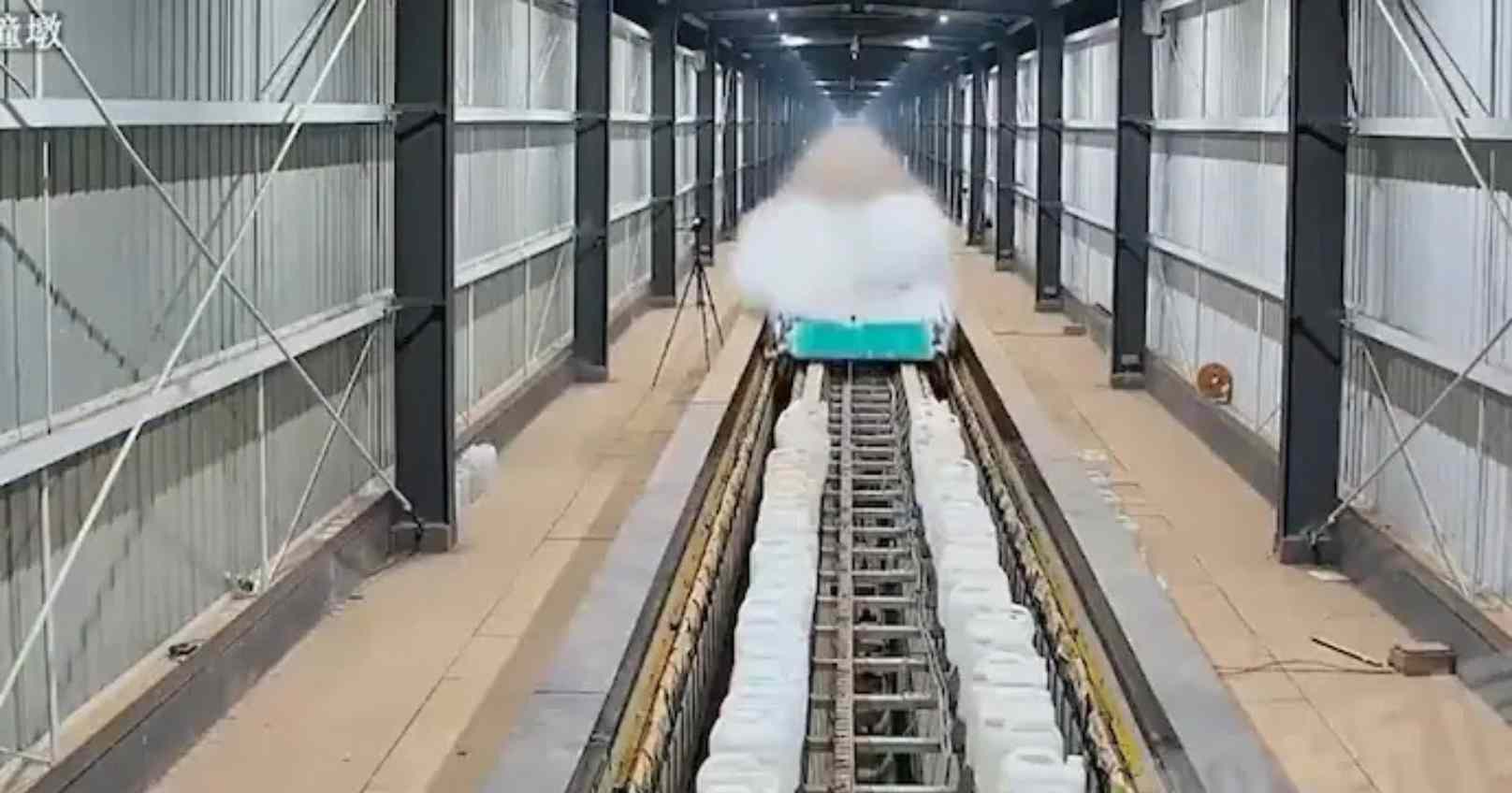
China has marked a significant leap in next-generation transportation technology by achieving a world-first in superconducting magnetic levitation research. Scientists at the National University of Defense Technology (NUDT) propelled an experimental maglev vehicle weighing approximately 1.1 tonnes to an astonishing speed of 700 km/h, doing so in just two seconds—an achievement unmatched anywhere in the world.
The test was carried out on a specially designed 400-metre trial track and showcased not only extraordinary acceleration but also controlled deceleration. Researchers confirmed that the vehicle was safely and smoothly brought to a halt after reaching peak velocity, demonstrating high stability even under extreme operating conditions.
Visuals broadcast by China’s state television network showed the compact test platform speeding across the track so rapidly it appeared almost invisible, with frictionless motion producing minimal resistance as it glided above the surface.
According to the research team, the experiment surpassed all previous international records related to maglev speed and acceleration. The success was attributed to advances across multiple engineering domains, including ultra-powerful electromagnetic propulsion, stable suspension and guidance mechanisms, advanced energy storage systems, and high-intensity superconducting magnets.
These innovations enable the vehicle to hover several centimetres above the track, eliminating physical contact and drastically reducing friction, noise and vibration—key factors in achieving extreme velocities.
Professor Li Jie from NUDT said the achievement represents a crucial breakthrough for China’s ambitions in ultra-high-speed ground transport. He added that superconducting maglev technology has applications beyond passenger rail, potentially supporting future transport systems and even aerospace-related launch technologies.
Maglev systems operate fundamentally differently from traditional trains. Instead of wheels, they rely on magnetic forces generated by electromagnets embedded in both the vehicle and the guideway. The repulsion between like magnetic poles causes the train to levitate, while changing magnetic fields push it forward. This design minimises mechanical wear, lowers maintenance demands, and improves overall energy efficiency.
Experts believe such technology could eventually form the backbone of hyperloop-style systems operating in low-pressure environments, where theoretical speeds could exceed 1,000 km/h. It may also be adapted to assist aircraft or spacecraft during initial acceleration, reducing fuel consumption and emissions.
NUDT has spent more than three decades advancing maglev research and previously developed China’s first manned maglev test platform. Earlier this year, the team achieved speeds of 648 km/h, while China’s Shanghai maglev line—currently the world’s only commercial maglev service—operates at a top speed of 430 km/h.
With this latest accomplishment, China has further strengthened its leadership in advanced maglev innovation, paving the way for even larger-scale trials in the near future.