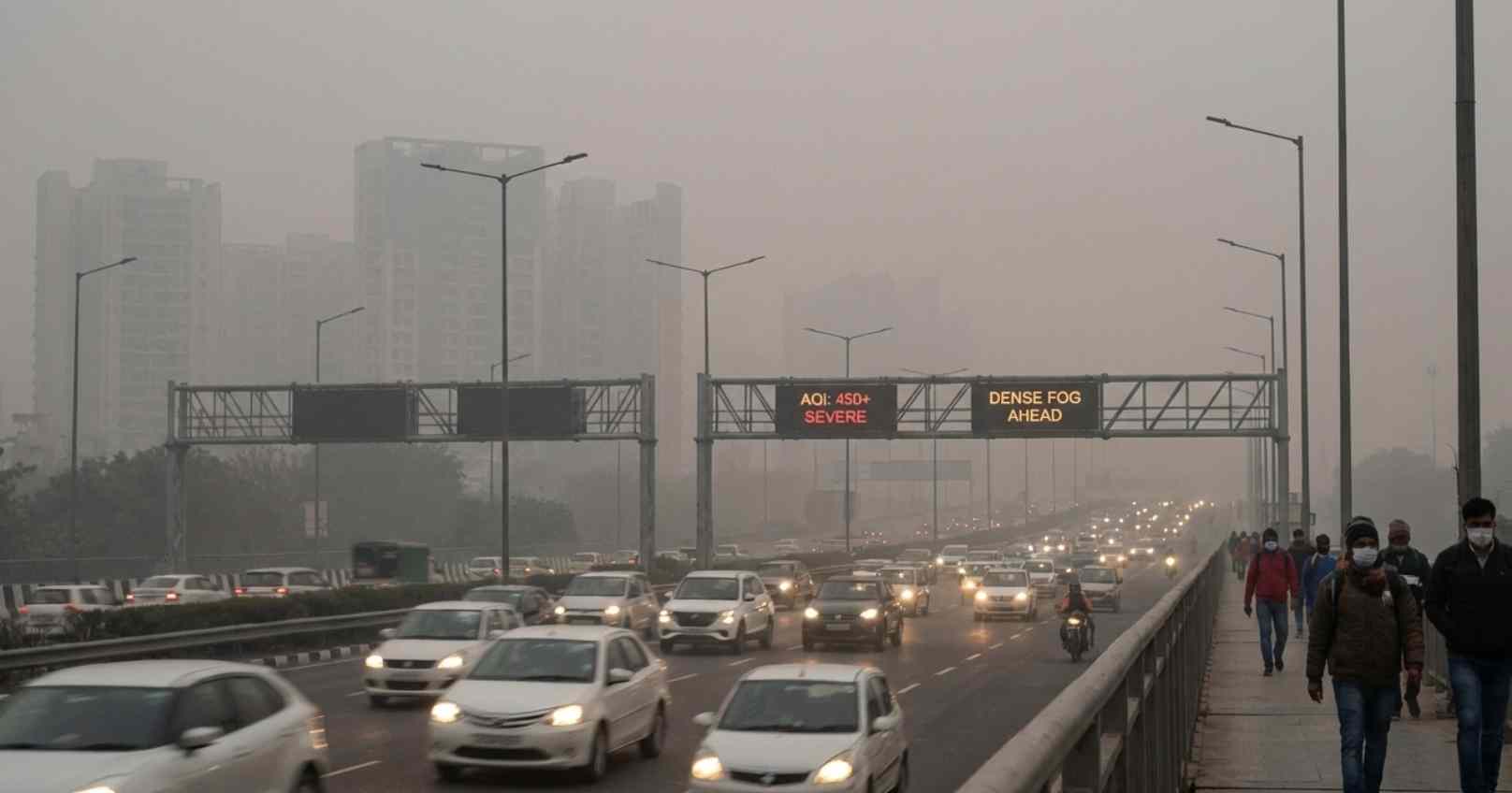
Delhi and large parts of the National Capital Region (NCR) plunged deeper into an air pollution emergency on Sunday as a thick blanket of smog and fog pushed air quality into the most dangerous category and sharply reduced visibility across the region.
According to data from the Central Pollution Control Board (CPCB), Delhi’s overall Air Quality Index (AQI) touched 461 by 7 am, worsening from 431 recorded the previous day. The spike placed the capital firmly in the “severe” bracket, signalling serious health risks even for healthy individuals.
Pollution Peaks Across the Capital
All 40 air monitoring stations in Delhi reported ‘severe’ readings. Several locations were just short of the maximum measurable AQI of 500. Rohini recorded one of the worst levels at 499, followed by Bawana at 498 and Vivek Vihar at 495. Areas such as Ashok Vihar, Wazirpur, Narela and Anand Vihar also registered extremely high pollution levels above 490.
Central and south Delhi zones were no better, with ITO, Mundka, Punjabi Bagh, Nehru Nagar, Chandni Chowk and Okhla all reporting AQI values between 470 and 486. Even comparatively greener localities like Lodhi Road and Najafgarh crossed the 400-mark, highlighting the widespread nature of the crisis.
NCR Cities Also Struggle
The air quality emergency extended beyond Delhi. Noida recorded an AQI of 470, while Ghaziabad stood at 460, both falling under the ‘severe’ category. Gurugram’s air remained ‘very poor’ at 348, and Faridabad reported a ‘poor’ AQI of 220.
Smog and Fog Cripple Visibility
Early morning hours saw thick smog merging with dense fog, drastically reducing visibility across the region. In several pockets, visibility dropped to near zero. The situation prompted the implementation of low-visibility procedures at Indira Gandhi International Airport. Although flights continued, pilots were advised to exercise heightened caution.
The India Meteorological Department (IMD) warned that visibility at the airport could fall to as low as 100 metres during peak fog hours before marginally improving later in the day.
Weather Conditions Fuel Pollution
Meteorological factors were cited as the primary reason behind the sudden deterioration. The IMD noted the influence of a weak western disturbance over north Pakistan and a strong subtropical westerly jet stream, which led to calm winds, increased moisture and a shift in wind direction — conditions that trap pollutants close to the ground.
Mist and fog are expected to persist during night and early morning hours over the coming days, limiting dispersion of pollutants.
GRAP Stage-IV Measures Enforced
In response to the rapidly worsening air quality, the Commission for Air Quality Management (CAQM) activated Stage-IV of the Graded Response Action Plan (GRAP) across Delhi-NCR on Saturday night.
This ‘Severe+’ stage includes emergency curbs such as:
-
A ban on the entry of BS-IV diesel trucks into Delhi, except those carrying essential goods
-
Prohibition on the movement of Delhi-registered diesel heavy vehicles below BS-VI norms
-
Complete suspension of construction and demolition activities, including major infrastructure projects
-
Shutdown of stone crushers, mining operations and related industrial activities across NCR
Schools Move to Hybrid Classes
Educational institutions were also impacted. Governments in Delhi and NCR were directed to shift Classes VI to IX and Class XI to a hybrid mode, allowing students the option of online learning. Authorities may extend similar arrangements to other grades depending on conditions.
Further steps — such as closing colleges, restricting non-essential businesses or introducing odd-even vehicle rules — remain under consideration.
Health Advisory Issued
Residents were urged to strictly follow health advisories under GRAP. Vulnerable groups, including children, senior citizens and people with respiratory or cardiac conditions, were advised to stay indoors and avoid physical exertion. Mask usage was recommended for anyone stepping outside.
Short Relief Proves Temporary
Delhi had briefly witnessed improved air quality earlier in the week, with AQI levels dipping below 300. However, the relief was short-lived as pollution surged again from Thursday, crossed into ‘severe’ territory on Saturday and worsened further on Sunday.
With unfavourable weather likely to persist, authorities warned that hazardous air conditions may continue in the days ahead, posing sustained risks to public health and daily life in the capital.
(AI-generated image used for representative purposes)