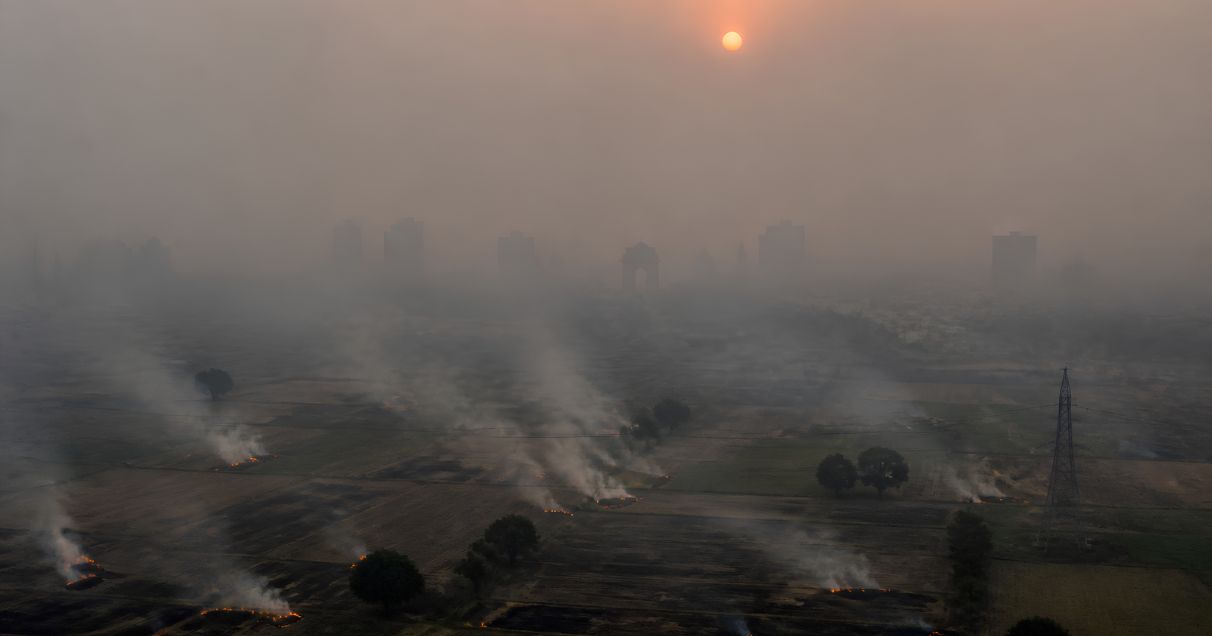
Delhi's air quality deteriorated further on Tuesday, with the AQI reaching 348, as rising farm fires in neighbouring states are expected to push the contribution of stubble burning to the capital's PM2.5 pollution beyond 22 per cent by November 5.
Delhi's pollution levels have climbed steadily over the past three days, with the Air Quality Index (AQI) moving from 261 on November 1 to 324 on November 2 and 348 on November 3, placing the city in the 'very poor' category, according to data reported by news agency Press Trust of India (PTI).
The worsening air quality coincides with an anticipated rise in pollution from agricultural fires. Forecasts issued by the Decision Support System for Air Quality Management in Delhi, operating under the Ministry of Earth Sciences, estimate that stubble burning's share of the city's PM2.5 concentration will increase from 8.583 per cent on November 2 to 15.301 per cent on November 3.
The contribution is projected to reach 20.057 per cent on November 4 and 22.207 per cent on November 5. These estimates are based on historical fire counts and emission patterns.
PUNJAB RECORDS HIGHEST NUMBER OF FARM FIRES
Satellite surveillance detected 219 incidents of paddy residue burning across the monitored states on November 2. Punjab accounted for 98 of these fires, followed by Rajasthan with 67 and Madhya Pradesh with 48. Uttar Pradesh reported four incidents, while Haryana recorded two.
No farm fires were detected in Delhi or Uttarakhand on the day, according to the Consortium for Research on Agroecosystem Monitoring and Modelling from Space Lab at the ICAR-Indian Agricultural Research Institute, cited by PTI.
Between September 15 and November 2, a total of 3,535 farm-fire incidents were recorded across the monitored regions. Punjab accounted for 1,612 cases, the highest among the states, while Rajasthan reported 738 and Madhya Pradesh 614. Uttar Pradesh recorded 349 incidents, Uttarakhand 176, Haryana 44 and Delhi two.
FARM FIRES SHOW LONG-TERM DECLINE
Despite the continued detection of agricultural fires this season, the latest figures indicate a substantial reduction in incidents compared with previous years.
The monitored regions recorded 51,822 farm fires between September 15 and November 2 in 2020. The figure dropped to 24,583 in 2021 before rising to 26,490 in 2022. It subsequently declined to 18,991 in 2023, 9,668 in 2024 and 4,993 in 2025.
Punjab's figures have also fallen considerably. The state recorded 1,612 incidents up to November 2 this year, against 2,262 during the corresponding period in 2025 and 41,176 in 2020.
Haryana reported 44 incidents this season, compared with 122 last year and 2,606 in 2020.
The figures are based on satellite monitoring carried out using the standard methodology for identifying crop residue-burning incidents. The stubble-burning season generally extends from September 15 to November 30. Delhi recorded its first farm fire of the current season on September 19, followed by another on October 24.
POLLUTION TRIGGERS POLITICAL EXCHANGE
The deteriorating air quality has also triggered a political confrontation between the BJP-led Delhi government and the Aam Aadmi Party (AAP).
Delhi Environment Minister Manjinder Singh Sirsa has defended the government's record, claiming that the capital experienced its cleanest October in a decade and recorded 220 clean-air days this year. He blamed Punjab, governed by the AAP, for the continuing stubble-burning incidents and alleged that more than 1,000 farm fires had occurred under its administration.
Sirsa also shared visuals purportedly showing Punjab Police personnel near burning fields and levelled allegations of a cover-up involving a relative of former Delhi Chief Minister Arvind Kejriwal in connection with the appointment of a pollution board chairperson.
AAP leader Saurabh Bharadwaj rejected the BJP's claims and accused the Delhi government of manipulating air-quality readings. He alleged that water was being sprayed around monitoring stations and that new monitoring facilities had been installed in green areas to influence the reported pollution levels.
Meanwhile, the Commission for Air Quality Management (CAQM) has activated Stage II measures under the Graded Response Action Plan (GRAP) as pollution levels deteriorate across Delhi-NCR.
Although farm fires are expected to contribute a larger share of the capital's particulate pollution in the coming days, they are not the only factor behind the worsening air. Vehicular emissions, construction dust, industrial pollution and other local sources also contribute to the problem.
Weather conditions and wind patterns further influence how pollutants disperse or accumulate over the region, making the severity of Delhi's winter pollution dependent on several factors beyond stubble burning alone.