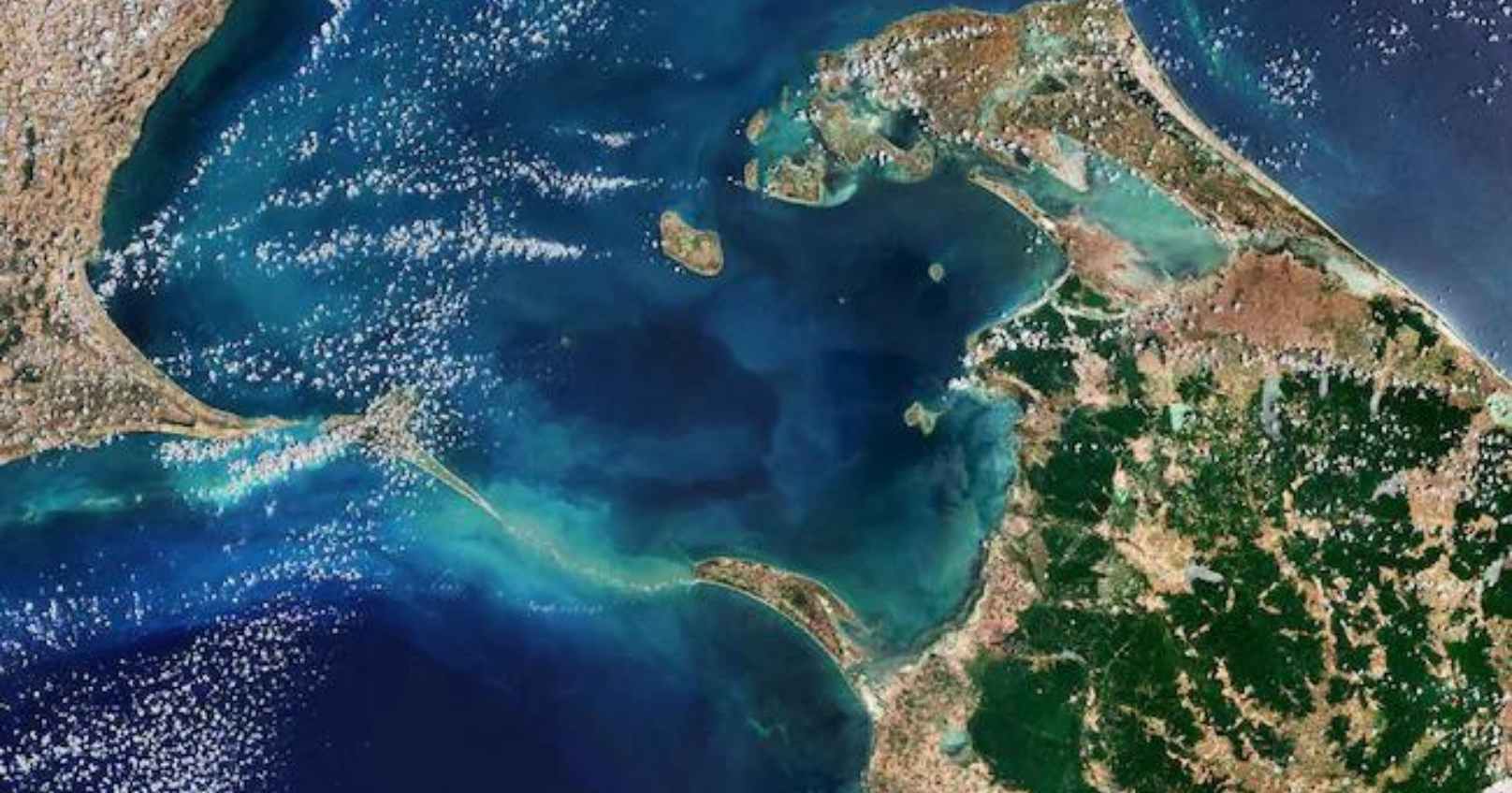
European Space Agency's Satellite Captures Stunning Image of Ram Setu
The European Space Agency's Copernicus Sentinel-2 satellite has revealed a breathtaking view of the Ram Setu, a natural bridge linking India and Sri Lanka
24-06-2024

The European Space Agency recently shared a captivating image of the Ram Setu, also known as Adam's Bridge, captured by its Copernicus Sentinel-2 satellite. This natural formation stretches approximately 48 km between Rameswaram Island, off India's southeast coast, and Mannar Island in Sri Lanka. The bridge separates the Gulf of Mannar to the south, an inlet of the Indian Ocean, from the Palk Strait to the north, an inlet of the Bay of Bengal.
Geologically, the Ram Setu consists of limestone shoals that are believed to be remnants of a land bridge that once connected India and Sri Lanka. This bridge is mentioned in ancient Hindu scriptures and folklore, notably in the epic Ramayana, where it is said to have been built by Lord Rama and his army to reach Lanka.
Over time, natural forces such as storms have gradually eroded parts of the bridge, making it less traversable. Historical records suggest that the bridge was still passable until the 15th century. Today, some parts of the Ram Setu remain visible as sandbanks, with shallow waters ranging from 1 to 10 meters deep, as depicted by the light color of the sea.
Mannar Island, covering approximately 130 sq km, is connected to mainland Sri Lanka by both a road bridge and a railway bridge visible at its southern end. Similarly, Rameswaram Island, also known as Pamban Island, is accessible via the iconic 2-km-long Pamban Bridge. The island is home to towns like Pamban on its western edge and Rameswaram about 10 km to the east.
Ecologically, both sections of the Ram Setu are part of protected national parks in India and Sri Lanka. These areas serve as crucial habitats for various wildlife, including birds like the brown noddy, and marine species such as fish, sea grasses, dolphins, dugongs, and turtles.
Prime Minister Narendra Modi visited Arichal Munai earlier this year, which marks the starting point of the Ram Setu. His visit highlighted the cultural and historical significance of this ancient bridge that continues to fascinate and inspire people across the world.
The image captured by the Copernicus Sentinel-2 satellite not only showcases the natural beauty of the Ram Setu but also underscores its importance in Hindu mythology, its ecological value, and its role in connecting the cultural heritage of India and Sri Lanka.


Delhi's air quality deteriorated sharply after Diwali, with PM2.5 concentrations crossing 3,700 micr
Read More
Pakistan has attributed Lahore’s deteriorating air quality to pollution allegedly carried across t
Read More
Four coaches of the Karmabhoomi Express caught fire near Rajpura in Punjab on Friday after a blaze r
Read More