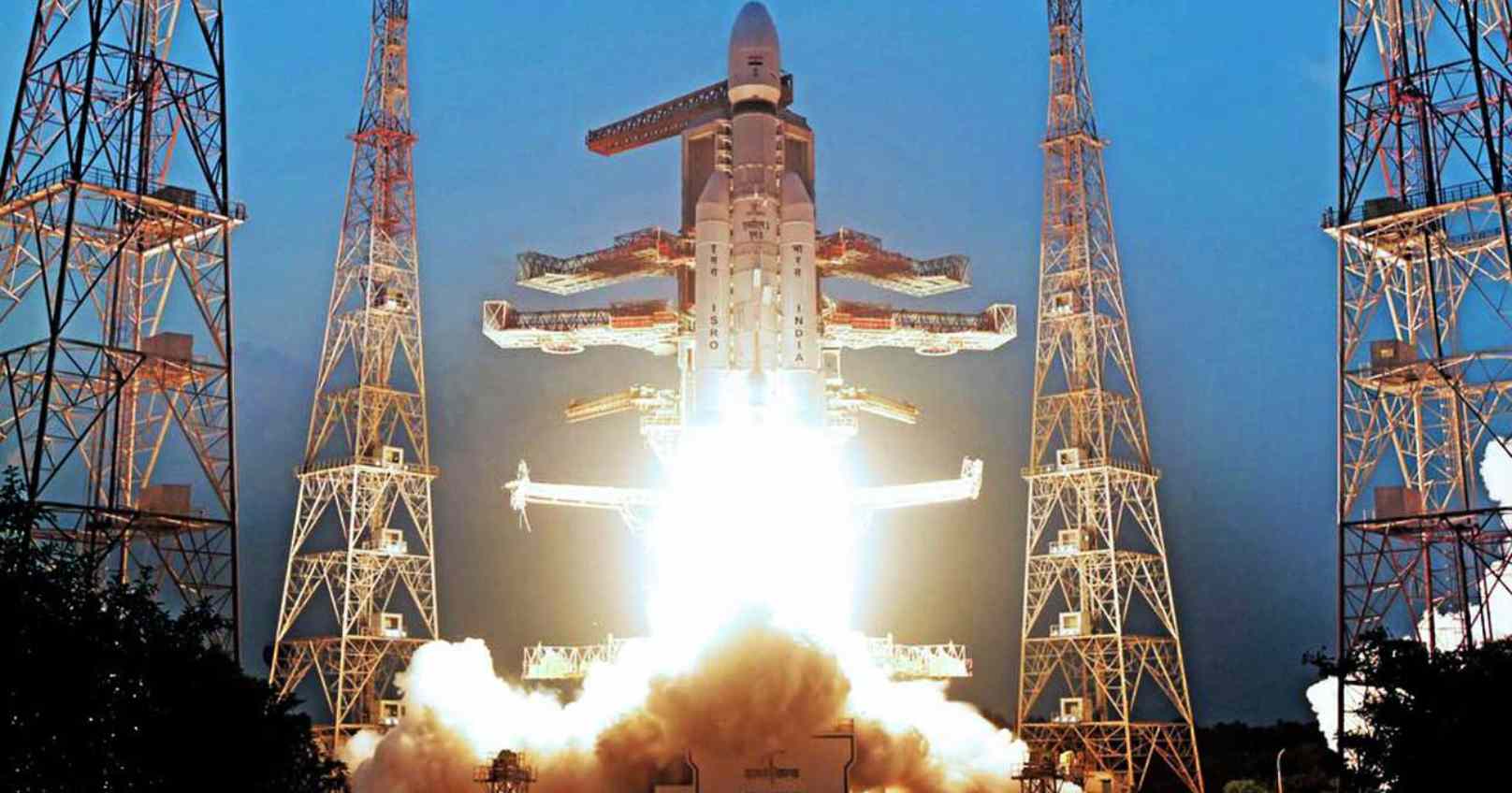
India achieved another major milestone in its space journey on Sunday, as the Indian Space Research Organisation (ISRO) successfully launched its heaviest-ever communication satellite, CMS-03, aboard the powerful LVM3-M5 rocket from Sriharikota.
The satellite, weighing 4,410 kg, was placed precisely into a Geosynchronous Transfer Orbit (GTO), marking a significant step in India’s pursuit of self-reliance in space technology. Designed to deliver multi-band communication services across the Indian mainland and adjoining oceanic regions, CMS-03 replaces the earlier GSAT-7 series, launched in 2013.
ISRO Chairman V. Narayanan confirmed the success, saying, “The 4,410 kg satellite has been accurately injected into its intended orbit.” Calling the LVM3 rocket India’s own “Bahubali” for its immense lifting power, Narayanan highlighted its role in carrying forward the legacy of the prestigious Chandrayaan-3 mission.
“This mission adds another proud chapter to our journey. All eight LVM3 launches, including the experimental ones, have recorded 100 percent success,” he said, adding that CMS-03’s 15-year operational life stands as a “shining example of Atmanirbhar Bharat.”
Despite challenging weather conditions, ISRO scientists ensured a flawless launch sequence. Prior to developing the LVM3, India relied on the Ariane-5 rockets from the Kourou spaceport in French Guiana to launch heavier satellites — such as the 5,854 kg GSAT-11 in 2018.
The LVM3-M5 (Launch Vehicle Mark-3, fifth operational mission) is a three-stage rocket comprising two solid strap-on boosters (S200), a liquid core stage (L110), and a cryogenic upper stage (C25) — all built with completely indigenous technology. It can carry 4,000 kg to GTO and up to 8,000 kg to Low Earth Orbit (LEO).
The C25 cryogenic engine, developed at the Vikram Sarabhai Space Centre (VSSC), powers the rocket’s upper stage, while the Vikas engines, crafted by the Liquid Propulsion Systems Centre (LPSC), drive the core liquid stage.
The LVM3’s reliability and capacity have made it India’s designated launch vehicle for future human spaceflight — the Gaganyaan mission — under the Human-Rated LVM3 (HRLV) configuration.
ISRO currently operates a versatile fleet of launch vehicles:
-
PSLV — the workhorse, ideal for payloads up to 1,750 kg.
-
GSLV — used for satellites around 2,200 kg.
-
SSLV — tailored for smaller payloads (up to 500 kg).
-
LVM3 — the heavy-lift booster capable of over 4,000 kg to GTO.
The LVM3-M5’s flawless flight reinforces India’s growing independence in space exploration and technology. Coming after the success of Chandrayaan-3, which made India the first nation to soft-land near the Moon’s south pole in 2023, this achievement cements ISRO’s position among the world’s top spacefaring powers.