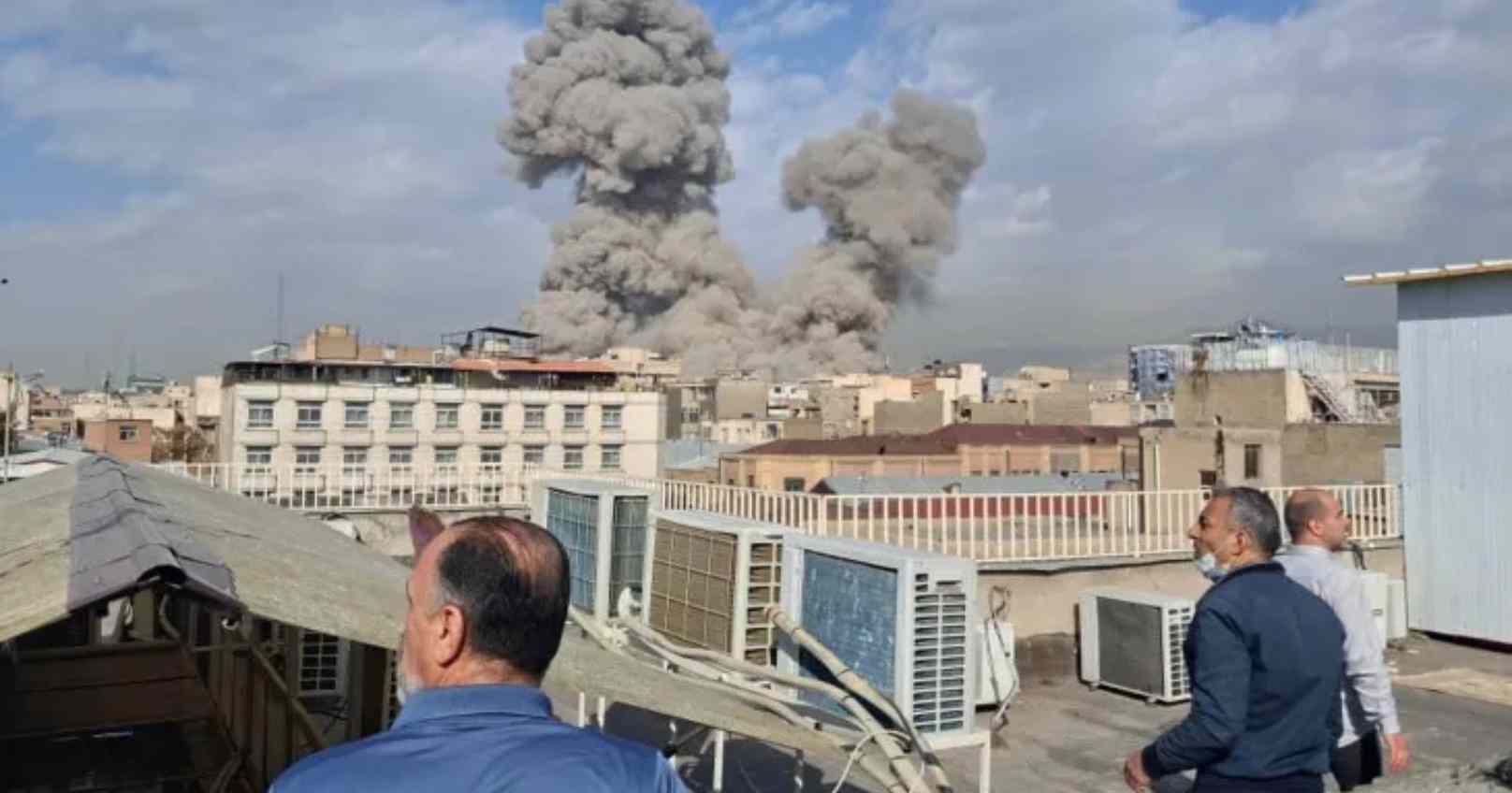
A dramatic escalation unfolded in the Middle East on Saturday after Iran launched missile attacks targeting several major Gulf cities, including Abu Dhabi and Dubai in the United Arab Emirates, Doha in Qatar, and Riyadh in Saudi Arabia. The attacks occurred shortly after joint military strikes by the United States and Israel inside Iranian territory.
Residents in Dubai reported hearing powerful explosions and witnessing missiles streaking across the night sky. Several described seeing bright fire-like trails moving rapidly overhead before disappearing into the distance.
Authorities in the UAE confirmed that a civilian of Asian origin died after missile fragments landed in a residential neighbourhood in Abu Dhabi. The country’s defence ministry condemned the strike, describing it as a reckless escalation that endangered civilian lives and threatened regional stability.
Explosions and Missile Interceptions Across the Gulf
Multiple explosions were reported across Gulf cities as air defence systems attempted to intercept incoming missiles. Kuwait stated that its defensive systems were activated against airborne threats, while sirens were heard in parts of Jordan amid the heightened alert.
Officials in Qatar said that their air defence units successfully intercepted the projectiles aimed at the country. Initial assessments indicated no casualties or damage in residential zones, though authorities urged citizens to stay away from unidentified debris.
Saudi Arabia issued a strong condemnation of the strikes, calling them a direct violation of the sovereignty of several Gulf states, including the UAE, Bahrain, Kuwait, and Jordan. Riyadh warned that Tehran could face serious consequences following the attacks.
US Military Facilities in Targeted Cities
Several of the cities affected by the missile strikes host key American military facilities.
In Abu Dhabi, the Al Dhafra Air Base is used jointly by the UAE and the United States Air Force. Meanwhile, Jebel Ali Port in Dubai serves as a major docking hub for US naval vessels operating in the region.
Qatar is home to Al Udeid Air Base, the forward headquarters of US Central Command, while American troops stationed in Saudi Arabia operate from the Prince Sultan Air Base near Riyadh.
Missile Strike Reported Near US Fleet Base
Authorities in Bahrain also reported that a missile targeted the headquarters of the United States Navy Fifth Fleet in the capital city of Manama. Officials said the strike hit a service facility associated with the naval fleet, though further details were still being assessed.
The Fifth Fleet is responsible for overseeing naval operations across strategic waterways including the Persian Gulf, the Red Sea and parts of the Indian Ocean.
Conflict Triggered by US–Israel Operation
The regional crisis intensified after the United States and Israel launched coordinated military strikes on Iranian targets earlier in the day. According to US officials, the operation involved large-scale military action inside Iran.
Former US President Donald Trump described the mission as the beginning of “major combat operations” against Iran. The Pentagon reportedly referred to the campaign as Operation Epic Fury.
Israeli Prime Minister Benjamin Netanyahu said the strikes were aimed at neutralising what he called a critical threat posed by Iran.
Iran responded by launching additional missiles toward Israel, further intensifying the confrontation.
Regional Airspace Shut, Flights Diverted
The rapidly escalating conflict forced several countries to shut down their airspace, including Israel, Iran, Iraq, Kuwait, Bahrain and Qatar.
As a result, international airlines began diverting or suspending flights across the region. Flights operated by Indian carriers such as Air India and IndiGo were also rerouted due to the closures.
With missile exchanges expanding across multiple countries, fears are growing that the confrontation could develop into a broader regional conflict affecting the entire Middle East.