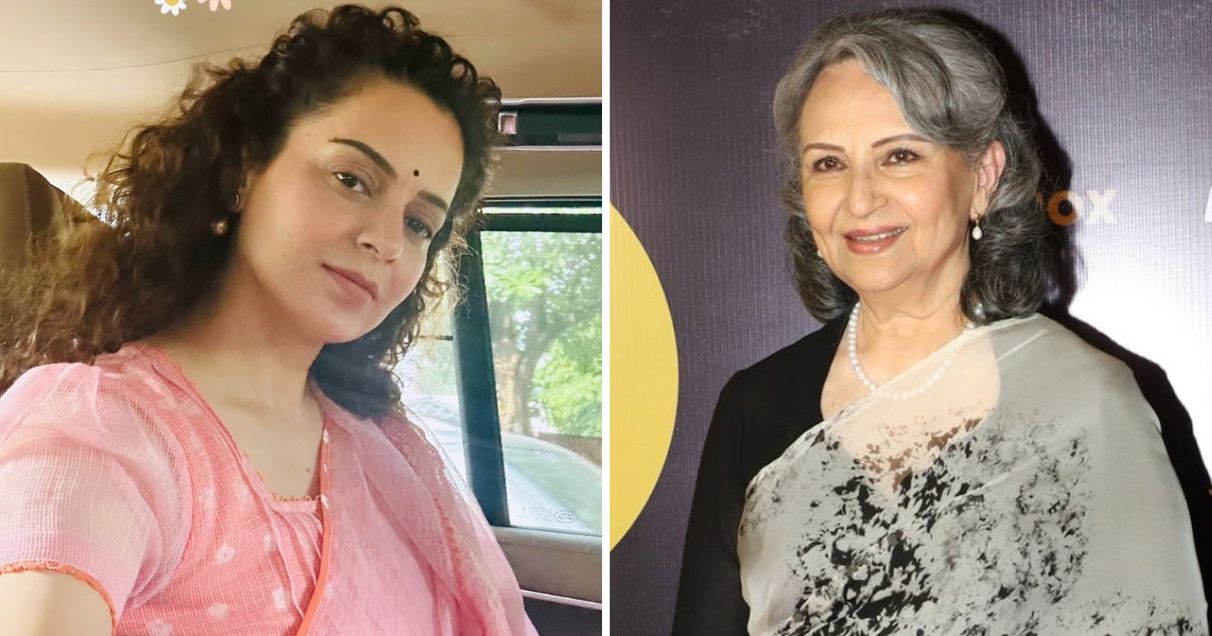
The long-running debate over Vande Mataram has taken a fresh turn after Kangana Ranaut criticised veteran actor Sharmila Tagore’s suggestion that only the song’s opening two stanzas should be retained for wider acceptance.
Tagore had argued that some of the later verses, which invoke Hindu deities, could be difficult for Indians who follow monotheistic faiths. Ranaut, however, said the composition should be viewed as poetry and as a product of the freedom struggle rather than interpreted solely as a religious text.
Why Sharmila Tagore prefers the first two stanzas
In a recent interaction with IANS, Tagore spoke about the difficulty some sections of Vande Mataram could pose for people who believe in a single God.
Her argument centred on the references to Hindu deities in the later portions of the composition. She felt the opening two stanzas, which focus on the motherland, offer a formulation that is easier for people across religious communities to embrace.
The comments came as Vande Mataram is once again at the centre of a national discussion over its rendition and significance.
Kangana sees a different meaning in the song
Ranaut responded to Tagore through social media, saying she respected the veteran actor's right to express her reservations but disagreed with the way she had approached the poem.
From Ranaut's perspective, artistic works routinely use symbolism and metaphor. She argued that references to Shakti in Vande Mataram can represent strength and awakening rather than being treated simply as religious references.
She also linked the composition to India's anti-colonial struggle, saying its larger purpose was to inspire people and awaken a sense of collective strength.
Ranaut subsequently urged Tagore to move beyond what she described as a "Hindu-Muslim mindset", framing the song as something that should bring people together rather than become divided along religious lines.
The historical debate behind Vande Mataram
The disagreement also revives a much older discussion.
Bankim Chandra Chattopadhyay wrote Vande Mataram, which later appeared in his novel Anandamath. The composition became closely associated with India's freedom movement and eventually received the status of the country's National Song.
The opening portions praise the motherland, while subsequent verses contain references to Hindu goddesses. Those later references have historically generated debate over whether the complete composition can serve as a common national expression for citizens belonging to different faiths.
The question of using only the opening portion is therefore not new. The issue had already been debated during the freedom movement, particularly in the 1930s, when concerns were raised over the religious imagery contained in the later verses.
Political controversy adds another layer
The latest exchange between the two actors comes against the backdrop of a wider political disagreement over Vande Mataram.
The Congress has reiterated its preference for the first two stanzas at its own programmes, while supporters of the complete rendition argue that the entire composition represents an important part of India's national and cultural history.
The debate has consequently moved beyond the question of music or lyrics. It now touches on competing interpretations of nationalism, religious inclusion, artistic expression and the country's historical memory.
Mukesh Khanna also weighs in
Actor Mukesh Khanna has separately entered the controversy, arguing that Vande Mataram deserves to replace Jana Gana Mana as India's National Anthem.
That position, however, does not reflect India's current official arrangement. Jana Gana Mana remains the National Anthem, while Vande Mataram has the status of the National Song.
Khanna's intervention has nevertheless added another prominent voice to the growing debate over the two compositions and their respective places in India's national identity.
Two interpretations, one national symbol
At the heart of the Tagore-Ranaut disagreement is a question of interpretation.
Tagore's concern is about whether religious imagery in the later portions could alienate sections of India's diverse population. Ranaut's response is that poetry frequently uses religious and cultural imagery symbolically and should be understood within its historical setting.
For now, the disagreement has given fresh momentum to an issue that has repeatedly resurfaced in India's public life: whether Vande Mataram should be approached primarily as a patriotic expression, a work of literature, a cultural symbol, or through all these lenses simultaneously.