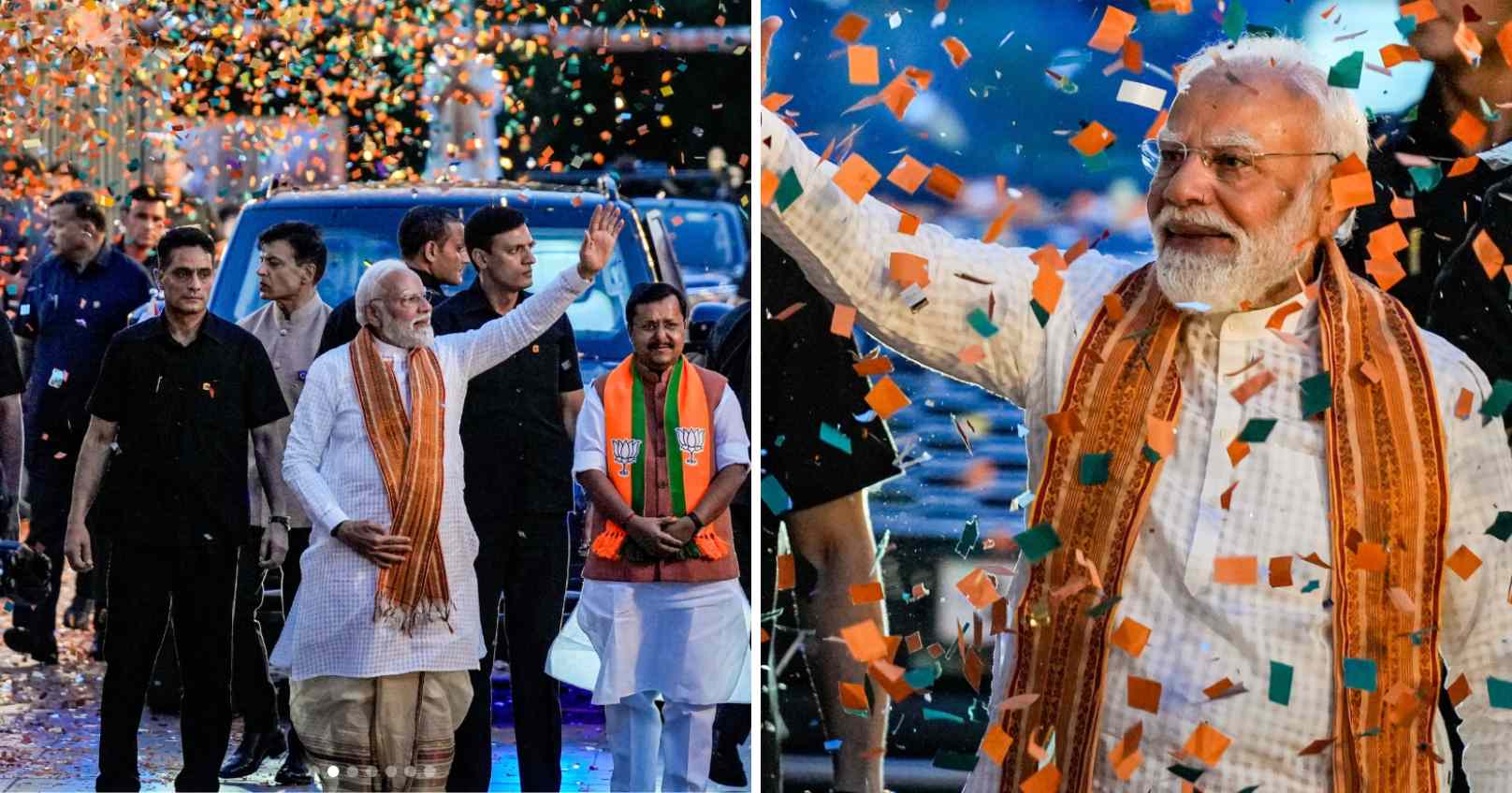
Prime Minister Narendra Modi once again used sartorial symbolism to underline a political moment, appearing at the BJP headquarters in New Delhi clad in classic Bengali traditional wear following his party’s sweeping performance in West Bengal.
The 75-year-old leader chose a white kurta — known locally as a panjabi — paired with a Tussar silk dhoti featuring a red border, a style closely associated with Bengali cultural identity. Observers noted that he carefully draped the outfit in customary fashion, even tucking the loose end of the dhoti into his kurta pocket, a detail typical among Bengali men. He completed the look with a cotton stole adorned with delicate dotted motifs, commonly referred to as buti designs in the state.
Addressing party workers, Modi praised Bengal’s voters for what he described as record participation, calling it the highest turnout witnessed in any state since Independence. He credited booth-level workers and grassroots volunteers for the victory, describing their contribution as historic and invaluable.
Drawing a broader political narrative, the Prime Minister referenced his earlier remarks about the Ganga’s journey from the Himalayas to the Bay of Bengal. He noted that states situated along the river’s course — Uttarakhand, Uttar Pradesh, Bihar, and now West Bengal — are governed by the BJP or its allies, symbolising what he termed the widespread support for the party.
The celebratory mood at the BJP headquarters carried distinct Bengali undertones. Conch shells echoed through the venue, and Modi addressed supporters with a brief line in Bangla, declaring that change had arrived.
For years, the BJP had struggled to gain a firm foothold in West Bengal, often facing setbacks against Mamata Banerjee’s Trinamool Congress (TMC). While exit polls had hinted at a strong BJP showing, Banerjee had confidently projected a commanding mandate for her party, citing past instances where predictions had fallen short.
However, the final tally reflected a dramatic shift, with the BJP crossing the 200-seat mark and the TMC reduced to a significantly smaller presence in the Assembly. Banerjee rejected the outcome, alleging irregularities and accusing both the Election Commission and the BJP of acting against her party’s interests. She maintained that her party would regroup and return stronger.
The results mark a defining moment in Bengal’s political landscape, signalling a major realignment in a state long considered difficult terrain for the BJP.