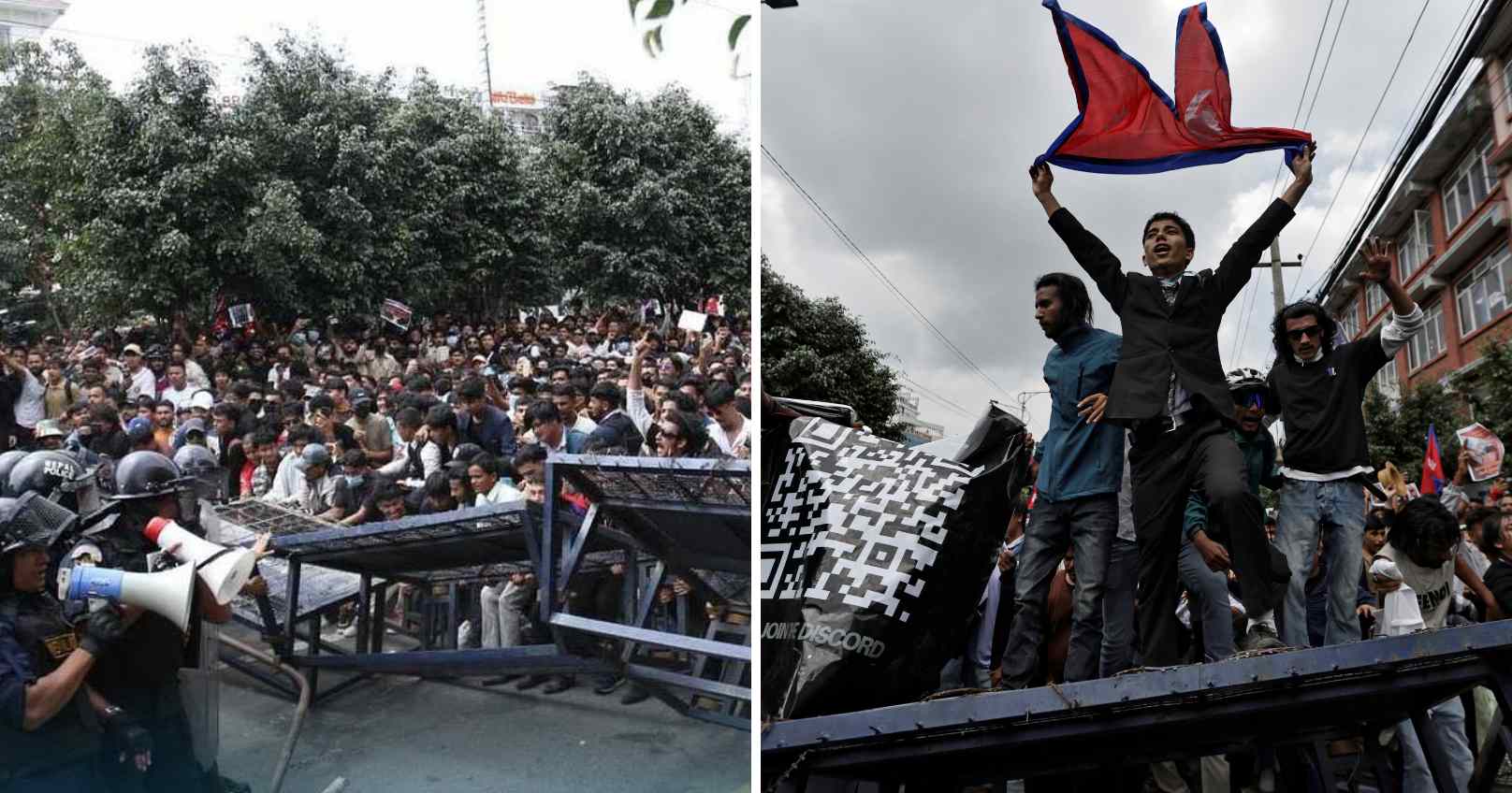
A wave of youth-driven demonstrations has erupted across Nepal, targeting both widespread corruption and the government’s sudden decision to outlaw 26 popular social media platforms. What started as online outrage quickly spilled into the streets on Monday, where protesters clashed violently with security forces outside Parliament. Police gunfire left at least 20 people dead and more than 250 others injured nationwide.
Large crowds of young people, many still in their school and college uniforms, filled Kathmandu and other major cities in what observers are calling the “Gen Z Revolution.” Protesters broke through barricades and entered restricted zones, prompting police to fire at multiple sites. In response, the authorities declared curfews in the capital and several other towns.
Amid the crisis, Home Minister Ramesh Lekhak stepped down, citing moral accountability. Demonstrators carried national flags and signs reading, “Stop corruption, not social media,” “Unban platforms,” and “Youth against corruption.”
The government has imposed emergency restrictions around Parliament and several sensitive areas, including parts of the India–Nepal border near Bhairahawa.
Broader Movement Beyond Gen Z
Speaking to India Today TV, a protester named Suhana dismissed the idea that only Gen Z is behind the movement. She explained that citizens of all generations—millennials, middle-aged groups, and even older Nepalese—are rallying together.
“This isn’t just about a ban on Facebook or Twitter,” she said. “It’s about years of frustration with corruption, mismanagement, and lack of accountability. What you see now is a civil rights movement demanding systemic change.”
The Nepal National Human Rights Commission condemned the police’s “excessive use of force” and the resulting casualties.
Army Deployed, Leaders Hold Emergency Talks
As tensions mounted, the government deployed the Nepal Army to maintain order in protest-hit regions of Kathmandu. Prime Minister KP Sharma Oli convened an urgent meeting of the National Security Council with senior ministers, the chief secretary, and the army chief at his official residence in Baluwatar.
The spark for the unrest came on September 4, when the government ordered a blanket ban on 26 platforms—including Facebook, X (formerly Twitter), WhatsApp, YouTube, and Reddit—arguing that companies had failed to register with the Ministry of Communications and Information Technology. Protesters, however, see the move as an attempt to stifle dissent and silence critical voices.
Even as internet access was restricted, young organizers turned to alternative apps like TikTok and Reddit to coordinate rallies. Thousands marched from Maitighar Mandala toward Parliament, chanting anti-government slogans. Police tried to disperse the crowd with water cannons and tear gas, but some protesters broke into the Parliament compound, setting fire to one of its gates. Images online showed clouds of smoke rising as demonstrators hurled objects at police.
Anger Rooted in Corruption and Inequality
Analysts note that the discontent goes far deeper than the social media restrictions. Years of alleged corruption, economic hardship, and growing inequality have fueled frustration among Nepal’s younger generation. The ban acted as the breaking point, triggering a nationwide outpouring of resistance.
Placards carried by students read messages such as “Independent voice is our right” and “Where has the taxpayers’ money gone?”
PM Oli Stands Firm
Despite the backlash, Prime Minister Oli defended his government’s actions, claiming that platforms ignoring Nepal’s laws and sovereignty could not be allowed to operate.
“Any attempt to weaken the nation will be resisted,” Oli said at a party gathering. “The independence and dignity of the country come before the interests of a few companies or individuals.”
According to official notices, the companies were given until August 28 to register. None of the major players—Meta (Facebook, Instagram, WhatsApp), Alphabet (YouTube), X, Reddit, or LinkedIn—complied by the deadline.