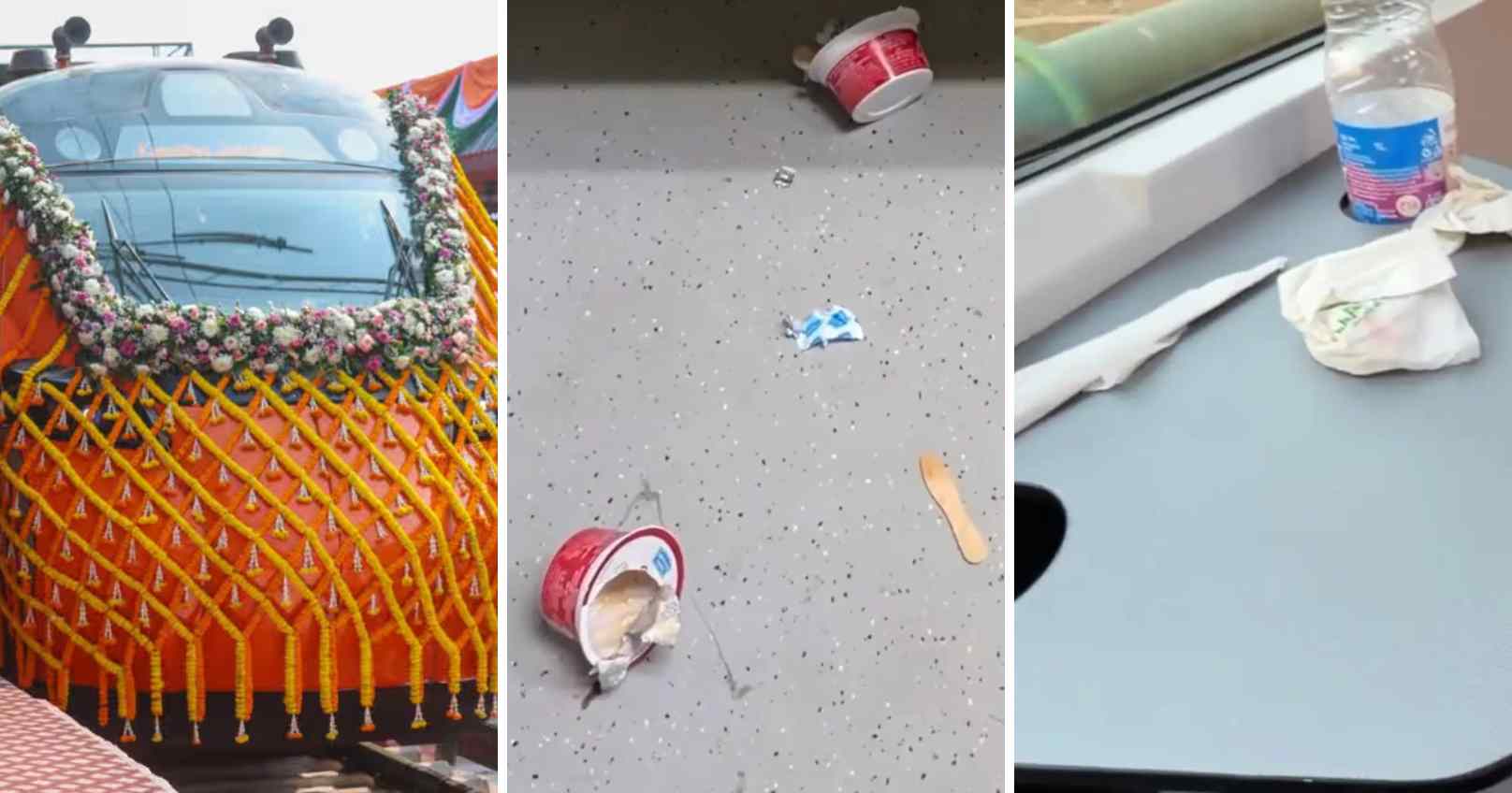
New Vande Bharat Sleeper Sparks Debate Over Civic Sense and Public Cleanliness
Litter found inside the newly flagged-off Vande Bharat Sleeper has revived concerns about passenger behaviour and respect for shared public infrastructure
20-01-2026

Just days before India’s first Vande Bharat Sleeper was unveiled, a senior railway official had appealed to travellers to treat the train with responsibility—follow washroom guidelines, avoid misuse of facilities and respect public property. The appeal, however, appeared to fade quickly as images of a littered coach surfaced within hours of the inaugural journey.
The semi-high-speed sleeper service between Howrah and Guwahati was ceremonially launched on Saturday, but by evening a video circulating on social media showed plastic wrappers and disposable cutlery scattered across the floor. The clip triggered widespread criticism, with many questioning why even premium trains meet the same fate as older services.
Rail enthusiasts often complain that while modern trains receive heavy promotion and investment, legacy services are neglected. Yet the latest incident suggests that passenger habits remain unchanged regardless of how advanced the coach is. For many commuters, it seems, every train is treated with the same casual disregard.
Some observers argue that poor behaviour is largely seen on trains and not on flights, attributing the difference to economic background. But that reasoning weakens in the case of Vande Bharat, where fares are significantly higher than conventional express services. A ticket on the new sleeper costs almost 50 per cent more than on older trains along the same route, indicating that price alone does not shape civic discipline.
Interestingly, the same travellers appear more restrained in urban metros and airplanes. Experts say the shorter duration of travel, stricter monitoring and a more formal environment encourage better conduct in those spaces, whereas long train journeys create a relaxed setting where old habits return.
Another factor is the perception of railways as “government property.” Many passengers assume that cleaning and upkeep are solely the authorities’ responsibility, overlooking the fact that public assets belong to citizens themselves. This mindset, critics say, fuels the tendency to dump waste without hesitation.
The incident was particularly ironic because the train had not even begun commercial operations; it was part of a ceremonial run following the Prime Minister’s flag-off. The post on X that exposed the mess drew sharp reactions, with users calling for civic sense to be taught from childhood and stricter penalties for littering.
Taking note of the controversy, railway officials reiterated that cleanliness is a shared duty. They emphasised that modern infrastructure can only succeed if users show basic respect for it.
The episode underlines a deeper challenge: India may be building world-class transport systems, but public behaviour has yet to catch up. Whether it is a gleaming new coach or a decades-old compartment, the real upgrade required may be in attitudes rather than technology.

CJP leaders Saurav Das and Ashutosh Ranka were released by a Special Executive Magistrate after furn
Read More
CJP leaders Saurav Das and Ashutosh Ranka will remain in judicial custody until October 21 after a S
Read More
Former India cricketer Yusuf Pathan is reportedly set to receive half of a disputed 1,000-square-met
Read More