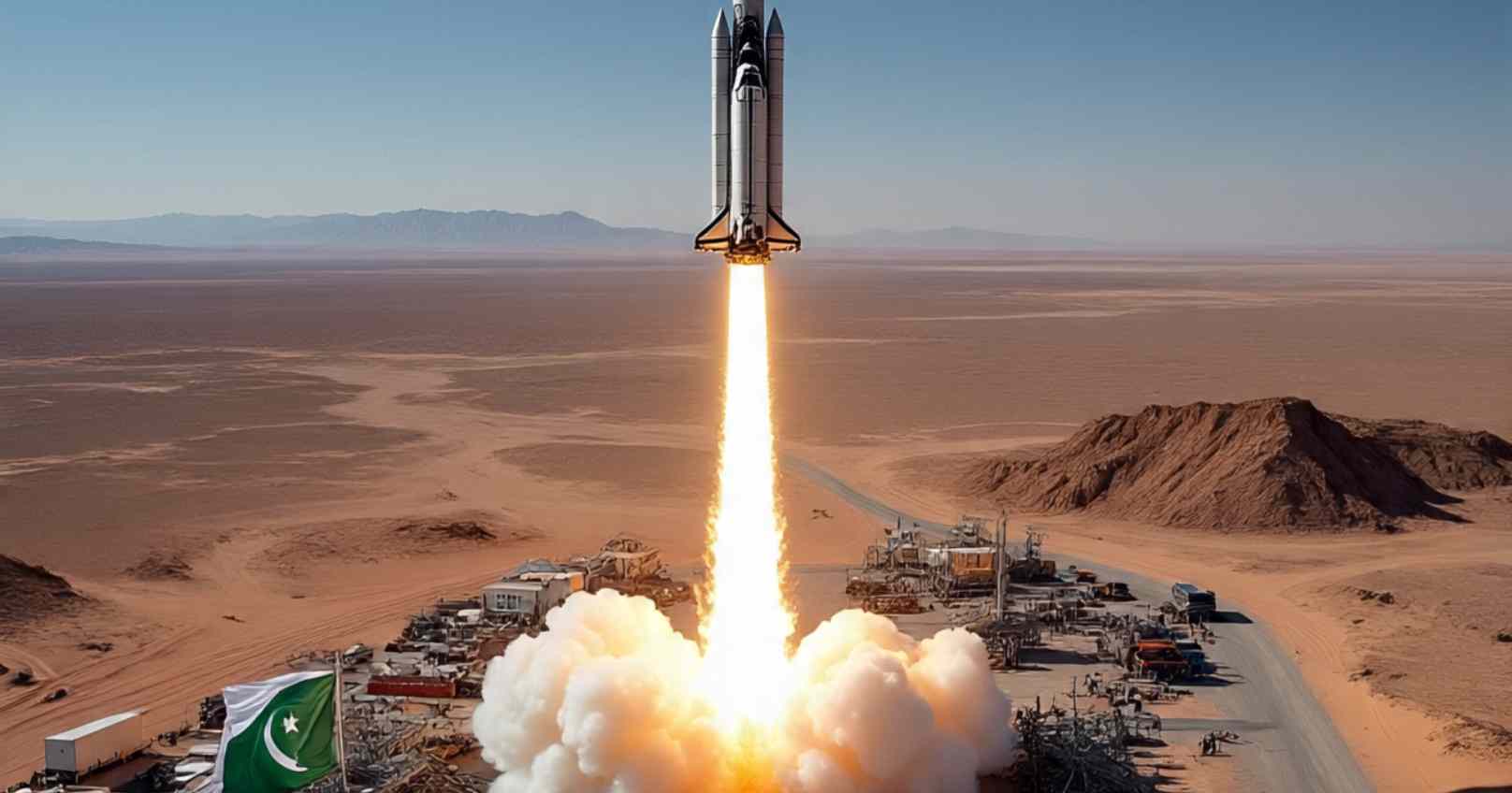
Pakistan Eyes 2035 Moon Mission - with China’s Liftoff
Amid economic turmoil and security challenges, Pakistan has unveiled its ambitious lunar plans, leaning heavily on China to turn its space dreams into reality
06-08-2025

Pakistan’s space journey is almost entirely propelled by Chinese partnership. Every satellite Pakistan has launched has been powered by China’s infrastructure and expertise. Even so-called "indigenous" satellites have relied on China for launch and design assistance.
Iqbal highlighted the recent launch of three satellites that were locally branded but technically backed by China. Pakistan also hopes to send its first astronaut to space by 2026—aboard a Chinese spacecraft, not one of its own.
Last month, China launched a Pakistani Earth observation satellite aimed at monitoring climate change, from its Xichang Space Centre. While SUPARCO may have provided input, the real muscle was provided by Chinese engineers and systems.
The Planning Minister also promoted "Uraan Pakistan"—the country’s renewed space vision under Prime Minister Shehbaz Sharif. While SUPARCO is steering the project, most of the thrust still comes from China.
Earlier this year, Pakistan officially joined China’s Chang’e 8 mission, part of the International Lunar Research Station (ILRS) plan. SUPARCO is expected to contribute a 35-kg rover to help explore the Moon’s South Pole in 2028—a scientific milestone for Pakistan, albeit one that again hinges on Chinese technology.
Pakistan’s space story began in 1961, making it one of the early adopters of space research in the developing world. Under the guidance of Nobel Prize-winning physicist Dr. Abdus Salam, SUPARCO was created with an ambitious vision. But in the decades since, the program has seen stagnation.
Chronic underfunding is a key issue. SUPARCO’s annual budget stands at just $36 million (PKR 290 crore)—a mere sliver compared to global space programs. Leadership, too, has become a point of concern. The agency has been led predominantly by retired military officers, sparking criticism over a lack of scientific and technical direction.
Educational infrastructure is another bottleneck. Pakistan has few academic institutions offering space science or aerospace engineering programs, leading to a limited talent pipeline for the sector.
Beyond the agency’s internal limitations, Pakistan's economic instability has also hurt its scientific progress. The country continues to owe billions under the China-Pakistan Economic Corridor (CPEC). According to The Express Tribune, payments owed to Chinese energy firms alone have touched PKR 423 billion as of mid-2025.
During the recent meetings in Beijing, Shan Zhongde reaffirmed China’s commitment to working with Pakistan but subtly reminded Islamabad of its ongoing economic reliance. While framed as a strategic alliance, the relationship underscores a deeper reality: Pakistan’s space program is being powered from Beijing more than from within.


CJP leaders Saurav Das and Ashutosh Ranka were released by a Special Executive Magistrate after furn
Read More
CJP leaders Saurav Das and Ashutosh Ranka will remain in judicial custody until October 21 after a S
Read More
Former India cricketer Yusuf Pathan is reportedly set to receive half of a disputed 1,000-square-met
Read More