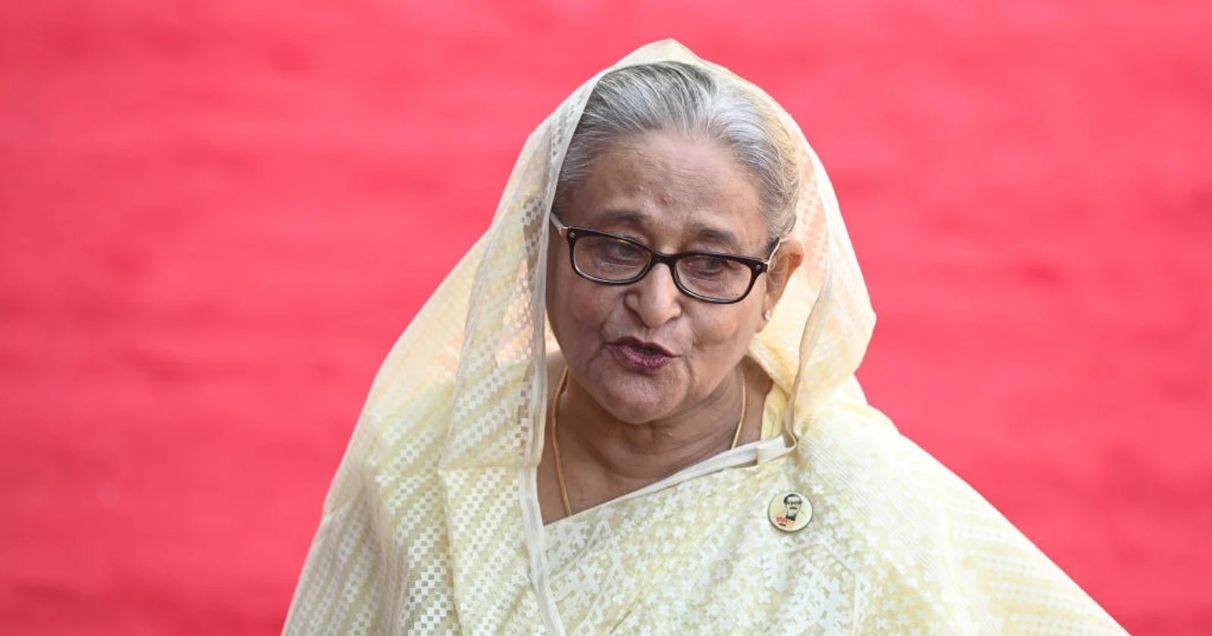
Sheikh Hasina's proposed return to Bangladesh on December 16 has intensified tensions between Dhaka and New Delhi, with the interim government insisting that the ousted leader can come back only through extradition.
The political future of Bangladesh's ousted prime minister Sheikh Hasina has once again become a flashpoint in the country's domestic politics and its relations with India. Hasina's announcement that she intends to return home on December 16, coupled with requests for travel documents and a possible journey aboard Bangladesh's national carrier, Biman Bangladesh Airlines, has prompted a strong response from the government in Dhaka.
Bangladesh has dismissed the announcement as a political bluff, maintaining that Hasina cannot enter the country voluntarily and must instead be handed over by India under the bilateral extradition arrangement. The dispute has placed New Delhi in a delicate diplomatic position, particularly as Dhaka seeks to make her return a matter of bilateral negotiations.
Bangladesh Rules Out Voluntary Return
Bangladesh's State Minister for Foreign Affairs, Humaiun Kobir, has made it clear that the government will not facilitate Hasina's return as an ordinary passenger. Responding to questions about her proposed journey on Biman Bangladesh Airlines, Kobir said the former prime minister could only be brought back through extradition and under strict security arrangements.
His remarks underline Dhaka's position that Hasina, who has been convicted and sentenced in Bangladesh, should be returned to face the consequences of the judicial proceedings against her.
Another senior government representative, Zahed Ur Rahman, Advisor to the Prime Minister in the rank of State Minister for Cultural Affairs, said the question of Hasina's return would be discussed with India rather than with the former prime minister herself. He argued that the legal process against her had concluded and described her announcement as an attempt to influence political supporters and Awami League workers.
Dhaka's insistence on extradition also reflects its concern that Hasina's physical return could trigger fresh political mobilisation in a country already experiencing considerable instability.
How Hasina Left Bangladesh in August 2024
Hasina's departure from Bangladesh followed the dramatic political upheaval of August 5, 2024. As protesters moved towards her official residence, she was evacuated by helicopter on the orders of the Bangladesh Army Chief.
A Bangladesh Air Force C-130J transport aircraft subsequently flew her to Hindon Air Base near New Delhi. Later that day, Army Chief General Waker-uz-Zaman addressed the nation on state television, announcing that Hasina had resigned and that an interim administration would be established.
Her departure took place amid rapidly deteriorating law and order conditions. However, questions surrounding the circumstances of her resignation and the subsequent political transition have continued to feature in Bangladesh's domestic debate.
India has maintained that it provided shelter to Hasina when she was still the country's serving prime minister and that the circumstances at the time left it with little practical choice.
India's High Commissioner to Bangladesh, Dinesh Trivedi, has defended New Delhi's decision, pointing to Hasina's constitutional position at the time she arrived in India.
Meanwhile, Ministry of External Affairs spokesperson Randhir Jaiswal has maintained that Bangladesh's extradition request is being examined under the established legal framework. New Delhi has not announced a timeline for a decision.
The legal questions surrounding Hasina's conviction, the proceedings conducted in her absence and the adequacy of her legal representation could further complicate the matter.
Why India Has Become Central to the Dispute
The Hasina extradition question has increasingly influenced India-Bangladesh relations. Dhaka has repeatedly sought India's cooperation in securing her return, while New Delhi has indicated that broader bilateral engagement should not be held hostage to a single issue.
Bangladeshi officials have argued that Hasina's return is no longer merely a question concerning an individual politician but one involving accountability and the country's judicial process.
Zahed Ur Rahman has also suggested that the mode of Hasina's return, whether by Biman Bangladesh Airlines or another means, would be part of discussions with India.
The contrasting positions highlight the diplomatic challenge facing both governments. Bangladesh wants India to facilitate her transfer, while New Delhi must consider the extradition framework and the legal circumstances surrounding the case.
December 16: A Date Loaded With Historical Significance
Hasina's decision to announce December 16 as her intended return date has added a symbolic dimension to the controversy.
The date is celebrated as Vijay Diwas in India, commemorating the surrender of Pakistani forces in Dhaka in 1971 following the Indian military campaign alongside the Mukti Bahini during the Bangladesh Liberation War.
On December 16, 1971, Pakistan's Lieutenant General AAK Niazi signed the Instrument of Surrender before India's Lieutenant General Jagjit Singh Aurora in Dhaka. The surrender of approximately 93,000 Pakistani military personnel marked a decisive moment in the creation of independent Bangladesh.
The same date is observed as Victory Day in Bangladesh and is a national holiday. Celebrations include military ceremonies, a 31-gun salute and events at Dhaka's National Parade Ground.
By choosing this particular day, Hasina has attached her proposed return to one of the most significant milestones in Bangladesh's national history. Her announcement could therefore be interpreted as an attempt to reconnect her political identity with the country's liberation legacy at a time when the Awami League's position remains deeply contested.
Awami League's Political Future Adds to Dhaka's Concerns
The possibility of Hasina returning has also raised questions about the future of the Awami League, which faced a sweeping political crackdown after her removal from office.
Following her departure, the interim administration led by Muhammad Yunus banned the party's political activities. Several senior leaders left the country, while others were arrested. Party workers largely withdrew from public political activity, and the Awami League was absent from the February elections, according to the supplied account.
The party's exclusion has not, however, eliminated its political influence. A return by Hasina could energise its remaining supporters and create fresh challenges for the country's current political establishment.
Prime Minister Tarique Rahman has accused the Awami League of attempting to destabilise Bangladesh and urged citizens to oppose what he described as efforts to revive violence, political killings and electoral malpractice.
The government has also stepped up security deployments. Nearly 3,000 paramilitary personnel were reportedly stationed across seven districts following incidents involving arson, crude bomb explosions and vandalism that disrupted transport services.
Rahman has further accused the former ruling party of prioritising the interests of external forces over those of Bangladesh. Although he did not identify any country, his comments were widely interpreted as an indirect reference to India.
Political Rivals Find Common Ground Over India
The growing tension has also brought political opponents of the Awami League into discussions about the country's internal security and regional relations.
Nahid Islam, convener of the National Citizen's Party (NCP), met Tarique Rahman on Monday. The NCP emerged from the student-led protest movement of 2024 and has been critical of the current government as well.
However, the renewed activity of Awami League supporters and reports of violence in several areas, particularly Gopalganj, have created pressure on rival political groups to coordinate their positions.
Following his meeting with Rahman, Nahid Islam argued that Bangladesh's current political confrontation had expanded beyond the rivalry between the Awami League, Bangladesh Nationalist Party (BNP) and NCP. He accused India of exercising influence over Bangladesh's internal affairs and alleged that forces linked to New Delhi were attempting to destabilise the country.
His remarks reflect the growing prominence of anti-India sentiment within sections of Bangladesh's political discourse.
Hasina's Return Could Reshape Bangladesh's Political Landscape
Hasina's proposed return has created a complex situation for Bangladesh's leadership. Allowing her back could revive the Awami League's political presence and potentially trigger fresh unrest. Keeping the party outside the political system, meanwhile, could deepen divisions within the country.
For India, the challenge is equally sensitive. New Delhi must navigate Dhaka's extradition demand while weighing the legal questions surrounding the case and the wider importance of maintaining stable bilateral relations.
Whether Hasina can return on December 16 remains uncertain. But her announcement has already reopened debates about political accountability, the legitimacy of Bangladesh's current political order and India's role in the country's future.
The controversy is no longer limited to the fate of one former prime minister. It has become part of a much larger struggle over Bangladesh's political direction and its relationship with its most important neighbour.