The Versova–Bandra Sea Link, one of Maharashtra’s most ambitious infrastructure projects, presents a striking combination of escalating costs, repeated deadline extensions and relatively modest construction progress: the government-approved project cost has climbed from ₹7,502 crore in 2017 to ₹18,120.96 crore, an increase of roughly 140 per cent, while physical progress stood at only about 31 per cent as of May 2026.
What makes the financing structure particularly significant is that the Government of Maharashtra ultimately carries the burden of project cost overruns and construction-stage cash shortfalls under the tripartite concession structure. The project brief records that the state is required to meet cash shortfalls during construction or operations and cost overruns beyond the envisaged project cost.
The project, officially named the Swatantrya Veer Savarkar Setu, is being implemented through Versova Bandra Sea Link Limited, or VBSLL, a wholly owned subsidiary of the Maharashtra State Road Development Corporation. MSRDC itself is wholly owned by the Maharashtra government, making VBSLL effectively a step-down state entity.
The present EPC contractor is APCO Infratech Pvt Ltd, which holds approximately 70 per cent of the construction joint venture, alongside Webuild/Astaldi Group with approximately 30 per cent, according to the project brief. The precise division should still be verified against the latest primary contractual records.
From ₹7,502 Crore To ₹18,121 Crore
The escalation in cost is perhaps the most glaring feature of the project. Early planning estimates were substantially lower. The estimated cost was ₹4,045 crore in 2012, rising to ₹4,340 crore in 2013 and ₹5,975 crore in 2014. The first formal administrative approval came in December 2017 at ₹7,502 crore.
After bids were received in 2018, the project cost was revised to ₹11,332.82 crore, of which the construction component was ₹6,993.99 crore. The latest government resolution-approved envelope is now ₹18,120.96 crore.
That represents an increase of approximately ₹10,619 crore over the 2017 sanctioned figure, or about 140 per cent. Even compared with the post-bid 2018 figure, the project cost has risen by roughly 60 per cent. There is, however, another number in the financing documents.
The lender-appraised project cost is ₹15,823.07 crore, below the GR-approved ₹18,120.96 crore ceiling. The difference effectively provides headroom within the government-approved project envelope. This distinction is important: ₹18,120.96 crore is the currently approved cost envelope, while ₹15,823.07 crore is the lender-appraised project cost.
Only Around 31% Complete
The cost escalation assumes even greater significance when placed against the construction record. Civil work commenced in April 2020. By August 2021, progress stood at just 2.07 per cent. It reached approximately 5 per cent in February 2022, around 15 per cent in April 2024, and 20.03 per cent in May 2024.
By June 2025, the project had reached approximately 25 per cent. In February 2026 it was around 30 per cent. In April 2026, civil progress was reported at 32 per cent, while financial progress was about 30 per cent.
Yet by May 2026, the project brief records overall physical progress at approximately 31 per cent against a milestone target of 35.84 per cent, putting it behind schedule. Component-wise figures underline how much work remains.
As of April 2026, piling was 46.73 per cent complete, bent piles 43.93 per cent, pile caps 32.64 per cent, piers 37.64 per cent, pier caps only 19.71 per cent and precast segments 24.80 per cent complete. Approximately 3,000 of the roughly 14,000 precast segments required had been cast by early 2026.
Deadline Moves From 2023 To 2028
The completion timetable has also shifted considerably. The EPC agreement was signed on September 4, 2018, while the appointed date was June 24, 2019. The project was originally reported for completion in 2023, although a 60-month construction period calculated from the appointed date would extend to June 2024.
The first major extension took the completion target to December 2026. A further extension pushed it to May 2028, which remains the current official deadline and was reaffirmed in the Maharashtra Budget presented on March 6, 2026. That effectively moves the project several years beyond its originally envisaged completion period.
There is an additional structural problem: marine construction has to stop for roughly three months every monsoon, limiting the contractor’s ability to recover lost time rapidly.
Reliance Won The Tender. APCO Entered Later
The original winning bidder was a joint venture of Reliance Infrastructure Ltd and Astaldi S.p.A, which quoted ₹6,993.99 crore and emerged L1 in 2018. Hyundai Engineering & Construction with ITD Cementation quoted ₹7,495 crore, while Larsen & Toubro with Samsung C&T quoted ₹7,615 crore, according to the MSRDC bid table.
That sequence matters because APCO Infratech did not win the original competitive tender. Reliance Infrastructure subsequently exited the construction joint venture in January 2022, and its stake was transferred to APCO Infratech with MSRDC approval. Webuild, which had absorbed Astaldi, continued as the foreign partner.
In other words, APCO entered a project whose winning consortium had already been selected more than three years earlier. The transition was followed by a delay in financial closure. At the time, in February 2022, only about 5 per cent of civil work had been completed.
In 2026, Chief Minister Devendra Fadnavis directed the contractor to increase manpower and machinery to accelerate construction.
The Political Chronology Around APCO’s Entry
The circumstances surrounding APCO’s entry deserve closer documentary examination, although the material presently available does not establish wrongdoing or political intervention. APCO was not among the bidders that competed against Reliance-Astaldi, Hyundai-ITD or Larsen & Toubro-Samsung for the original EPC contract.
It became the controlling Indian partner only after Reliance Infrastructure withdrew and MSRDC permitted APCO to take over Reliance’s stake. The timing becomes politically interesting because of the wider Maharashtra power structure then surrounding urban development and infrastructure.
In January 2022, when the substitution occurred, Eknath Shinde had not yet become Chief Minister. He was, however, already one of Maharashtra’s most powerful politicians and had been serving as Urban Development Minister. Thane developer Ajay Pratap Ashar was by then a longstanding Shinde associate.
When the Shinde-led government subsequently appointed Ashar Vice-Chairman of the Maharashtra Institution for Transformation, or MITRA, in December 2022, mainstream reports described him as one of Shinde’s closest associates and as someone who had worked with him for more than a decade.
Ashar’s perceived proximity to governmental decision-making had itself been a political controversy before Shinde became Chief Minister. BJP politicians, while then in opposition, had raised allegations concerning Ashar’s purported influence in the Urban Development Department while Shinde headed it. Devendra Fadnavis, then Leader of the Opposition, had also reportedly raised objections concerning Ashar.
Those were political allegations. They were not findings of wrongdoing. The political equations subsequently changed dramatically. Shinde became Chief Minister in June 2022 with BJP support. Six months later, his government appointed Ashar to MITRA in a position carrying cabinet-rank stature.
Against that background, the process through which APCO was approved as the replacement for the original controlling EPC partner warrants scrutiny. But there is an important evidentiary boundary.
The material reviewed by The Daily Herald does not presently establish that Ajay Ashar recommended APCO, intervened with MSRDC, knew APCO’s promoters, participated in the Reliance-to-APCO substitution or otherwise influenced APCO’s entry into the Versova–Bandra Sea Link project.
No record examined so far establishes such a connection. Nor does the available material show that the substitution resulted from anything other than the contractual and commercial restructuring following Reliance Infrastructure’s withdrawal.
The relevant questions are therefore investigative rather than accusatory: Who proposed APCO as Reliance Infrastructure’s replacement? Under which provision of the original EPC agreement was the substitution permitted? Which MSRDC authority or board approved it?
What technical and financial qualification exercise was undertaken before allowing APCO to assume the controlling stake in a consortium that had originally won the project through competitive bidding?
Were competing contractors or alternative replacement partners considered? And what reasons were formally recorded for approving APCO? The answers lie in the MSRDC approval files, board minutes, correspondence and supplementary EPC documentation.
Until those records are available, any attempt to link Ashar personally to APCO’s appointment would go beyond the evidence. But the chronology itself is sufficiently significant to merit examination.
Who Is Ajay Ashar?
Ashar is not an infrastructure contractor involved in the VBSL construction. He is an established Thane-based real-estate developer and founder of Ashar Group, established in 2001.
His significance in this story arises not from any documented business relationship with APCO, but from his unusually close proximity to Eknath Shinde and his subsequent formal elevation into Maharashtra’s policymaking machinery.
Contemporary reports concerning his December 2022 MITRA appointment described Ashar as a close Shinde aide and associate who had worked alongside him for more than a decade. His appointment was controversial because BJP politicians had previously questioned his perceived influence when the party was in opposition.
The irony was unmistakable: a businessman whose alleged proximity to the Urban Development Department had previously been attacked by BJP leaders was subsequently appointed to a major state policy body by the Shinde-BJP government.
Ashar ceased to be part of MITRA’s reconstituted governing structure in March 2025, after Maharashtra’s political balance had again changed and Devendra Fadnavis had returned as Chief Minister. None of those facts establish any role in the VBSL contractor substitution. But they demonstrate why the institutional record surrounding the 2022 APCO entry deserves to be placed in the public domain.
Who Is APCO Infratech?
APCO Infratech is a privately held infrastructure company incorporated in 1992 and headquartered operationally in the NCR, with its registered office in Lucknow.
The company is promoted by Anil Kumar Singh and his family, originally from Faizabad, now Ayodhya. Singh is its Managing Director and key promoter. The project brief also identifies Vinod Kumar Singh and Rajesh Pratap Singh among directors on record, though the latest board composition should be checked against current MCA filings.
The company has grown into a sizeable infrastructure contractor. According to figures cited in the project brief, FY2025 revenue was approximately ₹7,838.64 crore, while company-stated metrics put net worth at around ₹3,316 crore, turnover at roughly ₹6,649 crore and its order book at more than ₹35,500 crore.
Rating agencies have cited APCO’s experienced promoters, strong order book and government counterparties as strengths, but have also flagged heavy equity commitments to HAM projects, execution risks, geographic concentration and investments in non-core assets including business jets said to be unlikely to generate commensurate returns.
Why Did The Cost Rise?
The project brief attributes the escalation to a combination of technical, environmental, contractual and time-related factors rather than one single cause.
Among them are major design modifications, including relocation of three navigation spans near Juhu, alteration of connector lane configurations and extension of one connector following objections from the fishing community. There was also an increase in the scope of work.
Another major disruption followed the relocation of the casting yard from Juhu/Versova to Malad after a Bombay High Court restriction arising from an environmental PIL. MSRDC had told the High Court that the stalled casting yard was costing approximately ₹68 lakh per day.
Other contributors included additional expenditure on lighting and beautification, inflation associated with prolonged mobilisation, and the contractor transition following Reliance Infrastructure’s exit. The revised design received environmental and CRZ clearance from the Union environment ministry in early 2026. The redesign also increased the number of mangroves proposed to be removed from 1,585 to 1,799.
State Funding Dominates
The financing structure provides another important insight into who is effectively carrying the project.
Against the lender-appraised cost of ₹15,823.07 crore, approximately ₹10,323.07 crore, about 65 per cent, is proposed as equity and subordinated debt from MSRDC/Government of Maharashtra.
The remaining ₹5,500 crore, or approximately 35 per cent, is senior term debt. State Bank of India has sanctioned ₹3,000 crore and Union Bank of India ₹2,500 crore, with the loans maturing on March 31, 2042.
But as of November 30, 2025, only ₹833.31 crore of this debt had been drawn, roughly 15 per cent, meaning the project had until then been funded predominantly through state support. By the same date, the Maharashtra government had infused approximately ₹3,695.60 crore through equity and subordinated unsecured loans.
The brief states that the approximately ₹4,590 crore cost overrun arising from scope changes is to be funded entirely by the Government of Maharashtra under the concession arrangement. That is arguably the most politically sensitive feature of the financial structure: despite the project being built through an SPV and EPC arrangement, much of the escalation risk ultimately rests with the state.
A- With State Support; B Without It
Another striking disclosure emerges from the credit ratings. Versova Bandra Sea Link Limited carries an ACUITE A-/Stable rating. But its standalone unsupported rating is only ACUITE BB/Stable.
The project brief says this gap illustrates the extent to which the stronger rating rests on Maharashtra government support rather than solely on the economics or execution strength of the project itself.
The A- rating has remained stable through several rounds of cost escalation because the government support structure, rather than project performance alone, is a central factor in the credit assessment.
Another Constraint: Bandra Casting Yard Has To Move
Even as the project attempts to accelerate, another logistical constraint has emerged. The existing Bandra casting yard has to be vacated because the land parcel has been allotted to Adani Realty, according to the project brief. MSRDC is therefore searching for replacement land.
Given the importance of precast segments to construction, with only about 3,000 of approximately 14,000 required segments cast as of early 2026, disruption to casting capacity is a material execution issue.
₹1,722 Crore More For A Separate Connector
The ₹18,120.96 crore price tag does not represent the entire future infrastructure expenditure associated with making the sea-link network functional.
In June 2026, the Maharashtra cabinet’s infrastructure sub-committee chaired by Chief Minister Devendra Fadnavis approved a separate ₹1,722.40 crore, 3.55-km connector linking the Bandra Fort end of the VBSL with the Savarkar Sea Bridge and Mumbai Coastal Road. Its construction cost is ₹1,183.79 crore, with the remainder covering GST, land acquisition and other expenditure.
The package includes ₹50 crore for rehabilitation of approximately 40 hutments, ₹20 crore for fishermen and ₹20 crore for environmental mitigation. Crucially, this ₹1,722.40 crore sanction is separate and is not included in the ₹18,120.96 crore VBSL project cost.
If viewed together purely as associated sanctioned infrastructure expenditure, the ₹18,120.96 crore VBSL envelope and ₹1,722.40 crore connector amount to nearly ₹19,843 crore, though they remain legally and administratively separate projects.
The Unanswered ₹6,994 Crore Question
One of the most important gaps in the publicly available documentation concerns the EPC contract itself. The original construction contract was awarded at ₹6,993.99 crore. But despite the project cost subsequently climbing to ₹18,120.96 crore and the scope undergoing major revisions, the project brief says that the revised EPC contract value payable to the APCO-Webuild joint venture has not been publicly restated.
It lists confirmation of the current EPC contract value from MSRDC or the relevant Government Resolution annexure as an outstanding issue requiring verification. This is an important distinction. A rise in the total project cost does not automatically mean that the contractor’s payment has increased by the same amount.
The ₹18,120.96 crore figure includes financing and project-level components beyond the EPC construction contract. Without the revised EPC agreement or government annexure, it would therefore be inaccurate to attribute the entire ₹10,619 crore increase since 2017 directly to APCO or its joint venture.
But another question now sits alongside it. What exactly were the contractual terms under which APCO stepped into the winning consortium after Reliance Infrastructure’s exit, and how were those terms subsequently affected by the project’s redesign, extensions and escalation? That documentation would provide an important missing piece of the VBSL story.
Exact Expenditure Still Not Public
There is another data gap. Financial progress was approximately 30 per cent in April 2026. Applying that percentage to the ₹15,823.07 crore appraised cost would imply approximately ₹4,700-4,800 crore of expenditure; applying it to the ₹18,120.96 crore GR-approved cost would suggest about ₹5,400 crore.
However, the project brief specifically cautions that exact certified expenditure to date has not been published and says an MSRDC annual report or RTI response would be required for a definitive figure.
Available numbers nevertheless show that by November 2025, ₹3,695.60 crore of government equity/subordinated funding and ₹833.31 crore of term-loan drawdown had been deployed — approximately ₹4,529 crore in aggregate.
An Extraordinary Engineering Project , And A Major Fiscal Bet
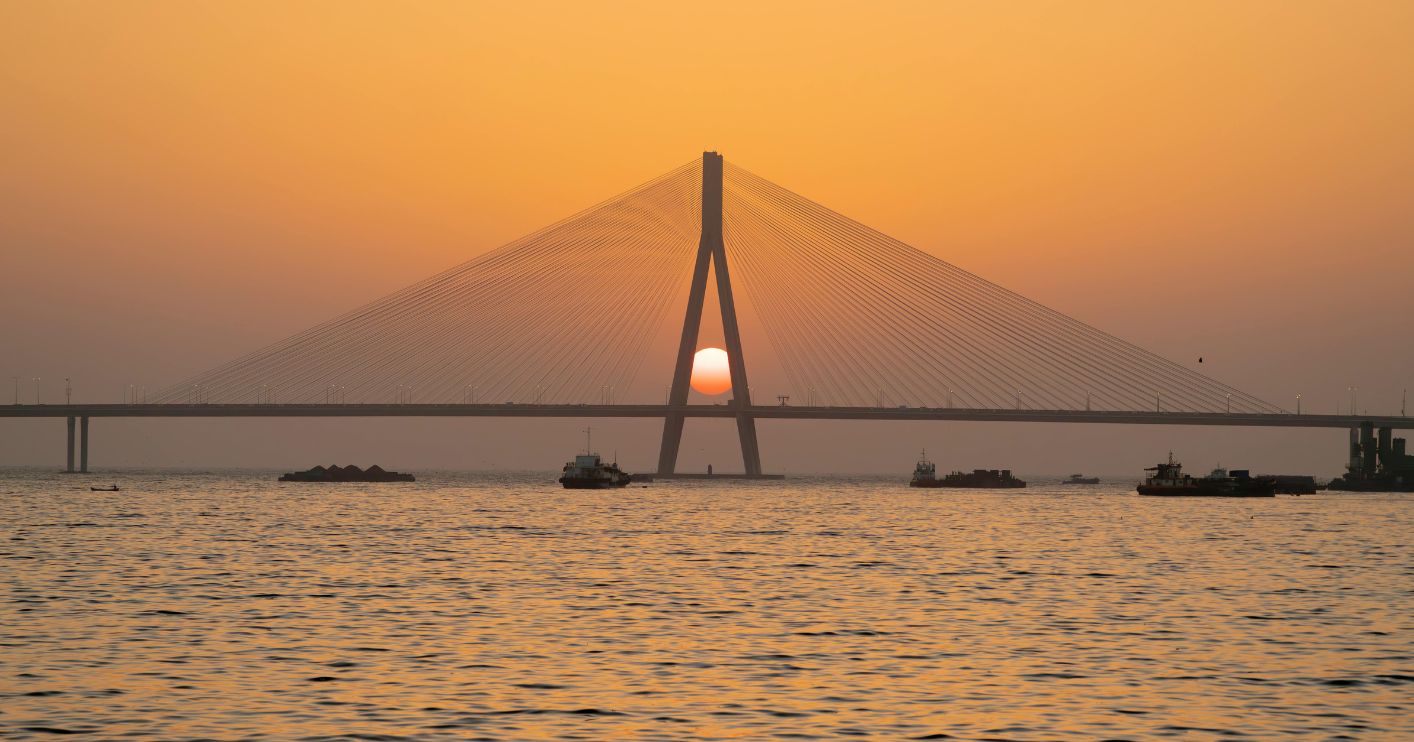
There is little dispute about the scale of what Maharashtra is attempting. The main marine bridge is approximately 9.6 km long, while the complete project including connectors extends to 17.17 km — roughly three times the length of the Bandra-Worli Sea Link.
It will carry eight lanes over its principal section and includes four major connectors at Bandra, Carter Road/Otters Club, Juhu Koliwada and Versova/Nana Nani Park. The project involves around 3,000 piers, approximately 14,000 precast segments and substantial marine engineering.
Once completed, it is projected to cut Bandra-Versova travel time from approximately 45-60 minutes to 10-15 minutes, with estimated traffic of 60,000-70,000 vehicles a day. That potential public benefit is substantial. But so is the fiscal exposure.
A project administratively approved at ₹7,502 crore in 2017 now carries a government-approved envelope of ₹18,120.96 crore. Its completion date has moved years into the future. Only around one-third of physical work was complete by May 2026.
A substantial portion of the financing is being supplied directly by the state. Cost overruns linked to scope changes are being borne by Maharashtra. A separate ₹1,722 crore connector has now been sanctioned outside the principal project cost.
And the contractor currently controlling the Indian side of the construction joint venture was not the company that originally won the tender, but entered in 2022 after the original L1 partner withdrew and MSRDC approved its replacement.
There is presently no evidence establishing that Ajay Ashar played any role in that substitution. But given his documented proximity to Eknath Shinde, the political controversy that had already surrounded his perceived influence in Maharashtra’s urban-development establishment, and his subsequent elevation to a cabinet-rank policy position, the MSRDC records explaining APCO’s entry deserve public scrutiny.
The central question therefore is no longer merely whether Mumbai needs the Versova-Bandra Sea Link. It is how the project moved from ₹7,502 crore to ₹18,121 crore, how a contractor that did not originally win the tender came to control the construction joint venture, how much Maharashtra taxpayers will ultimately bear, and whether the May 2028 deadline can finally hold.