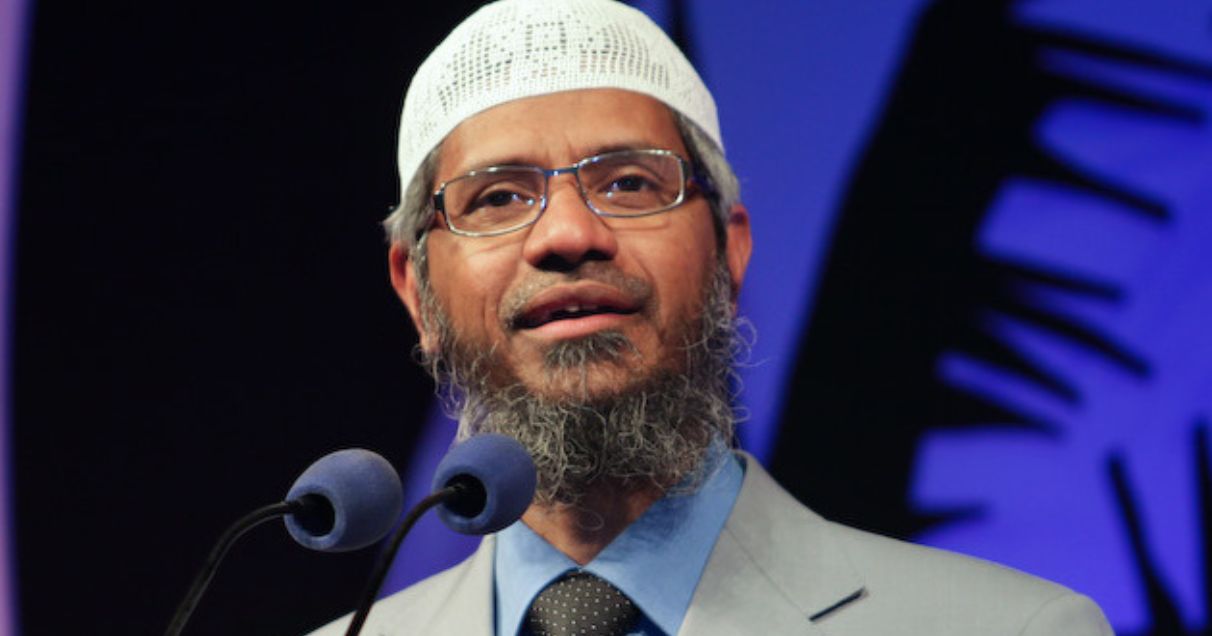
Fugitive Indian preacher Zakir Naik has come under fire from journalists, academics and activists across India, Pakistan and Afghanistan after arguing that the Taliban’s restrictions on girls’ education stem from security concerns and a lack of female teachers. Critics have challenged his explanation, pointing to international reports documenting the prolonged exclusion of Afghan girls and women from secondary schools and universities.
In a video that has circulated online, Naik said media coverage of Afghanistan did not always present the complete picture. He claimed to have spoken directly with Taliban representatives and argued that further education for girls had been postponed until suitable teachers and safer conditions were available.
“If someone delays education until they have the right teacher, there is no problem at all,” he said, defending the Taliban’s position.
Naik also maintained that Afghan women could pursue postgraduate qualifications in Islamic disciplines, including Sharia, Arabic and Quranic studies. He rejected the suggestion that women in Afghanistan had been entirely denied access to higher education, describing such claims as misinformation.
His remarks prompted a wave of criticism, with opponents questioning both the evidence behind his assertions and the implications of portraying the restrictions as a temporary delay rather than a systematic barrier to education.
UN reports contradict Naik’s claims
International agencies have documented extensive restrictions on education for Afghan girls and women since the Taliban returned to power in August 2021.
According to a UNICEF report cited in the coverage, more than 2.6 million Afghan girls have been denied secondary education since the Taliban takeover. Girls have been excluded from formal schooling beyond Class 6 since September 2021, while women were barred from universities in December 2022.
Afghanistan remains the only country where girls and women are prohibited from accessing secondary and higher education on such a nationwide basis, according to UNICEF.
The restrictions have expanded beyond schools and universities. Following the Taliban’s return, authorities introduced gender segregation in classrooms and required female teachers for girls. In March 2022, the Taliban reversed plans to reopen secondary schools to girls.
In December that year, women were barred from public and private universities. Restrictions were tightened further in December 2024, when women were prohibited from attending medical training institutions, including nursing and midwifery programmes, according to reports by the UN Assistance Mission in Afghanistan and the US Special Inspector General for Afghanistan Reconstruction.
These measures have raised concerns about the long-term consequences for women's employment, healthcare and access to qualified female professionals.
Afghan journalists question the teacher shortage argument
Afghan commentators were among those who challenged Naik’s explanation that the shortage of female teachers was a key reason for keeping girls out of school.
Azim Shinwari, a former member of Afghanistan’s security forces now based in Belgium, questioned how Afghanistan could develop a new generation of qualified female teachers if girls were prevented from progressing through the education system.
He also asked Naik to provide evidence for his claims that Afghan women were pursuing master’s degrees and doctorates in Islamic studies. Shinwari recalled having previously reported an alleged meeting between Naik and representatives of the Taliban’s General Directorate of Intelligence in Saudi Arabia.
Mariam Solaimankhil, a member of Afghanistan’s Parliament in Exile, also criticised the argument. She pointed out the contradiction between citing a shortage of female teachers and the Taliban’s restrictions on women’s employment.
Mahbob Shah Mahbob, editor of Afghan International Pashto, similarly questioned where future teachers would come from if schools remained closed to girls. He argued that Afghan students needed access to education rather than explanations for its denial.
Afghan-born US-based journalist Lina Rozbih took a more direct approach, challenging Naik to live under Taliban rule in Afghanistan if he supported the restrictions he was defending.
Malala Yousafzai’s father calls remarks troubling
Ziauddin Yousafzai, an education activist and the father of Nobel Peace Prize laureate Malala Yousafzai, described Naik’s justification as deeply troubling and disappointing.
Yousafzai argued that presenting an indefinite restriction as a temporary postponement did not adequately address the problem. He also questioned the logic of citing a shortage of female teachers without explaining how that shortage could be resolved when girls themselves were being denied education.
He warned that such arguments risked providing religious justification for the Taliban’s exclusion of Afghan girls from classrooms.
Indian scholars question Malaysia’s position on Zakir Naik
The controversy also revived questions about Naik’s continued presence in Malaysia, where he has lived since leaving India in 2016.
Indian Islamic scholar A Faizur Rahman expressed surprise at the support Naik receives in parts of the Muslim world and questioned Malaysian Prime Minister Anwar Ibrahim over the preacher’s presence in the country. Indian historian S Irfan Habib also commented on the Malaysian leadership’s apparent willingness to accommodate him.
YouTuber and historian Ruchika Sharma criticised religious figures who, in her view, failed to condemn the restrictions imposed on Afghan women and girls, describing the situation as a serious human rights violation.
The criticism reflects a broader dispute over the role of religious leaders in responding to the Taliban’s policies and whether explanations based on security or staffing shortages can justify denying an entire generation access to education.
Why Zakir Naik left India
Naik left India in 2016 amid allegations that his speeches had influenced one of the terrorists involved in the Dhaka cafe attack. He has denied wrongdoing in connection with the allegations against him.
He subsequently faced Indian cases involving alleged money laundering, unlawful activities and the promotion of religious hatred. Naik has denied the charges. He sought asylum in Malaysia in 2017 and obtained permanent residency there, while Indian efforts to secure his extradition have remained unsuccessful.
Afghanistan faces a growing shortage of female professionals
The debate over Naik’s remarks comes as concerns grow over the long-term impact of Afghanistan’s education and employment restrictions.
A UNICEF assessment published in April warned that the country could lose up to 20,000 female teachers and 5,400 healthcare workers by 2030 if the restrictions continued.
The projected losses have sharpened concerns about the future availability of women professionals in a country where cultural and practical barriers can make access to male teachers and healthcare providers difficult for many women and girls.
Critics of Naik’s position argue that the teacher shortage he cited cannot be separated from the restrictions preventing girls from completing their education and women from working. With no announced date for reopening secondary schools and universities to girls and women, the uncertainty surrounding Afghanistan’s education system continues into the sixth year of Taliban rule.