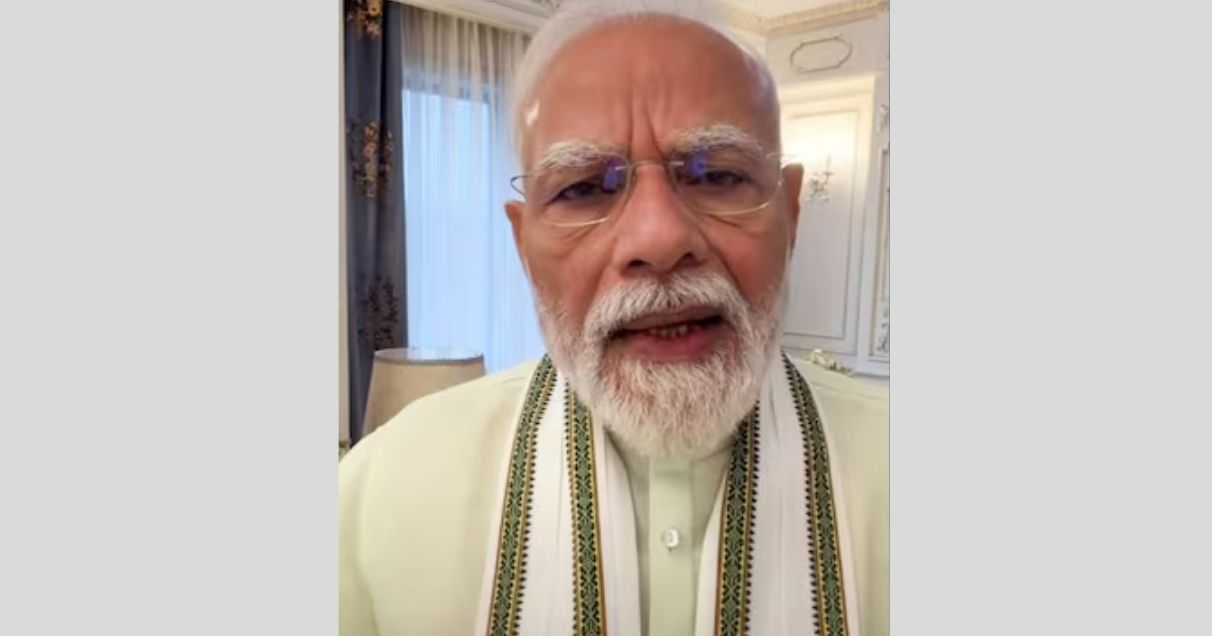
Prime Minister Narendra Modi has taken his economic message directly to India's younger generation, releasing a selfie-style Instagram video celebrating the country's 7.8 per cent GDP growth while simultaneously reviving his call for Indians to spend more of their money at home.
Speaking from Bishkek, where he is attending the Shanghai Cooperation Organisation Summit, Modi highlighted India's stronger-than-expected economic performance during the April-June quarter of 2026-27.
But the nearly three-minute video went considerably beyond GDP numbers.
The Prime Minister used the message to push a wider economic nationalism agenda — buy Indian products, hold weddings in India, reconsider unnecessary foreign holidays and avoid buying gold when it isn't required.
The central argument was straightforward: India's economic strength can be reinforced if more Indian consumption and expenditure remain within the domestic economy.
7.8% GDP growth beats expectations
Official data released on Monday showed the Indian economy expanding 7.8 per cent during the first quarter of FY27, exceeding the Reserve Bank of India's 7 per cent projection.
Manufacturing, services and investment activity are believed to have contributed to the stronger performance.
Modi highlighted the number prominently in his Instagram message, presenting the growth rate as evidence of India's resilience at a time when the international economy remains exposed to considerable uncertainty.
The Prime Minister pointed to wars, geopolitical instability and supply-chain disruptions while arguing that the global economy has struggled to regain sustained stability since the Covid-19 pandemic.
Against that backdrop, he portrayed India's growth performance as particularly significant.
A day earlier, Modi had celebrated the GDP figures on X, describing the performance as a major achievement and taking a swipe at those who had predicted a weaker economic outcome.
‘Jhooth ki goonj’ remark sparks political interest
The political language employed in the Instagram video attracted almost as much attention as the economic message.
Modi accused unnamed critics of spreading what he described as “jhooth ki goonj” — an echo of falsehoods — and creating an atmosphere of pessimism despite India's economic progress.
The formulation immediately generated political speculation because of its similarity to Rahul Gandhi's “Chhatron Ki Goonj” youth-outreach campaign.
Modi did not name the Congress leader while making the remark.
Nevertheless, the choice of phrase is being interpreted in political circles as a possible indirect response to Rahul's campaign.
The timing is also noteworthy.
The Prime Minister has been making visible efforts to strengthen communication with younger Indians following the large student demonstrations at Delhi's Jantar Mantar in July.
Using a direct-to-camera, selfie-style Instagram format represents a departure from the more conventional presentation associated with prime ministerial economic messaging.
It was also unusual for Modi to devote a social-media address to a domestic economic subject while travelling overseas for a major diplomatic summit.
Modi revives ‘Vocal for Local’
The GDP figures became the platform for a renewed appeal for Atmanirbhar Bharat.
Modi urged Indians to strengthen domestic industry through the familiar “Vocal for Local” philosophy.
But he extended the argument beyond simply purchasing Indian-manufactured products.
The Prime Minister wants Indians to think about where they travel, where they celebrate major family occasions and even where their savings are directed.
One of his recurring messages is “Wed in India” — encouraging affluent Indian families to organise destination weddings within the country rather than spending substantial amounts on ceremonies overseas.
India possesses enough destinations, hotels and tourism infrastructure to host such celebrations domestically, the government has previously argued.
Keeping that expenditure within India could benefit hotels, airlines, event companies, restaurants, local businesses and employment.
Think before taking that foreign holiday
Modi also urged Indians to reconsider overseas travel when it is not necessary.
The appeal has an economic rationale.
Foreign travel results in expenditure outside the country and creates demand for foreign currency. Encouraging more domestic tourism can instead direct household spending towards India's own hospitality, aviation and tourism industries.
The Prime Minister had made a similar argument earlier this year when instability in the Middle East and the Iran conflict placed pressure on international energy prices.
For an economy that imports substantial quantities of its energy requirements, sharply higher crude prices can increase the import bill and create additional pressure on foreign exchange.
Reducing avoidable foreign expenditure, in the government's formulation, can contribute to greater economic resilience.
Modi's unusual message on gold: Don't buy unless you need it
Perhaps the most striking element of the Prime Minister's appeal concerned gold.
India is one of the world's largest consumers of the precious metal, but much of the country's demand is satisfied through imports.
That means India's cultural and investment appetite for gold can also contribute significantly to the country's import bill.
Modi therefore urged citizens to avoid purchasing gold simply for the sake of doing so.
The message was not an argument against gold altogether. Instead, the Prime Minister suggested that people reconsider purchases where there is no genuine requirement.
Placed alongside the appeals to holiday domestically and organise weddings within India, the message forms part of a broader attempt to encourage consumption patterns that retain more economic activity within the country.
Economics meets Gen Z politics
There is another dimension to the video that extends beyond economic policy.
The medium may itself have been part of the message.
Instead of relying solely on a speech, official statement or conventional government video, Modi addressed viewers directly through a format familiar to millions of young Instagram users.
The presentation comes as India's political parties increasingly compete for the attention of Gen Z voters.
Youth unemployment, recruitment delays, examination controversies and paper leaks have become politically sensitive issues, particularly following the July student protests in the national capital.
Rahul Gandhi has also intensified his own youth outreach.
Against this backdrop, Modi's Instagram intervention appears designed to link India's headline economic performance directly with the aspirations of younger citizens.
Developed India by 2047
The Prime Minister ultimately connected the 7.8 per cent growth figure with his longer-term political and economic objective: transforming India into a developed economy by the centenary of independence in 2047.
Greater self-reliance, domestic production and preference for Indian goods and services would, Modi argued, help move the country towards that objective.
His appeal effectively asks Indians to see everyday spending decisions as part of a larger national economic project.
Buy local.
Holiday at home where possible.
Celebrate weddings in India.
Think before purchasing imported gold.
And keep more Indian money circulating through the Indian economy.
For Modi, the unexpectedly strong GDP number provided the opportunity to sell that argument to a generation accustomed to receiving its messages not through podium speeches — but through a smartphone screen.
India grew 7.8 per cent despite a turbulent world. Modi's next message to Indians is about keeping that momentum going: spend more at home, strengthen Swadeshi and make self-reliance an everyday economic choice.