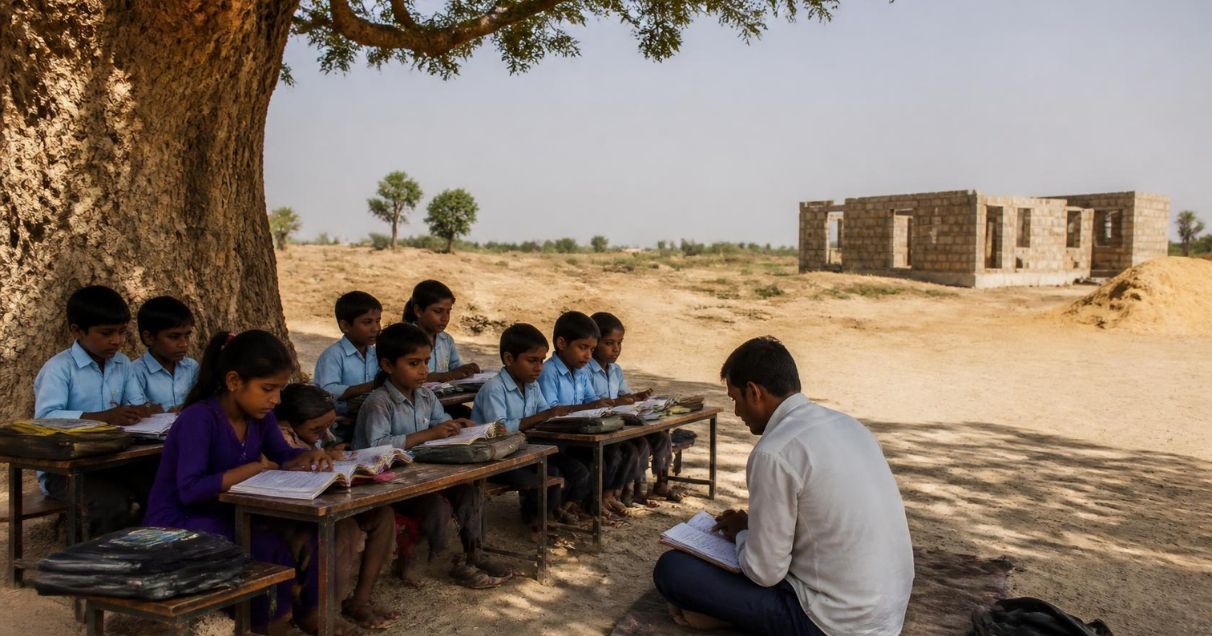
As many as 611 government schools in Rajasthan are functioning without their own school buildings, according to information presented by the state government in the Legislative Assembly.
The disclosure has once again brought the condition of government school infrastructure into focus, with the ruling BJP and the Opposition Congress trading blame over the issue.
The figures were shared in response to a question raised by Leader of Opposition Tika Ram Jully. According to UDISE data for 2025-26 under the Samagra Shiksha Abhiyan, the 611 schools without buildings include 10 girls' schools.
The BJP government blamed the infrastructure shortcomings on the previous Ashok Gehlot-led Congress administration. Referring to an assessment carried out following the Jhalawar school accident, the ruling party said the audit had exposed serious deficiencies in school infrastructure that the present government was now attempting to address.
Jaipur, Jhalawar Among Areas With Schools Lacking Buildings
The problem is spread across several districts and blocks of Rajasthan.
Jaipur has 38 government schools without their own buildings, according to the data presented in the Assembly. In Jhalawar district, Aklera block accounts for the highest number, with 23 schools lacking buildings.
Khanpur has 16 such schools, while Jhalrapatan has 11. Bap in Phalodi district also has 11 schools without buildings, followed by Chotisarvan in Banswara, where 10 schools face the same problem.
The issue has gained further attention following a recent controversy involving a government school near Jaipur.
School Shifted After Building Was Declared Unsafe
A team from the Cockroach Janta Party, led by its co-convenor Ashutosh Ranka, had recently attempted to visit a government school in Bagru near Jaipur amid allegations that it was operating from a cowshed-like temporary structure.
The school's original building had reportedly been declared unsafe and shut down last year. Students were subsequently moved to a temporary arrangement, prompting questions over the availability of a permanent and suitable learning space.
The visit itself later became controversial after members of the CJP team were allegedly attacked while travelling to inspect the school.
Toilets and Drinking Water Also Missing in Thousands of Schools
The infrastructure concerns are not limited to school buildings.
The state government informed the Assembly that among 64,484 government schools with their own buildings, thousands still lack essential facilities.
A total of 2,047 schools do not have toilet facilities, while 1,049 schools lack access to drinking water, according to the figures.
Banswara has the highest number of schools without toilets, with 188 institutions facing the problem. Dungarpur follows with 124 schools, while Udaipur has 98 schools without toilet facilities.
In terms of drinking water, Dausa recorded the highest number, with 96 government schools lacking the facility.
Rajasthan Announces Funds for School Infrastructure
The Rajasthan government said it has earmarked Rs 550 crore for the repair and renovation of school infrastructure.
Another Rs 450 crore has been allocated for constructing buildings for schools that currently do not have their own premises or are functioning from damaged and unsafe structures.
The government has also outlined a larger funding plan, stating that around Rs 2,500 crore annually, or Rs 12,500 crore over five years, could be made available through various sources for the construction, maintenance and repair of government school infrastructure.
The administration has maintained that upgrading schools and ensuring access to basic amenities remain key priorities.
Opposition Questions Government's Plan
Leader of Opposition Tika Ram Jully, however, questioned whether the government had a clear strategy to deal with the scale of the problem.
Citing findings from the same audit, Jully said 3,768 government schools had been identified as completely dilapidated or unsafe. He also claimed that 83,783 classrooms had been found unsuitable for use.
According to the Congress leader, the closure or relocation of schools because of unsafe buildings could also affect student enrolment.
Jully further pointed to observations made by the Rajasthan High Court regarding the condition of government schools, arguing that the issue required more than announcements and funding commitments.
The exchange in the Assembly highlights the wider challenge facing Rajasthan's education system. While the government has announced substantial funding for repairs and construction, the Opposition has questioned how quickly the money will translate into safer classrooms and better facilities for students.
With hundreds of schools still functioning without permanent buildings and thousands facing shortages of toilets, drinking water or safe classrooms, the condition of school infrastructure is likely to remain a major political and administrative issue in Rajasthan.