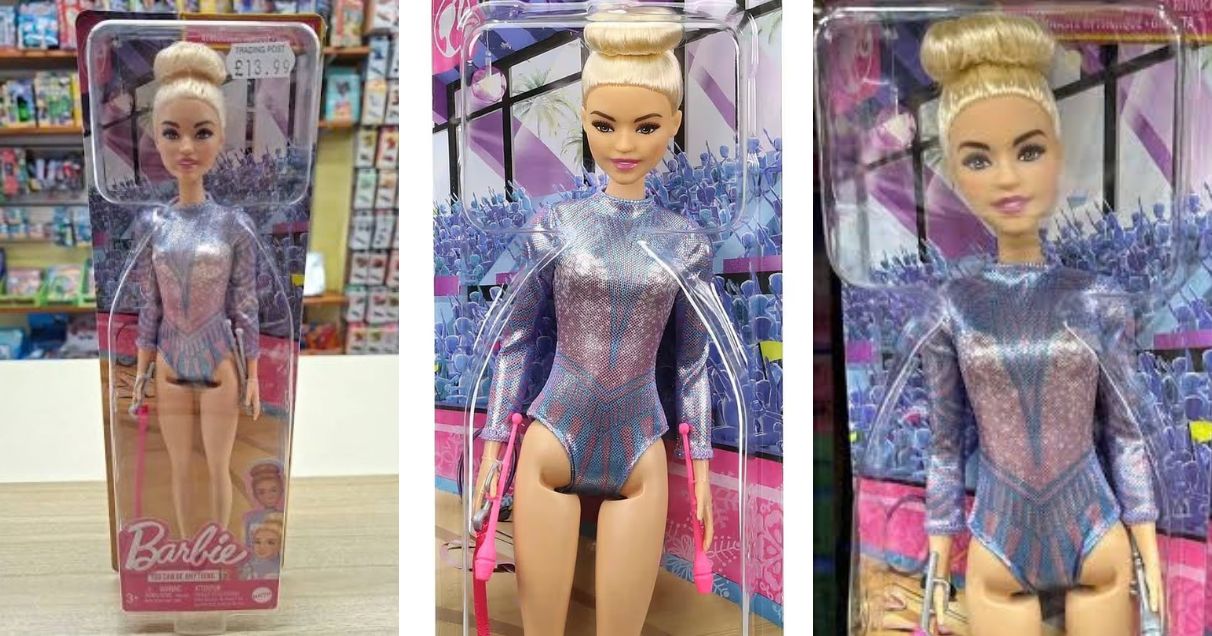
A Barbie doll from Mattel’s “You Can Do Anything” range has drawn criticism on social media after a TikTok creator claimed that some of the tiny figures printed on its packaging appeared to be performing gestures resembling Nazi salutes.
Ana Elizabeth, a content creator, said she noticed the figures while shopping at a CVS pharmacy store in the United States. The doll, which celebrates girls’ participation in sports, features a gymnast wearing a leotard and comes with ribbons and batons.
Although the packaging depicts what appears to be a sporting event, Elizabeth questioned the positioning of several blue-coloured spectators in the background, arguing that their raised arms resembled the notorious Nazi salute.
Her video has prompted widespread discussion online, with viewers disagreeing over whether the imagery is offensive or simply represents spectators cheering during a competition.
TikTok Video Triggers Calls For Accountability
In the clip, Elizabeth zoomed in on the printed audience to highlight the gestures that had caught her attention. She also added a German song, Weit Ist Der Weg Zurück Ins Heimatland, originally released in 1931 and later associated with Nazi marching music.
Her caption used dark humour to express her reaction: “She better win the Olympics, cause her coach will be heil-y disappointed.”
The post prompted some viewers to question how the imagery had made it onto the packaging of a widely sold children's toy.
One commenter questioned what else the gestures could represent, while another called for a boycott of Mattel. Other users argued that a company of Mattel’s size should have sufficient design and quality-control processes to identify potentially offensive imagery before products reach stores.
The criticism has largely focused on the apparent positioning of the miniature spectators rather than the gymnast or the doll itself.
Viewers Disagree Over The Interpretation
Not everyone who watched the video agreed with Elizabeth’s interpretation. Some users suggested that the figures were ordinary sports spectators raising their arms to cheer, rather than making a reference to Nazi symbolism.
One commenter noted that multiple figures appeared to have both arms raised, which they interpreted as a possible indication of celebration. Others criticised the online reaction as exaggerated, with one dismissing it as “reaching”.
The conflicting responses have highlighted how the small, stylised illustrations can be interpreted differently. The figures’ intended gestures have not been independently established, and the online discussion alone does not confirm that the packaging contains deliberate Nazi imagery.
Mattel had not issued a public response to the latest controversy at the time of writing.
Hanukkah Barbie Also Draws Mixed Reactions
The latest debate follows criticism of another recent Barbie release. Mattel recently introduced its first official Hanukkah-themed Barbie as part of its Holiday Sweaters collection, alongside two dolls celebrating Christmas.
Priced at $28, the Hanukkah edition features a cobalt-blue sweater decorated with a menorah, dreidels, snowflakes and Stars of David. The outfit is completed with blue checkered leggings and miniature boots.
While some social media users welcomed the doll as a move towards greater representation, others criticised its facial design. Some argued that the shape of its nose resembled historical antisemitic caricatures of Jewish people.
Supporters of the release also pointed to Barbie’s Jewish co-creator, Ruth Handler, suggesting she would have appreciated the inclusion of a Hanukkah-themed doll.
The two controversies have renewed discussion about the scrutiny faced by major toy brands over visual details and cultural representation. In both cases, reactions have varied, with some consumers raising concerns about potentially offensive imagery and others defending the designs or questioning the interpretations.