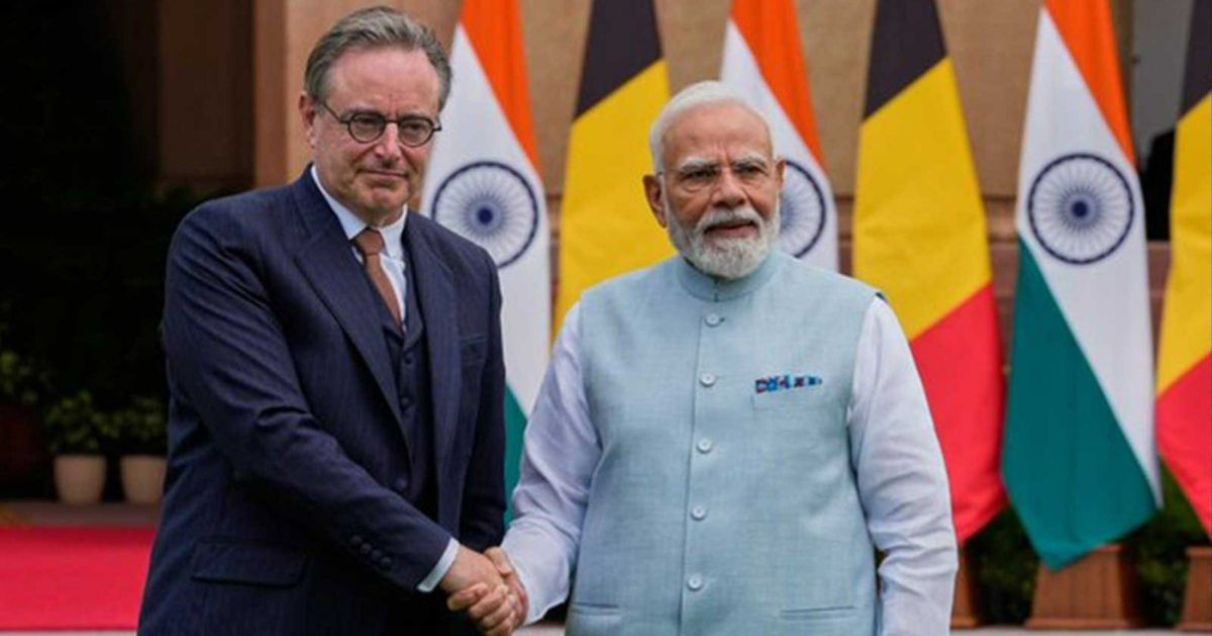
Belgian Prime Minister Bart De Wever has said Europe is undergoing a difficult realisation after years of allowing economic dependence on China to grow, admitting that India had identified the dangers much earlier and warned European nations about them.
Speaking at an event organised by the Confederation of Indian Industry (CII) in Delhi during his two-day India visit, De Wever said European economies had become vulnerable after years of relying heavily on cheap imports and external supply chains.
Without naming China directly, the Belgian leader criticised the practice of surplus goods being sold in European markets at prices that weakened local industries. He said such economic dependencies could eventually be used as tools of political and strategic pressure.
According to De Wever, Europe failed to recognise the warning signs despite India's early concerns.
He said Indian leaders had raised alarms about the consequences of excessive economic dependence, but Europe did not pay sufficient attention at the time.
De Wever specifically acknowledged Prime Minister Narendra Modi's role in warning European countries about the issue, saying Europe was now beginning to take those concerns seriously.
India Becomes Belgium's Priority Partner
The Belgian Prime Minister made it clear that India now occupies a central position in Belgium's international engagement strategy.
Calling India the top priority on Belgium's list of partners, De Wever said countries that failed to recognise India's importance were overlooking a major geopolitical and economic opportunity.
He said Belgium was looking for reliable partners at a time when global trade policies and tariffs could change suddenly, making trust an increasingly important factor in international cooperation.
De Wever said Brussels wanted to elevate its relationship with New Delhi beyond trade and investment and expand cooperation in political and strategic areas as well.
Belgium Assures India on Pakistan Military Supplies
The strengthening India-Belgium partnership also carries important implications for defence and security cooperation.
Belgium is understood to have assured India that it will not provide critical military equipment to Pakistan, addressing one of New Delhi's key security concerns.
The two countries are simultaneously exploring deeper defence-industrial collaboration, including potential arrangements for manufacturing military equipment in India using Belgian technology.
Ten agreements between Indian and Belgian defence companies were finalised during the Modi-De Wever engagements. Some of the proposed cooperation could involve joint manufacturing of defence equipment, including rockets, in India.
India and Belgium have also agreed to expand military exchanges and training programmes, while enhancing intelligence-sharing and cooperation between relevant agencies.
Prime Minister Modi described defence and security cooperation as one of the major pillars supporting the expanding partnership between India and Belgium.