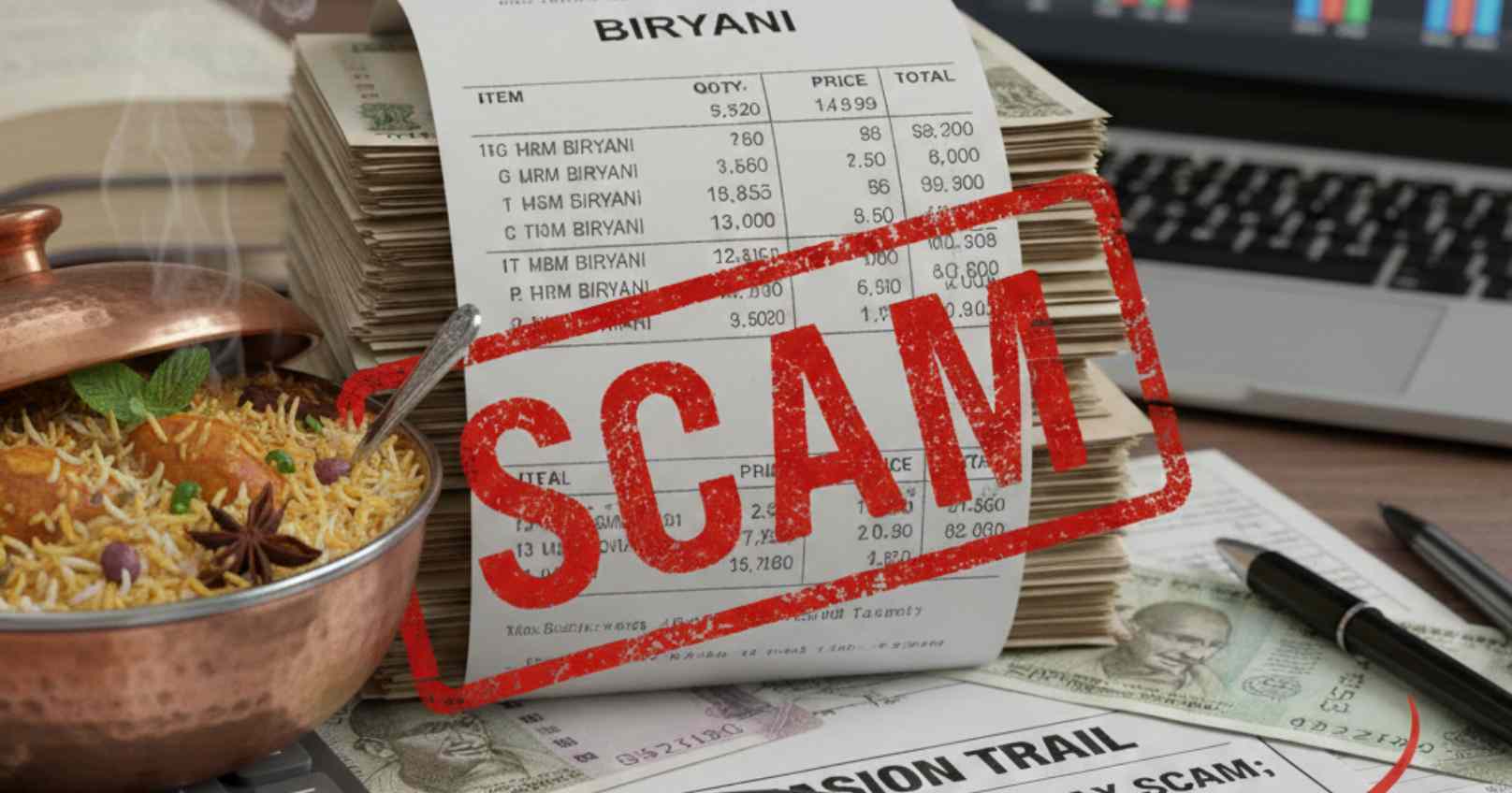
What started as a standard compliance visit by the Income Tax Department in Hyderabad has evolved into a sweeping national investigation uncovering an estimated Rs 70,000 crore in hidden restaurant turnover.
Late last year, tax officers walked into a few well-known biryani outlets in Hyderabad for routine checks. On the surface, everything appeared normal — busy kitchens, packed dining halls and functioning billing counters. But officials soon noticed a discrepancy: the crowd inside did not match the sales figures displayed in the billing system.
A Pattern Beyond One City
Initially, investigators suspected isolated under-reporting. However, further examination revealed that multiple restaurants were using the same billing software. That discovery changed the course of the inquiry.
Tracing the digital trail led officers to the software provider’s backend servers in Ahmedabad. There, authorities accessed nearly 60 terabytes of billing data linked to over one lakh restaurants across India. What began as a small mismatch in Hyderabad turned into a nationwide data audit.
Inside a digital forensics facility in Hyderabad, specialists began reconstructing deleted invoices. Although many bills had been erased from visible records, the system had retained digital footprints. Using advanced analytics and artificial intelligence tools, officials pieced together transactions that had been removed from active logs.
What the Data Revealed
Over a six-year period, restaurants examined in the probe generated approximately Rs 2.43 lakh crore in sales. Of this, more than Rs 13,000 crore worth of transactions had reportedly been deleted after being recorded.
Investigators found systematic patterns. Some establishments erased a handful of cash bills daily. Others removed records for entire date ranges — sometimes wiping out nearly a month’s worth of entries. In several cases, internal sales data did not match what was declared in tax filings.
State-wise analysis showed significant discrepancies. Karnataka recorded deleted transactions valued at roughly Rs 2,000 crore, followed by Telangana at around Rs 1,500 crore. Tamil Nadu, Maharashtra and Gujarat also reflected substantial gaps. In Andhra Pradesh and Telangana alone, scrutiny of over 3,700 PAN-linked entities suggested suppressed sales exceeding Rs 5,000 crore.
A sample audit of 40 restaurants in the two states indicated nearly Rs 400 crore in unreported turnover, with some outlets allegedly concealing up to a quarter of their revenues.
The Biryani Factor
One recurring pattern involved high-volume biryani outlets, particularly in cities such as Hyderabad, Bengaluru, Chennai and Mumbai. Because biryani is among the most frequently sold single-dish items in India’s food industry, even minor under-reporting per bill can accumulate into substantial unaccounted revenue.
Officials compared raw material procurement — especially rice and meat — against declared sales figures, GST filings and online delivery platform data. In numerous instances, ingredient purchases suggested higher output than reported turnover.
Authorities clarified that the investigation is not targeting any cuisine or community. The focus is on alleged manipulation enabled by digital billing systems across the restaurant sector.
Digital Trails Cannot Be Erased
Financial expert Sarthak Ahuja observed that modern tax enforcement relies heavily on digital trace analysis. According to him, examination of billing data from nearly 1.77 lakh restaurants since 2019 revealed average sales suppression of about 27% in many cases.
Even cloud-based systems, he noted, retain backend traces of deleted transactions. Attempts to wipe invoices or manipulate dates leave recoverable markers that investigators can reconstruct.
Probe Expands Nationwide
Following the initial findings, the investigation expanded from Hyderabad to Visakhapatnam and other cities. The Central Board of Direct Taxes widened its review to additional states, indicating that the scrutiny currently relates to one billing platform but could extend to others.
Authorities are now reconciling reconstructed billing data with tax returns, GST records and banking transactions. Notices and penalty assessments are expected to follow.
What began with inconsistencies at a few bustling biryani restaurants has grown into one of India’s most extensive digital tax investigations. The episode underscores a central lesson of the digital age: while invoices may be deleted from screens, their electronic footprints often remain.