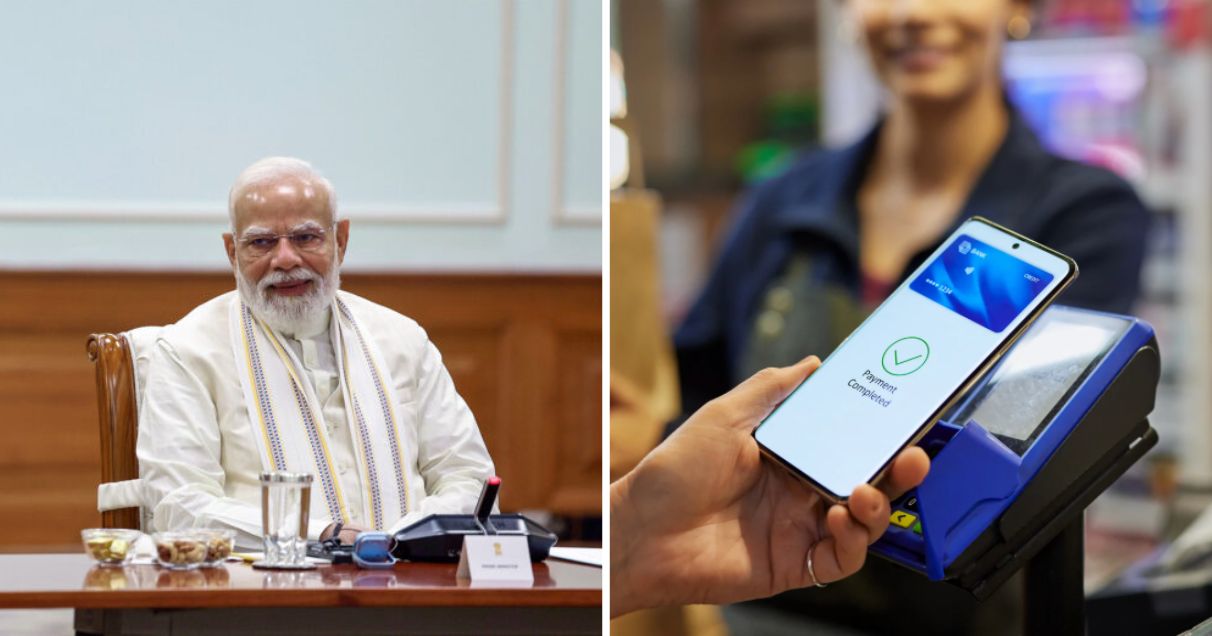
The Centre on Wednesday rejected allegations that its decision to introduce a Merchant Discount Rate (MDR) on certain high-value UPI merchant payments was influenced by the United States, saying India's digital payments policy is determined independently.
The clarification from the Finance Ministry came after Congress leaders linked the new UPI framework to earlier US concerns over India's zero-MDR system and alleged that the move could benefit American payment companies.
The government said the revised framework is aimed at creating a sustainable digital payments ecosystem and reiterated that consumers will not have to pay MDR on UPI transactions.
Government says UPI policy has no foreign link
Responding to the allegations, the Finance Ministry said India's decisions concerning UPI are taken independently, with the stated objective of building a digital payments system that is inclusive, affordable and financially sustainable.
The government has rejected suggestions that the new MDR structure was introduced because of pressure from foreign governments or companies.
Under the new framework, a 0.4 per cent MDR will apply to specified merchant UPI transactions above Rs 2,000, subject to a maximum charge of Rs 300 per transaction.
The government has maintained that the charge will operate within the merchant-side payments ecosystem and will not be collected from consumers.
P2P payments to remain free
The Finance Ministry has reiterated that person-to-person UPI transfers will continue to be free, irrespective of the amount transferred.
Payments to merchants up to Rs 2,000 will also remain outside the MDR framework. According to the government's latest clarification, approximately 96 per cent of person-to-merchant UPI transactions will remain unaffected.
Banks have also been advised to ensure that merchants do not pass the MDR directly on to customers.
The government said there would be no charge for consumers simply for sending money to another person, paying at a shop or using a UPI QR code under the applicable free-payment provisions.
Centre clarifies MDR is not a tax
The Finance Ministry also sought to distinguish MDR from a government levy.
It said the MDR is neither a tax nor a charge collected by the government or NPCI. Instead, the amount is distributed among participants in the payment ecosystem, including banks and payment application providers, to support the operation and expansion of UPI.
The government has said the framework is intended to help strengthen areas such as payment infrastructure, cybersecurity and technological resilience.
Congress alleges US pressure
The government's clarification followed criticism from Congress leaders, who have questioned the rationale and timing of the MDR decision.
Congress general secretary Jairam Ramesh alleged that the move could be linked to US concerns over India's zero-MDR model and asked whether the change was intended to create greater room for American card companies to compete with UPI.
The Congress has also argued that merchants could ultimately pass the additional cost on to consumers through higher prices, despite the government's direction that MDR should not be recovered directly from customers.
These remain political allegations; the Centre has rejected the claim that foreign pressure influenced the policy.
US trade report had flagged UPI concerns
The opposition has pointed to earlier criticism from the US Trade Representative (USTR) concerning the participation of American electronic payment service providers in India's UPI ecosystem.
The USTR had identified aspects of India's digital payments framework as barriers affecting foreign payment service providers, a point Congress leaders have cited while questioning the government's decision.
The Centre, however, has maintained that the new MDR framework was formulated through India's own policy and regulatory process and is intended primarily to support the long-term sustainability of the UPI ecosystem.
The new framework is scheduled to take effect from October 15, with the government maintaining that everyday consumers and the overwhelming majority of low-value merchant transactions will continue to remain outside the charge.