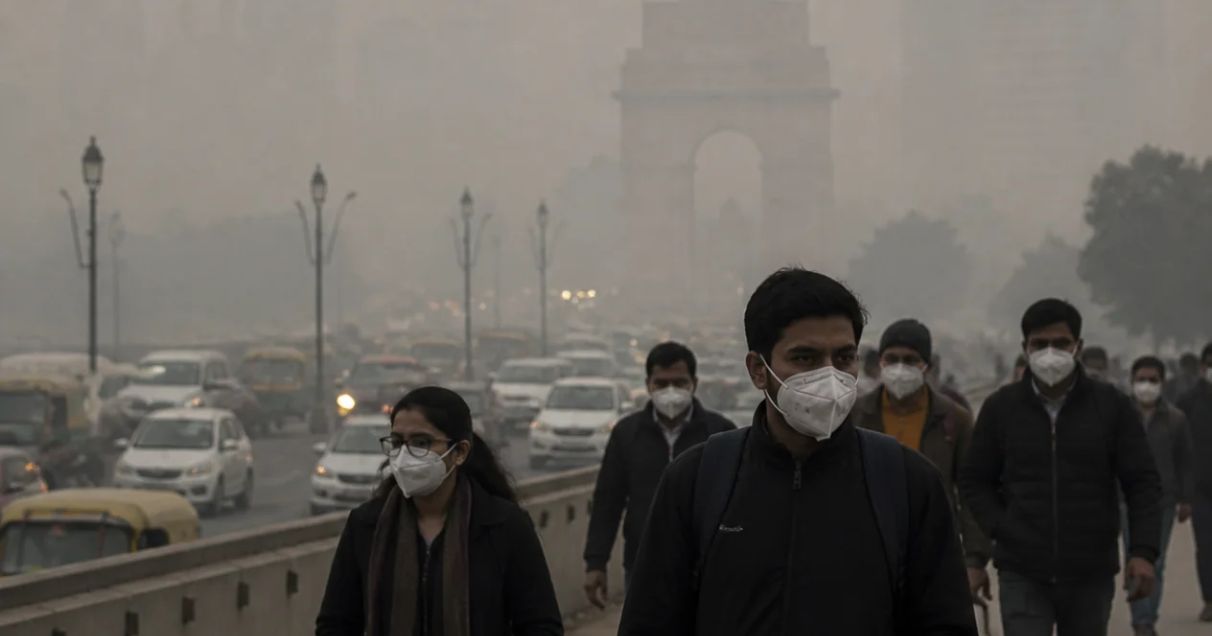
Delhi-NCR has moved to the second stage of the Graded Response Action Plan (GRAP) after air quality deteriorated sharply, with the Commission for Air Quality Management (CAQM) directing authorities to enforce additional pollution-control measures with immediate effect.
The national capital's Air Quality Index (AQI) reached 327 at 6 pm on Monday, placing it in the 'very poor' category, according to the Sameer app. The reading had climbed from 117 on October 31 to 261 the following day before crossing 300 on Monday morning.
The CAQM attributed the worsening conditions to unfavourable weather and said forecasts by the India Meteorological Department and the Indian Institute of Tropical Meteorology suggested that air quality was likely to remain 'very poor' over the next few days.
The latest restrictions come a day after an expanded winter pollution-control plan took effect across the region. Among its provisions are restrictions on the entry and operation of certain non-BS-VI vehicles registered outside Delhi, with exemptions for CNG and electric vehicles and specified categories.
WHAT CHANGES UNDER GRAP STAGE 2?
The second stage adds measures to discourage private vehicle use and curb pollution from commercial establishments and road dust.
Parking fees are set to increase to discourage people from using private vehicles. Hotels, restaurants and open eateries will be barred from using coal and firewood, including in tandoors. Diesel generator sets will also face tighter operating restrictions.
Civic agencies have been instructed to increase mechanical and vacuum-based road sweeping, including additional shifts and longer operating hours. Dust collected during the process must be taken to designated disposal sites.
Water sprinkling with dust suppressants will be carried out daily, preferably before peak traffic hours. Priority will be given to congested roads, busy intersections and identified pollution hotspots.
Authorities have also been asked to intensify inspections at construction and demolition sites and take targeted action based on the main sources of pollution in different areas.
STAGGERED OFFICE HOURS UNDER CONSIDERATION
The CAQM has asked the Delhi government and neighbouring NCR state administrations to consider staggered working hours for government offices and municipal bodies in Delhi, Gurugram, Faridabad, Ghaziabad and Gautam Buddh Nagar.
Other NCR districts may also consider similar arrangements. The Centre has been asked to examine the possibility of staggered timings for its offices in the region.
Resident Welfare Associations have separately been advised to provide electric heaters and electricity connections for security guards, sanitation workers and other outdoor staff. The measure is intended to prevent open burning of biomass and municipal waste during winter.
All authorities must continue implementing GRAP Stage 1 measures alongside the new restrictions.
WINTER POLLUTION PLAN ALREADY IN FORCE
The Delhi government's winter action plan came into effect on Sunday, with measures including dust-control operations, promotion of public transport and awareness campaigns against firecrackers.
The 'No PUC, No Fuel' rule requires motorists to produce valid Pollution Under Control certificates to obtain fuel. The plan also provides for 50 per cent physical attendance in government and private offices, with the remaining employees working from home.
Restrictions on dust-generating demolition and outdoor construction activities are scheduled to remain in place from November 1 to January 31, subject to exemptions.
Separately, the Centre has announced a complete suspension of construction and demolition activities across the National Capital Region from November 5 to November 20.
With the AQI now in the 'very poor' range, authorities across Delhi-NCR have been directed to step up enforcement of the pollution-control measures.