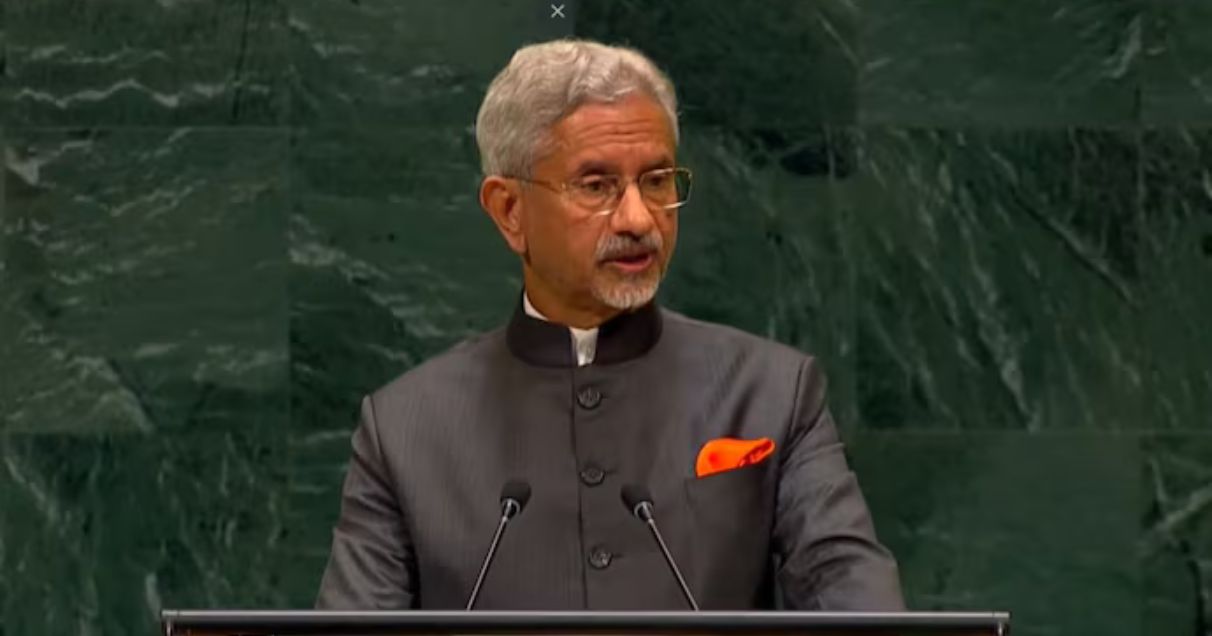
External Affairs Minister S Jaishankar delivered a sharp message on terrorism and cross-border security at the United Nations General Assembly on Saturday, warning that attempts to normalise terrorism or shield those responsible from accountability would not be accepted.
Without naming Pakistan directly, Jaishankar described it as a “serial practitioner of terrorism” and said governments involved in supporting or facilitating terror activities must face consequences. His remarks came a day after Pakistan Prime Minister Shehbaz Sharif spoke at the UNGA and highlighted Pakistan’s military response to India during the 2025 conflict.
Jaishankar’s Message To Pakistan
Addressing the 81st session of the UN General Assembly in New York, Jaishankar referred to the previous day’s remarks without identifying Sharif or Pakistan by name.
“Yesterday, a serial practitioner of terrorism misrepresented facts before this Assembly,” he said.
Jaishankar argued that terrorism could not be treated as a legitimate instrument of state policy and rejected efforts to avoid accountability for those responsible.
“Governments indulging in such practices must be held accountable,” he said, reiterating India’s position that there should be no dilution in its zero-tolerance approach towards terrorism.
‘Right To Defend’ Against Terrorism
Jaishankar also stressed that India would retain its right to respond to terrorist attacks.
His remarks came amid continuing tensions between India and Pakistan following the April 2025 Pahalgam terror attack and the subsequent Indian military operation, Operation Sindoor.
India has said the operation targeted terrorist infrastructure in Pakistan and Pakistan-occupied Jammu and Kashmir following the attack, which killed 26 civilians.
Jaishankar also called for greater international action against the financial infrastructure supporting terrorism, saying terror financing networks needed to be identified and dismantled.
‘Friendship And Goodwill Cannot Coexist With Terrorism’
The External Affairs Minister linked the issue of terrorism to broader diplomatic relations, arguing that sustained cooperation could be affected when terrorism is used as an instrument.
“Friendship and goodwill cannot coexist with terrorism,” Jaishankar said.
He added that the responsibility to change course lay with those involved in terrorism, while reiterating India’s position that cross-border terrorism must have consequences.
India Backs Two-State Solution In West Asia
Moving beyond India-Pakistan tensions, Jaishankar also addressed the situation in West Asia and reaffirmed India’s support for a negotiated two-state solution between Israel and Palestine.
“We strongly believe that a durable and lasting peace requires a two-state solution,” he said.
He also highlighted India’s humanitarian assistance to Palestinians and called for restraint, de-escalation and protection of civilians.
Jaishankar separately raised concerns over attacks affecting commercial shipping and seafarers using international waterways, calling for the protection of maritime commerce and uninterrupted energy flows.
The UN Secretary-General has likewise urged parties in the region to pursue de-escalation, protect civilians and restore navigational freedoms in accordance with international law.
Jaishankar Flags ‘4F Crisis’ Facing Global South
The External Affairs Minister also focused on economic and developmental pressures affecting countries in the Global South.
He described the challenge as a “4F crisis” involving food, fuel, fertiliser and finance, arguing that disruptions across these areas were adding to existing development and food-security concerns.
Jaishankar warned that progress towards the Sustainable Development Goals was facing growing pressure. He also raised concerns over restrictions on market access and practices that, according to India, can hinder the industrialisation efforts of developing economies.
AI, Technology And ‘Weaponisation’ Of Global Interdependence
Artificial intelligence and emerging technologies also featured in Jaishankar’s address.
He warned that AI could reinforce existing biases and said countries needed greater control over the technologies shaping their societies.
The minister also raised concerns about the increasing use of finance, technology, resources, connectivity and market access as instruments of geopolitical leverage.
He argued that the international system needed stronger cooperation and institutions capable of responding to the changing priorities of developing countries.
Jaishankar’s UNGA address therefore combined India’s concerns over terrorism and regional security with broader calls for reform of global institutions, greater accountability and stronger representation for the Global South.