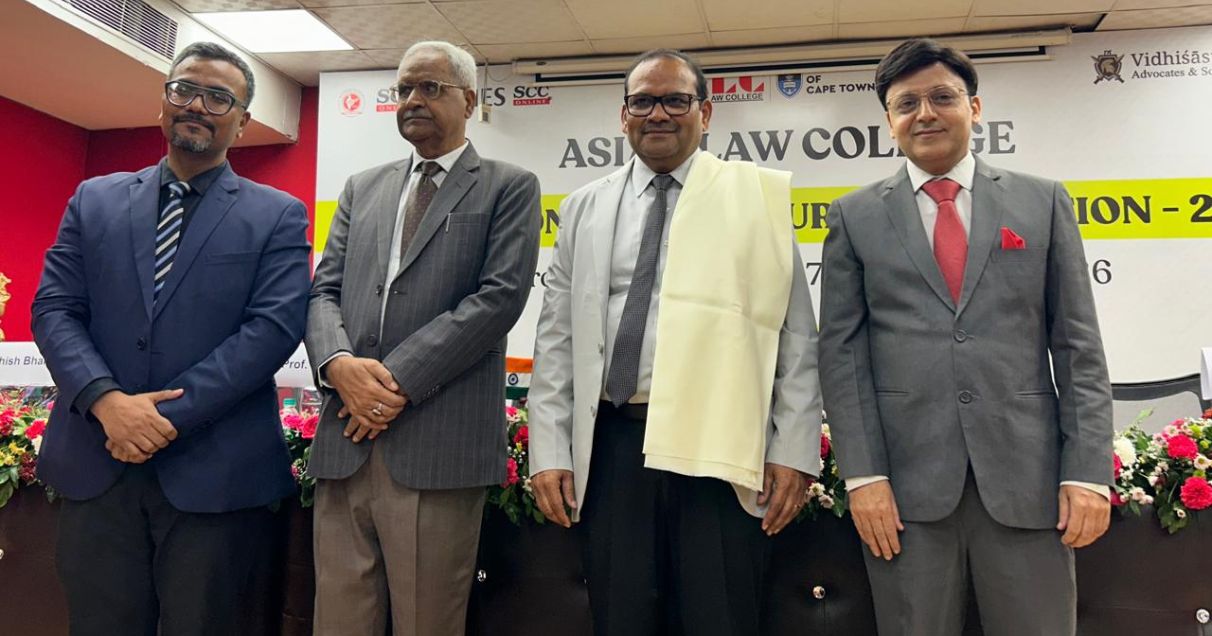
Asian Law College (ALC), Noida, hosted the International Moot Court Competition 2026 on Saturday, 26 September 2026, bringing together law students and members of the legal fraternity for an intensive exercise in advocacy, international law and contemporary legal problem-solving. The competition witnessed participation from teams representing institutions from India and several other countries, including the United Kingdom, Nepal and Indonesia, giving the event a genuinely international character.
The inaugural ceremony was graced by Hon'ble Mr. Justice J. K. Maheshwari, recently retired Judge of the Supreme Court of India, as the Chief Guest. Justice Maheshwari, who has also served as the Chief Justice of the Sikkim High Court and the Andhra Pradesh High Court, addressed the gathering and interacted with the young participants. His presence brought to the competition the perspective of a distinguished judicial career spanning different levels of the Indian judiciary and underscored the importance of sound legal reasoning, disciplined advocacy and professional ethics in the development of aspiring lawyers.
Adv. Nar Hari Singh, Advocate-on-Record, Supreme Court of India, former Additional Advocate General of Jammu & Kashmir and Senior Standing Counsel to the Union Government, attended the programme as the Guest of Honour. In his address to the participants, Mr. Singh highlighted the value of moot court competitions as an important bridge between classroom study and the realities of legal practice. Such exercises require students not merely to know the law, but to identify the decisive issue, research competing authorities, formulate a coherent case theory and defend their submissions under questioning—skills which remain central to effective advocacy before constitutional and appellate courts.
The 2026 competition was structured around a detailed fictional dispute titled “The Case Concerning the Sarneth Valley and Related Matters”, placed before the International Court of Justice between the fictional Kingdom of Aragon and the State of Vizier. The proposition records disputes concerning the conduct of hostilities, migration-control measures and diplomatic relations and requires the teams to address the problem through principles of international law.
Significantly, the moot proposition engages with some of the most rapidly developing questions confronting contemporary international law. One of its central features is the use of artificial intelligence-driven risk profiling in migration control. The fictional State of Aragon establishes “Humanitarian Processing Corridors” employing biometric registration and AI-powered risk-assessment systems, drawing upon telecommunications metadata, contact-chain analysis, behavioural indicators and intelligence inputs. The proposition further raises questions concerning algorithmic transparency, human review and possible structural bias in automated decision-making.
Participants were consequently required to argue four substantial questions: the legality under international law of AI-driven migration risk profiling; responsibility arising from restrictions imposed in a Transitional Security Buffer Zone; possible international responsibility for large-scale cross-border displacement arising from armed conflict; and whether the international-law principle of inviolability of diplomatic premises admits any limitation where diplomatic facilities are alleged to have been used for cyber or transnational security operations.
The proposition therefore enabled participating teams to engage simultaneously with international humanitarian law, State responsibility, refugee and migration concerns, emerging questions surrounding artificial intelligence and algorithmic governance, diplomatic law and cyber-security. By requiring competitors to argue both sides of a complex international dispute, the competition sought to cultivate the ability to distinguish legal principle from policy argument and to respond effectively to questions from the Bench.
The organisation and successful conduct of the competition was made possible through the efforts of the academic and organising teams of Asian Law College. Special appreciation was extended to Prof. Ashish Bharadwaj, Associate Dean, Asian Law College, and Prof. Dr. Saleem Akhtar, Director, Academic Advisory Board, Asian Law College, for their leadership and sustained efforts in organising the international competition and creating a platform through which students from different jurisdictions could interact and test their advocacy skills. During the inaugural programme, Dr. Akhtar addressed the gathering, while Prof. Bharadwaj delivered the Vote of Thanks.
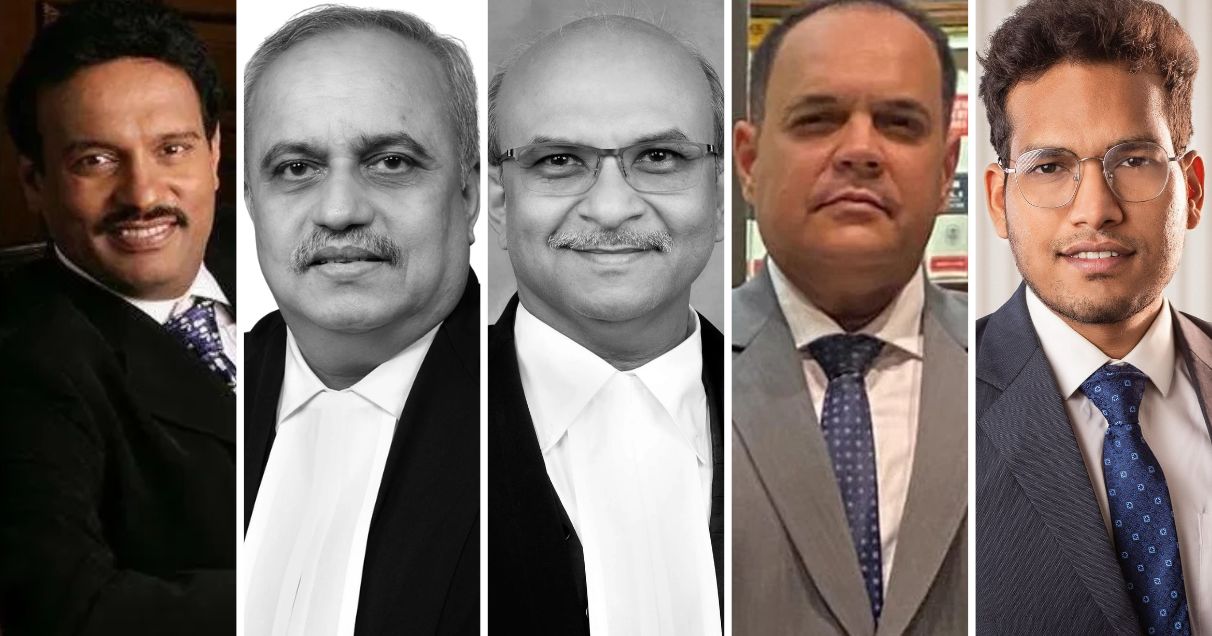
The programme also benefited from the involvement of members of the chambers of Adv. Nar Hari Singh. Adv. Vasudev Sharan Swain, Principal Junior to Mr. Nar Hari Singh, assisted substantially in the conduct and coordination of the Moot Court Competition and in facilitating the advocacy exercise. He was assisted by junior advocates Maanasee Hatkar, Bidisha Das and Aditi Midha, also from the law chambers of Mr. Singh. Their engagement with the competition reflected the valuable role that practising advocates can play in mentoring law students and familiarising them with the standards of preparation, research and courtroom presentation expected in professional practice.
The inaugural programme commenced with the arrival of the Chief Guest and ceremonial lighting of the lamp, followed by addresses by the academic leadership, the Guest of Honour and the Chief Guest. The programme concluded with the felicitation of the guests and a formal vote of thanks.
The Asian Law College International Moot Court Competition 2026 ultimately served not merely as a competitive event, but as a forum connecting legal education with judicial and professional experience. The participation of students from India and abroad, coupled with the involvement of a recently retired Judge of the Supreme Court, senior practitioners and young members of the Bar, reinforced the importance of advocacy training as an integral component of modern legal education. The event demonstrated how moot court exercises can prepare the next generation of lawyers to engage with increasingly complex questions at the intersection of law, technology, human rights, armed conflict and international relations