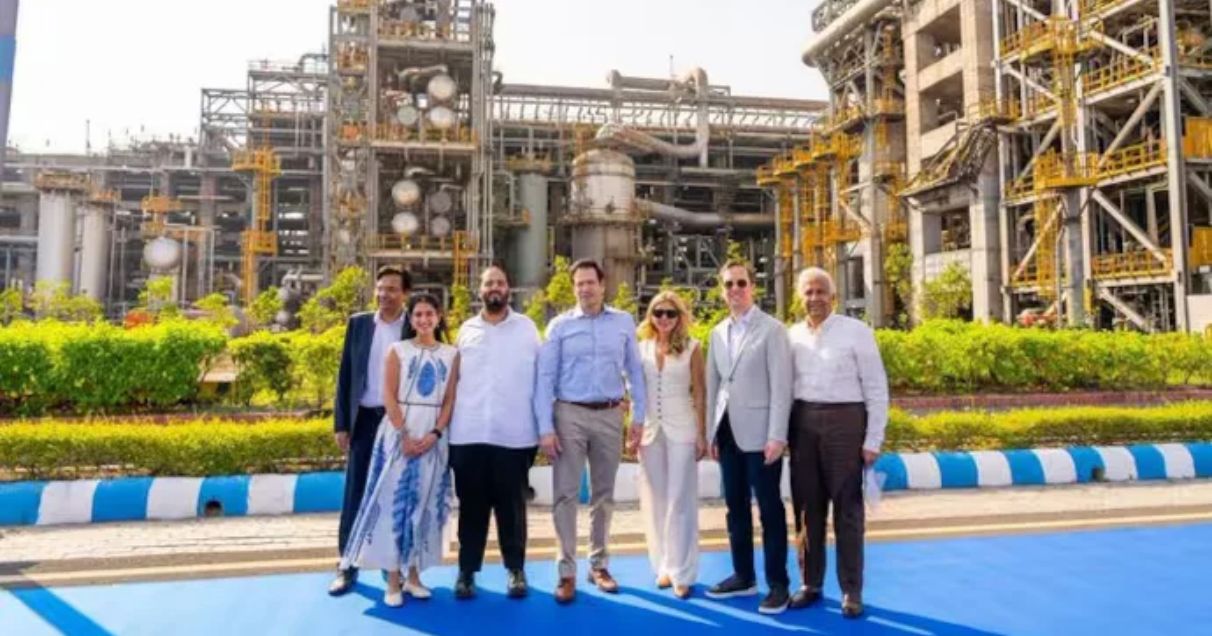
US Secretary of State Marco Rubio visited Reliance Industries’ sprawling Jamnagar complex in Gujarat on Wednesday, bringing one of India’s most influential industrial groups into focus as Washington and New Delhi seek to expand cooperation in the energy sector.
Reliance chairman Mukesh Ambani, his wife Nita Ambani and their children, Isha and Anant, reportedly welcomed Rubio during the visit, which included the company’s massive oil-refining operations, its Vantara wildlife rescue centre and its emerging clean-energy manufacturing facilities.
The programme was described by officials as a private visit, and neither side publicly disclosed detailed discussions. However, the itinerary brought together three major areas of Reliance’s business: conventional energy, conservation and renewable-energy technology.
US highlights surge in India's LPG imports
US Ambassador to India Sergio Gor, who accompanied Rubio, pointed to the expansion of energy trade between the two countries. He said India’s imports of US liquefied petroleum gas (LPG) had climbed from below 10% to 67% over the preceding year, making the US India’s largest supplier of the fuel.
Gor also highlighted Reliance’s proposed investment in a new oil refinery in the United States, presenting the project as an opportunity to expand domestic refining capacity and generate employment.
The visit followed Rubio’s remarks a day earlier describing India as a global refining powerhouse. He had also called on the country to process more Venezuelan crude, placing India’s extensive refining infrastructure at the centre of a broader discussion about international oil supplies.
Why Jamnagar matters to Washington
Reliance’s Jamnagar complex is among the most strategically significant refining hubs in the global oil industry. With the capacity to process approximately 1.4 million barrels of crude per day, the facility is the world’s largest single-site refinery and a major exporter of refined petroleum products.
Its ability to process substantial volumes of crude and supply fuels to international markets gives it an important role in global energy trade. For the US, closer commercial ties with Reliance could create opportunities to sell more energy products and strengthen links with a major refining market.
The timing of Rubio’s visit has also drawn attention to fuel prices in the US, where diesel costs have risen ahead of the midterm elections. Analysts see refining capacity and access to crude supplies as important considerations in Washington’s energy strategy.
Reliance’s Texas refinery project adds another dimension
The relationship extends beyond Indian purchases of American energy. Reliance is also involved in plans for a new refinery in Brownsville, Texas, a project announced by US President Donald Trump.
The proposed facility is expected to have a capacity of 168,000 barrels per day and is designed to process light shale crude produced in the United States. If completed as planned, it would be the first major new refinery built in the country in roughly 50 years.
The project would allow Reliance to establish a larger refining presence closer to US crude production, while potentially supporting American manufacturing and employment. Together, the Texas proposal and the Jamnagar complex illustrate the two-way nature of the companies’ energy ambitions.
For Washington, the prospect of processing more Western Hemisphere crude at Jamnagar could offer another route to international fuel markets. For Reliance, investment in the US would deepen its position as both an energy buyer and an overseas investor.
Rubio visits Ambani’s wildlife conservation project
Energy was not the only focus of the secretary of state’s itinerary. Rubio also toured Vantara, the animal rescue, rehabilitation and conservation initiative established by Reliance Industries and the Reliance Foundation in Jamnagar.
The centre, conceived by Anant Ambani, covers approximately 3,000 acres within the green belt of the refinery complex. According to figures provided by the organisation, it houses more than 2,000 animals representing 43 species and has a workforce of around 2,100 caregivers and conservation professionals.
Vantara says its rescue efforts have included more than 200 elephants, alongside thousands of other animals, reptiles and birds. Its work combines animal care, rehabilitation and conservation programmes.
Clean energy manufacturing also on the itinerary
Rubio’s final major stop was the Dhirubhai Ambani Green Energy Giga Complex, Reliance’s planned integrated manufacturing hub for clean-energy technologies.
The project is designed to cover several parts of the energy supply chain, including solar power equipment, energy storage, fuel cells, electrolysers and power electronics. Reliance is developing the complex on a site spanning around 5,000 acres, with an expected investment of Rs 75,000 crore, or approximately $10 billion.
The facility reflects the company’s push to expand beyond its established oil-refining and petrochemicals businesses into clean-energy manufacturing.
Rubio’s visit to the three facilities showcased the breadth of Reliance’s operations, from conventional fuels and international refining to wildlife conservation and renewable-energy technology. While the discussions were not publicly detailed, the itinerary underscored the company’s growing relevance to the commercial relationship between India and the United States.