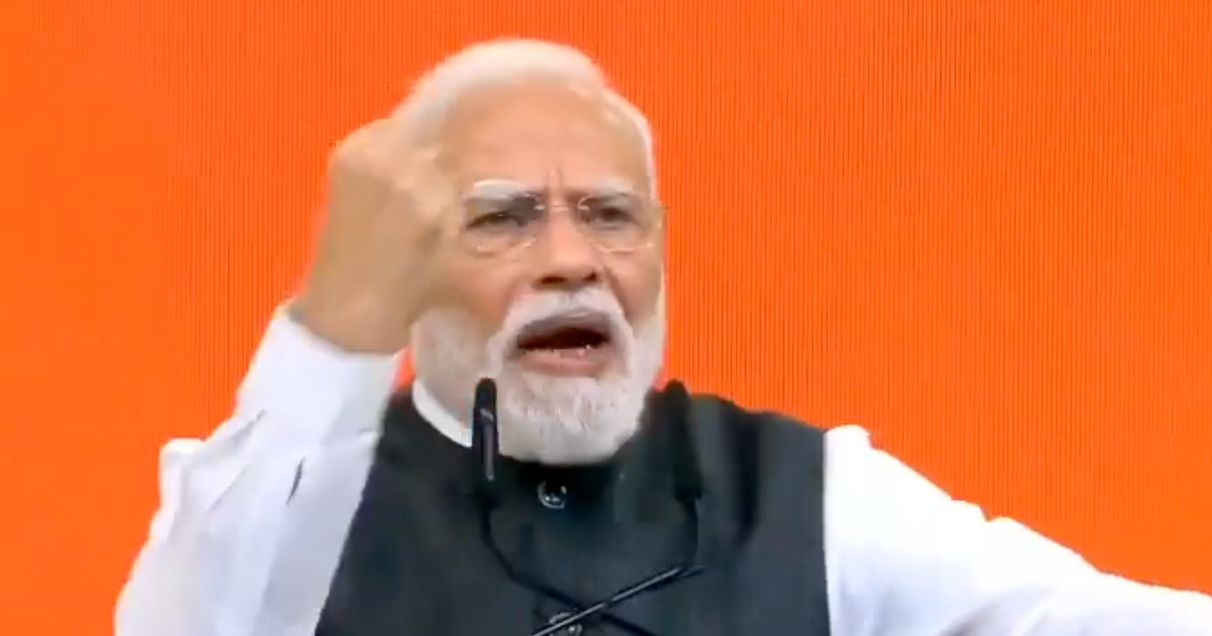
Prime Minister Narendra Modi marked 25 years since he first took office as Gujarat chief minister on Wednesday by calling on Indians to adopt an ambitious national outlook, using the slogan “We will do it” to underline his message.
Addressing a gathering at the Indira Gandhi Indoor Stadium in New Delhi, Modi outlined three major national ambitions — taking India into the world’s top three economies, hosting the Olympic Games and sending Indians into space.
Each time Modi mentioned one of the goals, the audience responded with the phrase “We will do it”, turning the speech into a repeated call-and-response.
Modi said the occasion should not be viewed merely as a milestone in his political career but as an opportunity to renew the country’s commitment to larger goals.
“Today is not just a day for memories. It is a day to fill our resolve with new energy,” Modi said, urging people to repeat the pledge to achieve bigger national objectives.
From Gujarat CM to Prime Minister
Modi was sworn in as Gujarat chief minister on October 7, 2001, succeeding Keshubhai Patel. He went on to serve as the state’s chief minister for three consecutive terms before becoming prime minister in 2014.
Marking the 25-year milestone, Modi said he paid tribute to party workers and supporters who had accompanied him through his political journey.
He also linked the anniversary to a broader call for national development, saying India should not settle for modest or easily achievable objectives.
“This is the time when we, as a nation, should set big goals,” he said.
Three targets for India
The three objectives highlighted by Modi covered the economy, space exploration and India’s ability to host a major global sporting event.
Modi reiterated the goal of making India a developed country by 2047, while identifying a place among the world’s three largest economies as a key economic ambition.
He also called for India to host the Olympic Games and for the country to send its citizens into space.
The targets come against the backdrop of India’s expanding economic and technological ambitions, as well as its efforts to increase its presence on the global stage.
Modi highlights India’s resilience
In his address, Modi contrasted India’s current economic position with the challenges faced by the country in previous decades.
He referred to global disruptions caused by the Covid-19 pandemic, the Russia-Ukraine war and conflict in the Middle East, arguing that India had demonstrated greater resilience during periods of international uncertainty.
“Whenever a crisis struck in the past, India’s economy would be shaken. Today, when a crisis comes, India’s strength is discussed,” Modi said.
He also highlighted the government’s emphasis on reforms and exports, contrasting it with what he described as an earlier period of “policy paralysis”.
According to Modi, India’s response to successive global crises demonstrated that the country had greater confidence in determining its own economic future.
A message on ambition
Modi said the scale of India’s potential required equally ambitious objectives.
He argued that pursuing small or easily achievable targets would not match the country’s capabilities and urged citizens to think beyond incremental progress.
“Today, we ourselves are the makers of our destiny,” he said.
The prime minister’s address comes amid a politically active period, with Opposition parties and civil society groups staging protests over several issues, including electoral-roll revisions and the functioning of the Election Commission.
Against that backdrop, Modi’s speech placed the emphasis on long-term national goals, economic growth, technological advancement and India’s aspirations to host major international events.