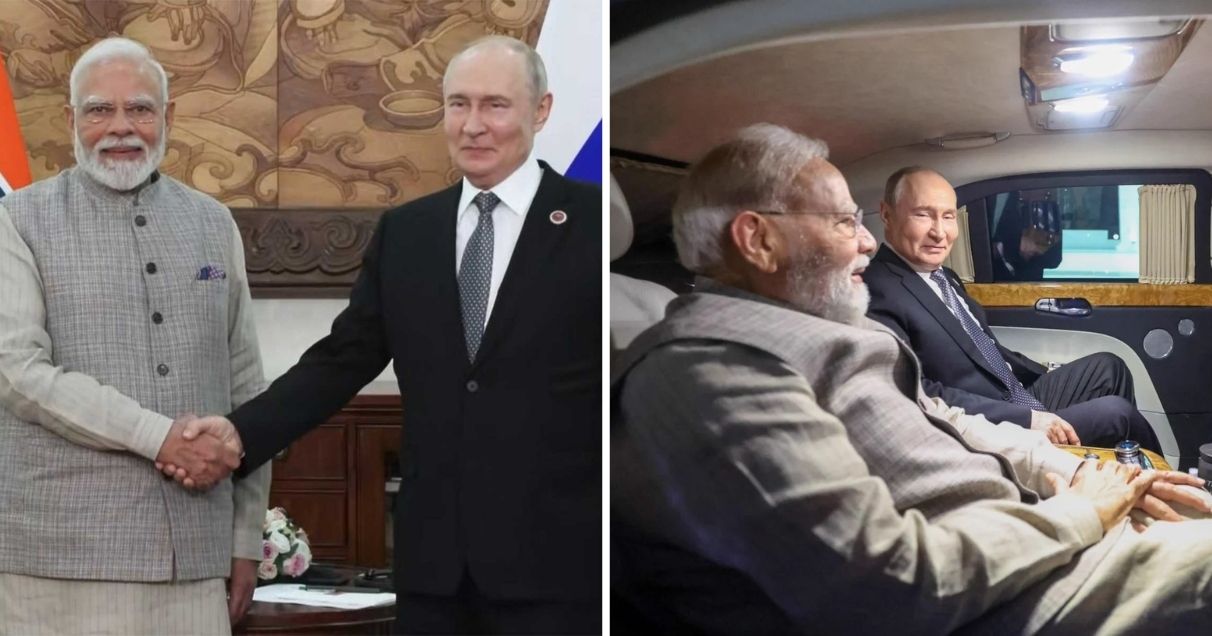
Prime Minister Narendra Modi met Russian President Vladimir Putin on the sidelines of the Shanghai Cooperation Organisation summit in Bishkek on Monday, using the high-level bilateral meeting to reiterate India's call for an early and peaceful resolution of the Ukraine conflict.
During approximately 30 minutes of talks, Modi conveyed that prolonged warfare ultimately comes at a cost to humanity and that diplomatic efforts must remain focused on bringing hostilities to an end.
The Prime Minister positioned India's approach within its longstanding advocacy of dialogue and diplomacy, invoking the country's association with Mahatma Gandhi and Gautam Buddha to underline New Delhi's preference for peaceful solutions to international disputes.
The meeting also provided Modi and Putin an opportunity to review the wider India-Russia relationship, with trade, investment, defence and energy featuring prominently in their discussions.
Modi and Putin share warm greeting
The personal warmth between the two leaders was visible before formal discussions began.
Modi walked towards Putin as the two leaders met, with the interaction beginning with a handshake and an embrace.
The Prime Minister subsequently shared footage from their meeting on social media, describing meeting the Russian President as a pleasure.
Their interaction comes amid continuing international attention on India's relationship with Moscow as the Ukraine conflict remains unresolved.
New Delhi has consistently maintained that dialogue and diplomacy offer the only sustainable route towards resolving the crisis.
In Bishkek, Modi again emphasised that every additional day of conflict represents lost opportunities for humanity, while progress towards peace creates renewed hope.
His broader message was that the international community must increasingly concentrate on how wars can be concluded rather than allowing conflicts to continue indefinitely.
India carries a message of peace
Modi framed India's position not merely as a matter of foreign policy but as an extension of the country's philosophical traditions.
Referring to the legacies of Gandhi and Buddha, the Prime Minister said India's message to the world remained centred on peace.
He stressed the importance of finding peaceful solutions to disputes at the earliest possible opportunity and reiterated India's willingness to support constructive initiatives aimed at ending conflict.
At the same time, Modi indicated that India and Russia could continue advancing their bilateral partnership while respecting their respective national interests.
Putin praises strength of India-Russia relationship
Putin, meanwhile, highlighted the continued development of ties between Moscow and New Delhi and credited Modi's personal attention with contributing to the relationship's momentum.
People-to-people exchanges are also expanding. Tourist movement between India and Russia reportedly increased by around 16 per cent in 2025, reflecting another dimension of the growing engagement between the two countries.
The relationship extends across several strategically important sectors, particularly defence and energy, while both governments have increasingly sought to broaden economic cooperation into new areas.
Trade and investment consequently formed part of Monday's discussions alongside the traditional pillars of the partnership.
Modi recalls Putin's India visit
The Prime Minister also referred to Putin's previous visit to India, describing it as an important moment in bilateral relations.
According to Modi, decisions taken during the Delhi engagement helped push economic cooperation forward and generated substantial follow-up work for officials on both sides.
The two governments have since been working to translate those understandings into concrete outcomes.
Attention is now turning towards Putin's next India visit.
The Russian President is expected in India for the annual BRICS summit, providing another opportunity for the two leaders to continue discussions on bilateral cooperation as well as major international developments.
Modi indicated that India was looking forward to welcoming Putin and expressed confidence that another visit would add momentum to the relationship.
Defence, energy and trade remain central
India and Russia share a relationship stretching back decades, with defence traditionally forming one of its strongest foundations.
Russia remains an important defence partner for India, while energy cooperation has acquired even greater significance in recent years.
Trade and investment have similarly become increasingly important as both governments seek to diversify the economic relationship beyond its traditional areas.
The Bishkek meeting therefore served two purposes: addressing the immediate geopolitical challenge posed by the continuing Ukraine conflict while simultaneously looking ahead to the next stage of India-Russia ties.
‘Car diplomacy’ makes another appearance
Beyond formal meetings, Modi and Putin continued a form of personal diplomacy that has become increasingly visible during their recent interactions.
The two leaders travelled together by car in Bishkek on their way to watch the World Nomad Games.
Such shared journeys have emerged as an informal feature of Modi-Putin engagements, providing the leaders additional time together away from the highly structured environment of official bilateral meetings.
A similar display of what has come to be described as “car diplomacy” was witnessed around their previous SCO and India engagements.
The symbolism was evident once again in Bishkek: even as international politics remains dominated by wars, sanctions and competing strategic interests, New Delhi and Moscow continue to demonstrate that their bilateral relationship retains both strategic depth and considerable personal warmth at the leadership level.
For Modi, however, the central public message from Bishkek extended beyond India-Russia relations.
As the Ukraine conflict continues, India's position remains that diplomacy must ultimately replace the battlefield.
From the SCO table in Bishkek, Modi’s message was simple: the world has spent enough time managing wars — it must now find ways to end them.