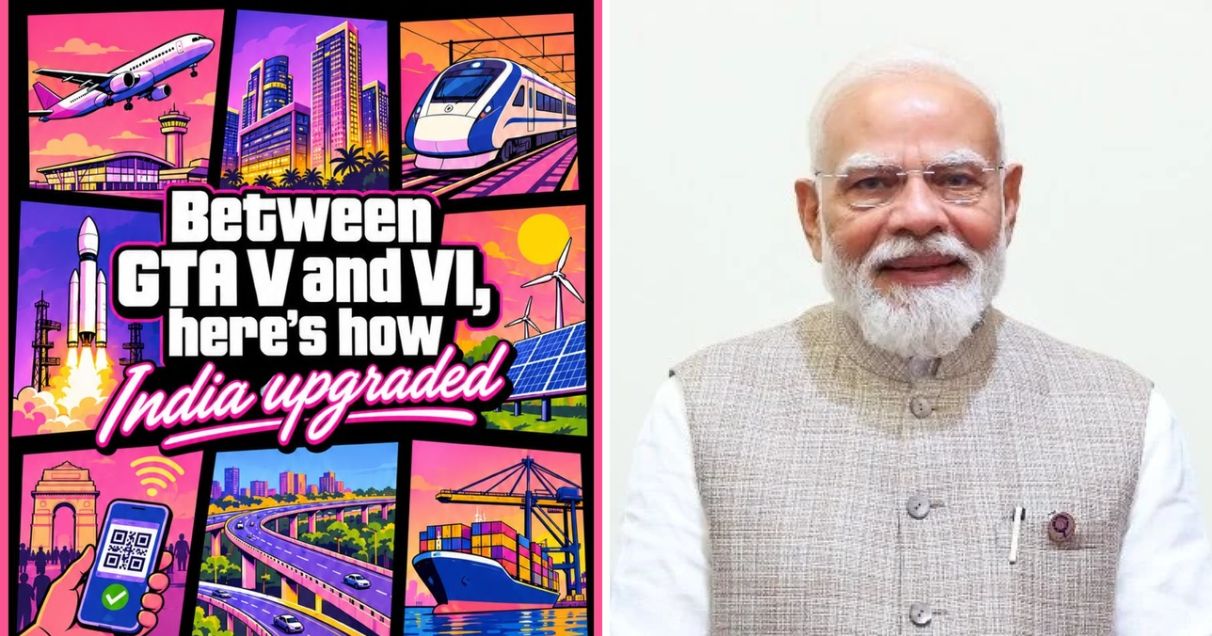
Prime Minister Narendra Modi has used a series of video game-inspired visuals to present India's development story, drawing on the style of Grand Theft Auto VI to connect government achievements with a younger, digitally engaged audience.
Sharing the post on X, Modi wrote: “India is playing a whole new game!” The accompanying graphics adopt the look and feel of the much-anticipated game, pairing bold visuals with figures that highlight changes in the country's social and economic indicators.
One of the key comparisons focuses on rural sanitation. The post puts coverage at 39 per cent in the earlier period and 100 per cent in the latest figures, presenting the expansion as a major development milestone.
The visuals also draw attention to the decline in extreme poverty, showing a fall from 27 per cent to 2.6 per cent. The improvement is set against broader assessments indicating that millions of people have moved out of poverty since 2011. World Bank data and economic reports have also documented significant changes in India's poverty levels, although estimates can vary depending on the methodology and period considered.
Economic performance forms the third part of the message. The post contrasts India's earlier description as part of the 'Fragile Five' economies with its current position as the fastest-growing major economy, underscoring the country's changing standing in the global economic landscape.
The presentation has attracted attention for its unconventional format. Rather than relying on a traditional list of policy achievements, the post uses gaming imagery and internet humour to package development figures in a way that is likely to resonate with younger users.
Several reactions welcomed the creative approach, describing it as a meme-friendly way of communicating India's progress. Some users likened the country's transformation to a 'redemption arc' — a popular online expression for a dramatic turnaround.
By borrowing the visual language of a globally recognised gaming franchise, Modi's post places familiar development claims within the fast-moving culture of social media, where humour, pop culture and political communication increasingly overlap.