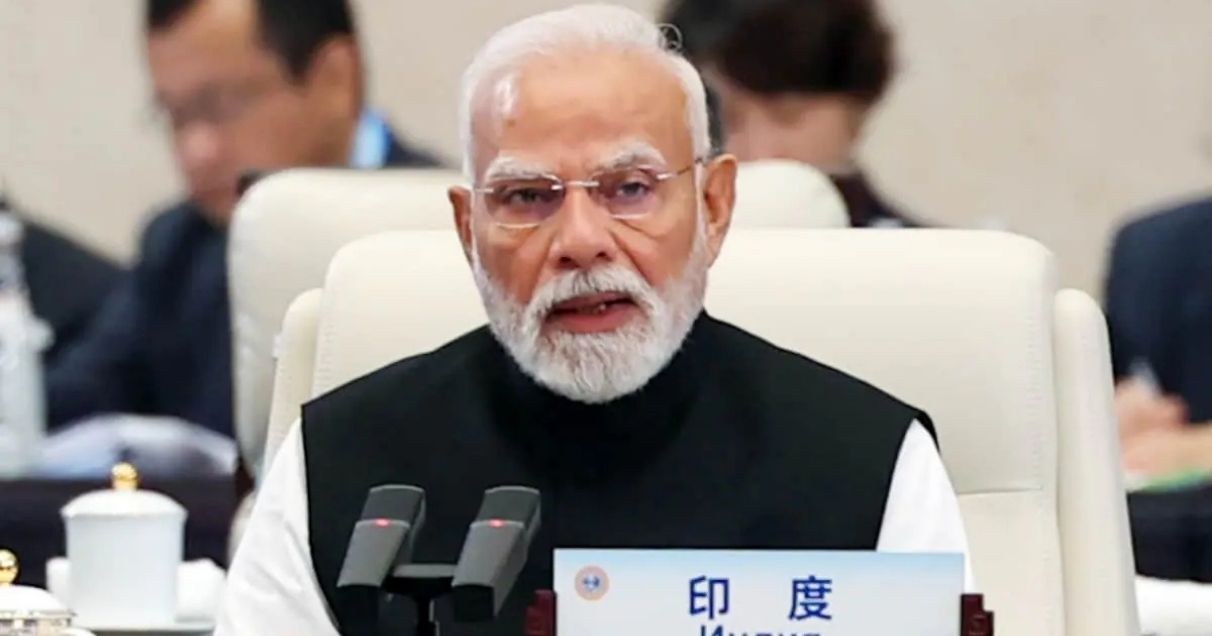
Prime Minister Narendra Modi delivered an unequivocal message against terrorism at the 26th Shanghai Cooperation Organisation Summit in Bishkek on Tuesday, calling upon member states to act collectively against not merely terrorists but the entire network that finances, shelters and supports them.
Speaking during the SCO leaders' roundtable, Modi warned against selective approaches to terrorism and said countries could not apply different standards depending upon their strategic interests.
The remarks assumed particular significance because Pakistan Prime Minister Shehbaz Sharif was among the leaders present at the table.
Modi argued that terrorism must never be regarded as a useful instrument of statecraft or a strategic asset. Without naming an individual country, he called for a firm international message to states that provide terrorists with support or sanctuary.
The Prime Minister's intervention placed security at the centre of India's message to the SCO, but his address ranged considerably further — from the wars affecting West Asia and the Global South to drug trafficking, trade corridors, national sovereignty and people-to-people exchanges.
Modi calls for action against terror ecosystem
For New Delhi, Modi made clear, combating terrorism requires confronting the infrastructure that enables it to survive.
His emphasis was on eliminating the broader ecosystem behind terrorism rather than limiting action to individual perpetrators.
He called upon SCO members to demonstrate unity on the issue and reject what India regards as double standards in the global response to terrorism.
The Prime Minister's comments were delivered in the presence of several of Eurasia's most powerful leaders.
Alongside Modi and Sharif, the roundtable included Chinese President Xi Jinping, Russian President Vladimir Putin, Iranian President Masoud Pezeshkian, Belarusian President Alexander Lukashenko, Kazakhstan President Kassym-Jomart Tokayev, Uzbekistan President Shavkat Mirziyoyev and Tajik President Emomali Rahmon.
Conflict no longer stays within borders
Modi broadened his security argument by pointing to the consequences of modern conflicts far beyond the territories in which they originate.
The Prime Minister said an increasingly interconnected global economy had dramatically expanded the meaning of security.
Developments in West Asia, he argued, demonstrate how instability in one part of the world can rapidly affect energy supplies, shipping routes, international trade and global supply chains.
Such disruptions frequently impose their greatest economic burden on developing countries and the Global South.
Against this background, Modi reiterated India's longstanding position that military confrontation cannot provide lasting answers to international disputes.
New Delhi, he said, continues to favour dialogue and diplomacy as the route for resolving wars and geopolitical tensions.
The comments followed Modi's meeting with Putin in Bishkek, during which the Prime Minister had similarly called for efforts to bring the Ukraine conflict to an end.
Narco-terrorism emerges as another major concern
Modi also identified narcotics trafficking as a serious regional security challenge.
Drug networks, he argued, cannot be viewed merely as conventional criminal enterprises because their consequences extend to young people, organised crime and the wider security environment.
The Prime Minister called for greater coordination between SCO countries against narcotics networks and welcomed the development of institutional mechanisms within the organisation to deal with organised crime, information-security threats, drugs and other security challenges.
The next challenge, according to Modi, will be ensuring that these institutions become operationally effective rather than remaining merely institutional structures.
He called for mechanisms capable of facilitating practical cooperation and rapid responses among member countries.
Connectivity yes, but sovereignty must come first
Modi also used the SCO platform to reiterate an important element of India's approach towards international infrastructure projects.
India supports stronger connectivity, easier trade and infrastructure capable of opening new economic opportunities, he said, but such projects must respect the sovereignty and territorial integrity of individual countries.
The formulation has considerable geopolitical significance given competing connectivity initiatives across Asia.
New Delhi has consistently maintained that major international infrastructure corridors cannot disregard sovereignty concerns.
Modi linked that principle directly to the SCO Charter.
The Prime Minister also argued that the definition of connectivity itself is changing.
Roads, railways and aviation links will remain important, but the next generation of regional integration will increasingly depend upon efficient customs systems, digital paperwork and better logistics networks.
Reducing bureaucratic friction at borders could therefore become as important to regional commerce as constructing physical infrastructure.
SCO cooperation must reach ordinary citizens
The third major element of Modi's address was opportunity.
The Prime Minister argued that the ultimate test of the SCO's effectiveness should not simply be the number of declarations, summits or institutional mechanisms it produces.
Its success should instead be visible in the lives of citizens.
Modi described people-to-people relationships as one of the organisation's greatest assets and portrayed the SCO region as a meeting point of ancient civilisations, cultures and intellectual traditions.
As the organisation looks towards its next quarter-century, he called for greater emphasis on exchanges between citizens.
For Modi, the practical measurement of regional cooperation should be whether it creates opportunities for young people, businesses, entrepreneurs and farmers.
Modi interacts with Xi and Putin
Earlier, SCO leaders assembled for the summit's traditional group photograph.
Modi was seen interacting briefly with Xi and Putin around the photo session.
The Indian Prime Minister and the Chinese President shook hands and exchanged a few words before the leaders posed together.
Sharif was subsequently seen approaching Putin following the photograph.
The informal exchanges came amid a packed diplomatic schedule for Modi in Bishkek.
On Monday, he held separate bilateral discussions with Putin and Iranian President Masoud Pezeshkian on the sidelines of the summit.
A formal bilateral meeting between Modi and Xi was not expected.
But it was Modi's intervention on terrorism that provided one of India's clearest messages from the SCO table.
With leaders from India, Pakistan, China, Russia, Iran and Central Asia sitting together, Modi sought to establish a simple principle: terrorism cannot be condemned selectively while networks supporting it are tolerated for strategic convenience.
For India, the message from Bishkek was unmistakable — there can be no distinction between a terrorist and the ecosystem that finances, shelters or uses terrorism for strategic ends.