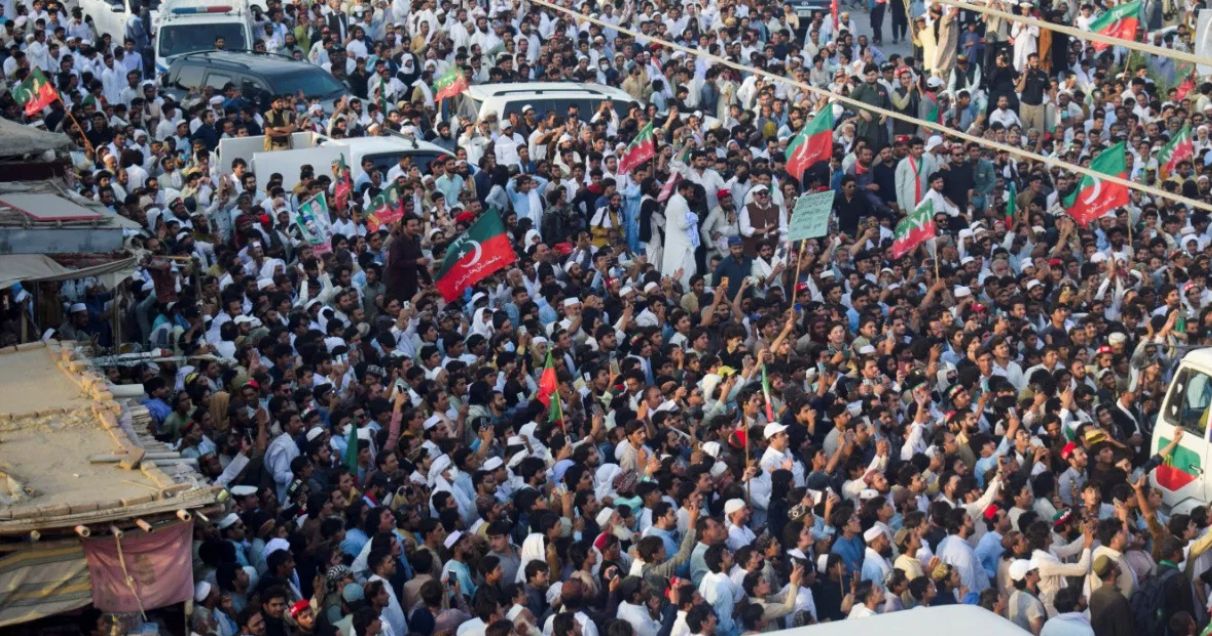
Pakistan’s federal government is considering imposing governor’s rule or declaring an emergency in Khyber Pakhtunkhwa as a protest march led by the Pakistan Tehreek-e-Insaf (PTI) moves towards Islamabad, according to Pakistani media reports.
The PTI, founded by jailed former prime minister Imran Khan, began its march on Sunday, October 4, from Lakki Marwat in Khyber Pakhtunkhwa. The demonstration is being led by provincial Chief Minister Sohail Afridi and is aimed at pressing for Khan’s release.
The march began after negotiations between the PTI and the federal government failed to produce an agreement. According to reports, the protesters had initially planned the mobilisation for September 27.
By late Sunday, the procession had reached Karak district, around 256 kilometres from Islamabad, according to Dawn.
The developing confrontation has raised the possibility of direct intervention by the federal government in the PTI-governed province. Government sources cited by Dawn said Islamabad was seriously examining the option of governor’s rule, while another report said an emergency could be imposed soon.
KP Governor Warns Of Emergency
Khyber Pakhtunkhwa Governor Faisal Karim Kundi has openly raised the possibility of emergency rule in the province.
Speaking to reporters on Sunday, Kundi said an emergency could be imposed if authorities considered it necessary to protect the province. He also warned PTI supporters participating in the march.
Kundi subsequently met Federal Interior Minister Mohsin Naqvi in Peshawar to discuss the security and political situation in KP.
According to a statement issued by the Governor’s House, the meeting focused on concerns surrounding the Islamabad march and the possibility that security checkpoints could be compromised.
The statement said the two officials believed that the provincial government’s position during discussions over counterterrorism operations had contributed to the current situation. It added that if Pakistan’s president and prime minister considered governor’s rule or emergency measures necessary to protect the province from terrorism and destruction, the governor would fulfil his constitutional responsibilities.
Kundi later said on X that KP Inspector General of Police Zulfikar Hameed and the provincial chief secretary had also attended the meeting.
“Security of our people remains our foremost priority,” Kundi said, according to his post, adding that the province had suffered significant losses from terrorism.
Federal Government Accuses PTI Of Security Failures
The debate over emergency rule comes amid growing tensions between Islamabad and the PTI-led provincial government over counterterrorism policy.
Federal officials have accused the KP government of failing to cooperate adequately with the Centre on efforts to combat militant groups.
Defence Minister Khawaja Asif also accused PTI leaders of facilitating terrorism in the province in a post on X.
A federal government source cited by Dawn said Islamabad believed its demands for greater provincial cooperation against militancy were justified and claimed that the PTI’s decision to proceed with the march had made the imposition of emergency measures increasingly likely.
The allegations have been rejected in substance by the PTI, which has argued that counterterrorism decisions should involve consultation between the federal and provincial governments rather than unilateral federal control.
Minister of State for Interior Talal Chaudhry has also compared the PTI’s protest strategy with that of the banned Joint Awami Action Committee (JAAC), which has previously led protests in Pakistan-occupied Kashmir.
Why Did PTI Talks With Islamabad Collapse?
The march was launched after negotiations between PTI representatives and federal officials broke down.
The two sides reportedly disagreed over both the proposed march and the handling of counterterrorism operations in Khyber Pakhtunkhwa.
Federal negotiators wanted the PTI to call off the mobilisation, while the party sought guarantees and commitments before agreeing to withdraw.
Counterterrorism emerged as one of the main areas of disagreement. The federal side reportedly wanted commitments from the KP government on preventing militant safe havens, opposing the Tehreek-e-Taliban Pakistan (TTP), cooperating on Afghan refugee policy and strengthening coordination with security agencies.
The PTI, meanwhile, reportedly objected to what it viewed as an attempt by the Centre to assume greater control over counterterrorism operations in the province.
Its negotiators called for greater federal-provincial consultation and participation from political and tribal representatives. They also sought access to Imran Khan and assurances regarding his medical treatment.
With the talks deadlocked, Afridi proceeded with the march on Sunday.
Emergency Rule Had Been Discussed Earlier
The possibility of imposing direct federal control in Khyber Pakhtunkhwa is not new.
Interior Minister Mohsin Naqvi had warned in September that Islamabad was examining legal options, including governor’s rule, if the PTI went ahead with its planned march.
The issue resurfaced on September 30, when Parliamentary Affairs Minister Tariq Fazal Chaudhry said the possibility of emergency rule in KP was being seriously considered.
Dawn subsequently reported that the option had also been discussed at a meeting involving President Asif Ali Zardari and Prime Minister Shehbaz Sharif on September 30. The proposal was ultimately set aside at that stage as the government opted to pursue negotiations with the PTI.
Those talks have now collapsed, with the PTI moving ahead with its march towards the capital.
The immediate focus is therefore on whether the federal government will impose emergency measures in Khyber Pakhtunkhwa as the protesters continue their journey towards Islamabad.