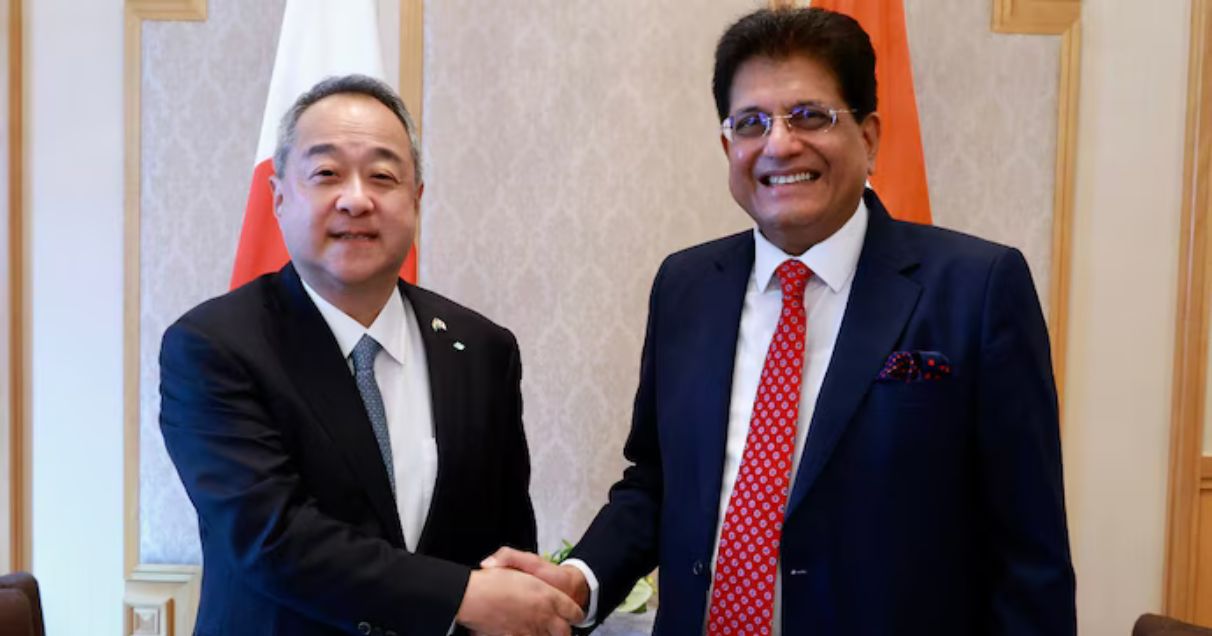
Union Commerce Minister Piyush Goyal has made a strong pitch for greater Japanese investment in India, positioning the country as a dependable destination for companies looking to expand their global operations.
Speaking to investors in Tokyo, Goyal highlighted India's business environment and contrasted it with the uncertainty that entrepreneurs may face in some other markets. Without naming China, the minister appeared to take a swipe at Beijing's treatment of prominent business leaders.
Goyal told the gathering that entrepreneurs in India could build successful businesses without fearing that their success would put them at risk of suddenly disappearing from public life.
His remarks appeared to draw an indirect comparison with Alibaba founder Jack Ma, whose public appearances became rare after he criticised Chinese regulators in 2020.
Jack Ma reference draws attention
Ma's troubles began after his criticism of China's regulatory system. Soon afterwards, the planned initial public offering of Ant Group, the financial technology company linked to Alibaba, was halted by Chinese authorities.
The Ant Group listing was expected to become the world's biggest IPO at the time. Alibaba subsequently faced a $2.8-billion anti-monopoly penalty as Beijing intensified its regulatory scrutiny of major technology companies.
Ma subsequently stepped back from the spotlight and reduced his involvement in his business empire. His extended absence triggered widespread speculation about his whereabouts and whether he had faced restrictions from Chinese authorities.
He later began appearing publicly again, including in 2023 when he took up a visiting academic position at the University of Tokyo. He has also maintained an association with the University of Hong Kong's business school.
Goyal's reference to an entrepreneur eventually resurfacing as a university professor was therefore widely interpreted as an allusion to Ma's experience.
India seeks bigger Japanese footprint
The minister's comments came as he led a large Indian business delegation during a four-day visit to Japan. More than 200 Indian business representatives are accompanying him as New Delhi seeks to strengthen economic ties with Japanese companies.
Japan is already among India's biggest sources of foreign investment. Between 2000 and 2026, Japanese companies invested around $48.14 billion in India.
Tokyo has also set an investment ambition of approximately Rs 60,000 crore for India over the coming decade.
However, the relationship continues to face challenges, particularly India's sizeable trade deficit with Japan. New Delhi is therefore looking to attract more Japanese manufacturing and technology investments that can strengthen domestic production and exports.
Goyal specifically identified areas such as semiconductors, artificial intelligence, clean energy and advanced manufacturing as sectors where Japanese companies could play a larger role.
'India is not merely a China-plus-one destination'
A central part of Goyal's message was that India should not be viewed simply as another location for companies attempting to reduce their dependence on China.
Global businesses have increasingly been exploring alternative manufacturing bases and supply chains amid geopolitical tensions and disruptions to international trade.
Goyal argued that India deserves to be considered independently because of the opportunities offered by its own market, workforce and industrial ecosystem.
He described India as more than a conventional "China-plus-one" option, stressing that companies should view the country as a long-term investment destination in its own right.
Goyal assures investors on data and intellectual property
The minister also sought to address concerns that multinational companies may have about protecting technology, business information and intellectual property.
He assured Japanese businesses that their data and intellectual property would be protected in India, while emphasising that the country does not rely on copying foreign technology to build its industries.
Goyal said India respects intellectual property rights and encourages entrepreneurship, presenting these as important advantages for overseas companies considering long-term investments.
At the same time, he made it clear that attracting foreign capital would not mean accepting every demand made by industry. India, he said, was open for investment but would continue to safeguard its own economic interests.
The broader message from Goyal's Japan visit was clear: New Delhi wants Japanese companies to move beyond viewing India merely as a supply-chain alternative to China and instead see the country as a major investment and manufacturing hub in its own right.