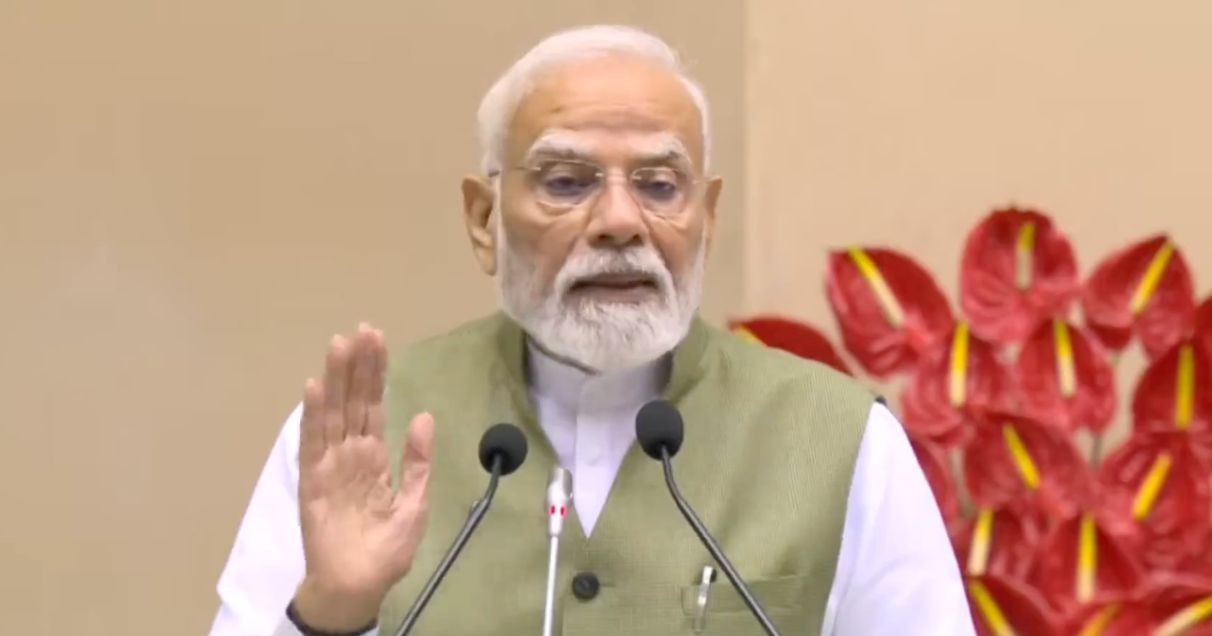
Prime Minister Narendra Modi has highlighted India’s expanding climate action, saying the country is pursuing economic growth while simultaneously stepping up efforts to protect the environment.
Speaking at the international conference on “The Future of Environment and Climate Dynamics”, Modi outlined India’s progress in renewable energy, cleaner transportation, water conservation and other sustainability initiatives.
He said India’s approach to environmental protection is closely linked to its traditional philosophy of respecting and living in harmony with nature.
Modi also pointed to India’s relatively low per-capita carbon footprint, saying the country was translating its traditional environmental values into contemporary solutions for climate-related challenges.
SOLAR POWER DRIVES INDIA’S ENERGY TRANSITION
Renewable energy featured prominently in the prime minister’s address, with solar power emerging as a key focus.
Modi said India’s solar energy capacity has surged from around 2 GW about 12 years ago to over 160 GW today. He said the expansion had also contributed to avoiding a significant amount of carbon emissions.
India has also recorded substantial growth in wind power, while hydropower capacity has continued to rise.
The government is simultaneously looking to expand nuclear power and attract greater private investment into the clean-energy sector.
These developments, Modi said, have contributed to a sharp increase in India’s installed non-fossil fuel-based electricity capacity.
INDIA CROSSES 50% NON-FOSSIL POWER MILESTONE
Modi said India crossed the 50 per cent mark in non-fossil installed electricity capacity in 2025, ahead of the country’s original 2030 target under the Paris climate commitments.
The prime minister presented the milestone as evidence of the pace at which India’s energy transition has progressed over the past decade.
He also highlighted the country’s efforts to meet its international climate commitments, with renewable energy playing a central role in reducing dependence on fossil fuels.
GREEN HYDROGEN, CLEAN TRANSPORT IN FOCUS
India’s climate strategy, Modi stressed, extends beyond electricity generation.
The government is also promoting green hydrogen, cleaner mobility and new technologies aimed at reducing emissions across different sectors.
The prime minister referred to India’s hydrogen-powered train as an example of efforts to explore cleaner alternatives in transportation.
Alongside emissions reduction, Modi highlighted the importance of conserving natural resources and developing technologies that can support long-term sustainable growth.
‘INDIA’S DEVELOPMENT MUST REMAIN IN HARMONY WITH NATURE’
Modi said India’s environmental philosophy is rooted in the belief that humans and nature share a close relationship.
Quoting the Sanskrit phrase “Mata Bhumih Putroham Prithivyah”, he described the Earth as a mother and people as her children.
The prime minister said the ideas and solutions emerging from the conference could contribute to addressing some of the major environmental challenges facing future generations.
He reiterated that India’s approach seeks to combine development, clean energy and environmental protection, while also encouraging greater global cooperation on climate action.