Prime Minister Narendra Modi used his Independence Day address to put young Indians at the centre of his 2047 vision, announcing new AI training and free competitive-exam coaching while outlining a seven-pronged development strategy.
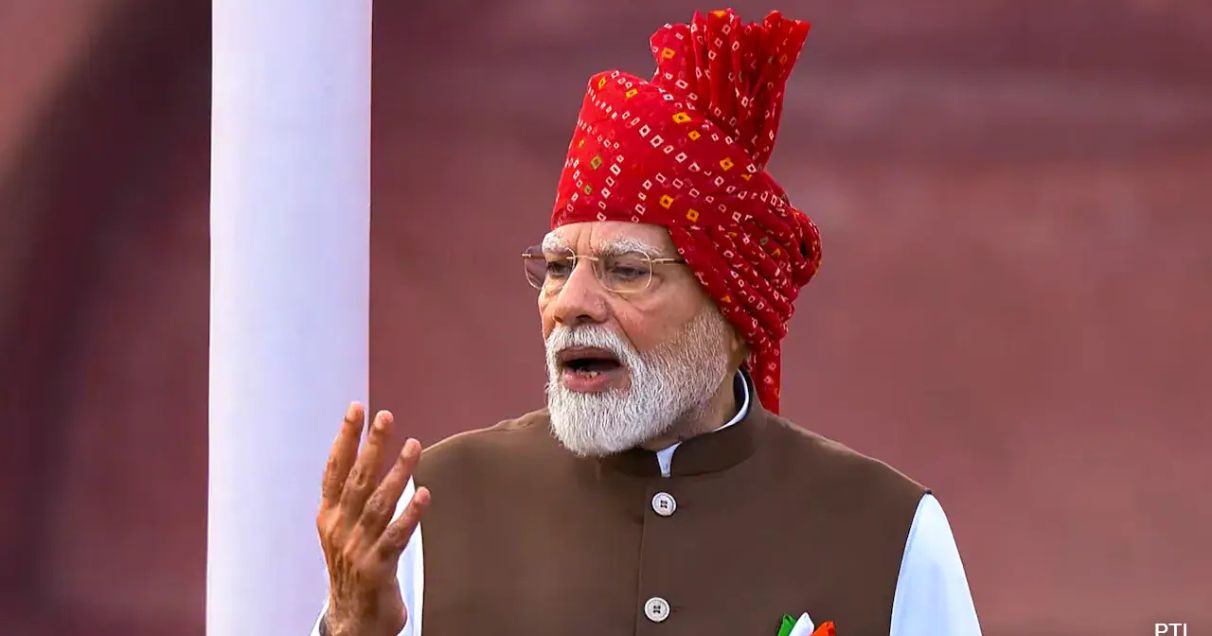
Prime Minister Narendra Modi's 80th Independence Day address from the Red Fort on Saturday combined a series of policy announcements with a strong political message on the country's future.
With India working towards the goal of becoming a developed nation by 2047, Modi placed youth, technology, manufacturing, energy security and self-reliance at the centre of his vision. His speech also included a sharp warning about what he described as a new ideological challenge posed by "dimaagi Naxals".
The address was Modi's 13th consecutive Independence Day speech as Prime Minister, a milestone previously achieved only by Jawaharlal Nehru.
YOUTH AT THE CENTRE OF MODI'S MESSAGE
Young Indians featured prominently in the Prime Minister's address, with Modi announcing initiatives aimed at expanding access to skills and education.
One of the biggest announcements was a plan to train one crore young Indians in artificial intelligence over the next year. The government also plans to provide free online coaching for competitive examinations, with the initiative particularly aimed at reducing the financial pressure faced by students from poorer and middle-class households.
The announcements come against the backdrop of recent student protests over examination-related issues, including allegations surrounding paper leaks and concerns over employment opportunities.
Modi said India's youth would be central to achieving the country's long-term development ambitions.
The Prime Minister also highlighted the expansion of India's education ecosystem. He said the country had added nearly 650 universities over the past 10 to 12 years, taking the total to close to 1,000. He also pointed to the rise in medical colleges and the growing presence of foreign universities in India.
WHAT IS MODI'S 'SAPTDHARA' PLAN?
A major part of the speech was the unveiling of a seven-part framework for India's development, referred to as 'Saptdhara' or seven streams.
The framework broadly covers the sectors Modi believes will determine India's economic and strategic strength in the coming decades.
1. MANUFACTURING
Modi called for India to become a major global manufacturing centre, with the country producing everything from components to finished goods.
The emphasis was on building domestic capacity while making Indian manufacturing competitive internationally.
2. AGRICULTURE AND FOOD
The Prime Minister also focused on agriculture and food processing.
He called for Indian agricultural products, including millets, spices and fruits, to find larger markets overseas and said India should aim to become a major global food producer.
3. TECHNOLOGY AND INNOVATION
Technology emerged as another major pillar of the roadmap.
Artificial intelligence, quantum technology, robotics and space were identified as areas where India needs to build its own capabilities rather than simply becoming a large consumer market.
Semiconductors were also given considerable importance. Modi said several new semiconductor manufacturing facilities could come up in India over the next seven to eight years.
4. GATI SHAKTI AND INFRASTRUCTURE
The fourth element focuses on connectivity and infrastructure.
Modi stressed the importance of faster transportation networks, modern highways and high-speed rail to improve movement across the country and support economic growth.
5. DEFENCE SELF-RELIANCE
Defence production was another key component.
Modi reiterated the government's emphasis on reducing dependence on foreign suppliers and developing advanced defence technologies domestically.
He highlighted areas such as drones, hypersonic systems and cybersecurity, with the larger ambition of making India not merely self-sufficient but also a supplier of advanced defence technology to other countries.
6. ENERGY SECURITY
Energy independence featured prominently in the speech.
Modi said India needs to expand its nuclear power capacity and set an ambitious target of 100 GW of nuclear energy capacity.
He also linked energy security with India's broader objective of becoming a developed economy by 2047.
7. INDIA'S SOFT POWER
The final component of the framework focuses on India's cultural and civilisational influence.
Modi pointed to yoga, Ayurveda and India's cultural heritage as assets that can strengthen the country's global standing and diplomatic influence.
MODI'S WARNING ABOUT 'DIMAAGI NAXALS'
The Prime Minister also used his speech to raise what he described as an emerging ideological threat.
While claiming that armed Naxalism had been substantially weakened, Modi warned about people who, in his formulation, continue to promote Maoist ideology without taking up arms.
He referred to them as "dimaagi Naxals" and said such individuals needed to be identified and isolated.
The remarks marked one of the sharper political portions of the address and broadened the discussion from armed insurgency to ideological influence.
SELF-RELIANCE REMAINS A CENTRAL THEME
Modi once again linked his development agenda with Atmanirbhar Bharat.
Semiconductors, critical minerals, defence technology and energy were presented as areas where India needs greater domestic capability.
The Prime Minister's broader argument was that economic growth alone would not be enough; India would also need control over strategically important technologies, resources and production capabilities.
WOMEN'S REPRESENTATION ALSO FEATURED
Another important political message concerned women's participation in decision-making.
Against the backdrop of the continuing debate over the implementation of women's reservation, Modi appealed to political parties to work together to ensure 33 per cent representation for women in Parliament and state assemblies.
He urged the Opposition to set aside political differences on the issue.
THE LARGER 2047 VISION
The various announcements were ultimately tied to one overarching goal: transforming India into a Viksit Bharat by 2047, when the country completes 100 years as an independent nation.
From training young people in AI to expanding semiconductor manufacturing, strengthening defence production and increasing nuclear capacity, Modi's speech attempted to connect immediate policy initiatives with a much longer-term national strategy.
The address therefore combined three broad themes — youth empowerment, strategic self-reliance and accelerated development.
For the Prime Minister, the challenge ahead is not simply to sustain India's economic growth but to build domestic capabilities in the technologies, industries and strategic sectors that could determine India's position in the world over the next two decades.