R&D, Innovation, and Patents: A Path to a 10x Economy
Investment in research and development is crucial for driving innovation, increasing patent output, and sustaining long-term economic growth in India
07-08-2025

Investment in research and development is crucial for driving innovation, increasing patent output, and sustaining long-term economic growth in India
07-08-2025With an ever-increasing new avenue of research and development, it becomes imperative to say that the relationship between technological advancement and a country's economic growth remains intertwined. Needless to say, the country's economic growth, measured primarily in GDP, is directly affected by the level of investment it puts in its Research and Development. OECD, in its publication (2015), The Innovation Imperative, mentions that a single percent increase in R&D expenditure results in a 0.13 percent increase in economic growth. Increasing Gross Domestic Expenditure on R&D (GERD) creates a multitude of levels of advantage for a country. The direct implication for this is the boost in production, which inherently creates a more competitive environment and often results in a better business avenue. Fig. 1 mentions a list of nations according to their spending on R&D (2023 statistics). Fig. 2 mentions a list of countries' R&D expenditures as a percent of their GDP. Fig. 3 talks about the sector allocation of R&D spending in India.
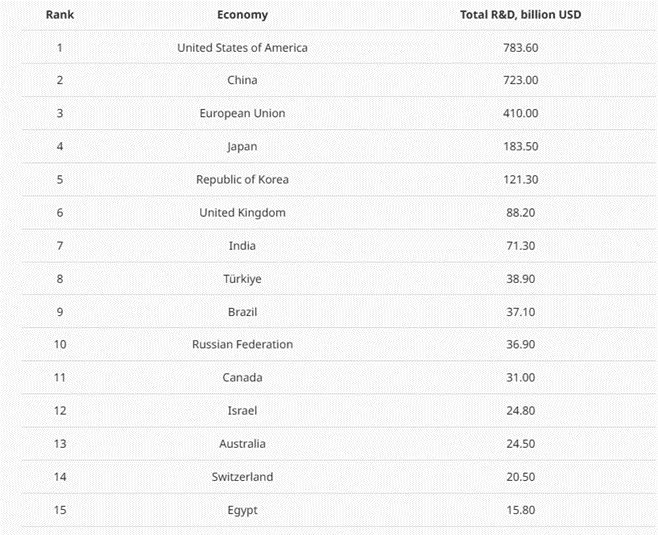
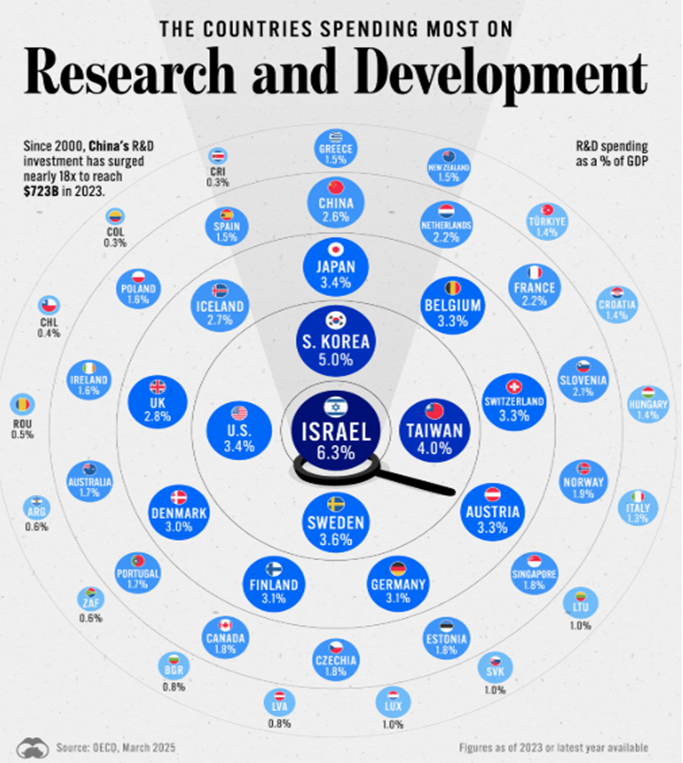
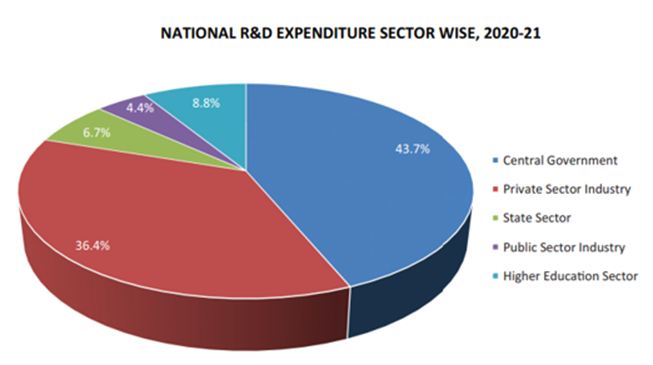
Fig. 1 gives us a clear picture that the USA remains at the top, followed by China. Surprisingly, clubbing US and China's R&D spending is more than the combined spending of the rest 13 nations in the list. India, in the 07th position, spends nearly 1/10th of China's expenditure. The data shows India spending 71.30 billion dollars, which is in slight contrast with the data available from The Economic Survey. Fig. 2 provides a different picture where the nation's spending is calculated as a percent of its GDP. Israel tops the list with 6.3% of GDP being spent on R&D, followed by South Korea, Taiwan, Sweden, and the US. Notably, the US remains at the top in the list of R&D spending but ranks 5th as per percent of GDP spent. China, holding the 2nd position in Fig. 1, comes at the 15th position as per the percentage of GDP spent.
Fig. 3 talks specifically about India, the data from the Department of Science and Technology shows that the R&D expenditure is maximum from the Central Government side, followed by the Private Sector, and a mere percentage from the state and public sector. On the contrary, the US and China's private sectors play a decent role in R&D spending. This is visible from the fact that major tech giants in the world belong to either the US or China. India's private sector needs to play a strong role when it comes to R&D spending.
Multiple theories were put forth to understand the relationship between R&D spending and economic growth. Various economists have given contradictory views regarding the level of direct and indirect impact on the economy, but none have clearly negated, giving us a clear picture of a favourable relation between the two. Multiple parameters were discussed, of which the author would discuss two of the most important, i.e., Innovation and Patents.
Innovation: Driver of the Growth Engine
The central part of the whole story is captured by a simple yet broader term, i.e., innovation. The importance of Innovation can be adjudged by the very fact that the National Bureau of Economic Research, in its research piece titled 'Are Ideas getting harder to find?' mentions that Innovation is responsible for half of the economic development of the United States. The structure of an innovation mechanism should focus not only on the ideation stage but also on the stage of maturity. The crucial role of an organization starts from ideating a novel technology to the stage of market entry. The growth of the existing market at the level of profitability also constitutes innovation strategies.
Patents: The Growth Engine
Itself Patents constitute the most important parameter in the umbrella of R&D. Patents, specifically, are provided for the novel product and process that fulfils three eligible criteria, i.e., novelty, industrial applicability, and inventive steps. For any country worldwide, the major indicator of a strong R&D environment is Patents. A quick look at the data shows that India is quite slow when it comes to filing and prosecuting patents. The reason might not be easy to comprehend since patents are the key to technological advancement and perhaps the only parameter to gauge the technological capabilities, either of a country or a specific industry player. As per the report of WIPO, patent filings grew by 2.7% to touch 3.7 million patents worldwide. India's patent filings remain poor. WIPO mentions that China leads domestic and foreign filings with 1.64 million applications, followed by the USA (518,364), Japan (414,413), Korea (287,954), and Germany (133,053). A few reasons that can substantiate India’s poor condition are a lack of awareness, difficulty in protecting patents even after a grant, and longer prosecution periods.
A quick look at the patent prosecution in India showcases that the Indian Patent Office has focused on the speedy disposal of patents. As per data available on the Intellectual Property website, India witnessed the filing of 1 lakh patents, with 14000 patents being examined and 64000 being granted. The process normally takes 15-18 months, and the process includes filing the patent, followed by the publication of the patent in the Patent Journal. This is followed by an examination of the patent, which includes a reply to the examination report and hearings before the controller, post which the patent is either granted or rejected.
Conclusion
The prerogative of enhancing the R&D environment with a more innovative approach lies with both the government and private sector. The world's biggest innovation has been done, not by any government, but rather by private sector giants. This shows the importance of how this sector plays a huge role. An increase in the R&D expenditure, along with duly protecting the research through patents, is the need of the hour. India is looking forward to a major tech revolution yet to come.


From the power and insolvency appeal courts to debt and military tribunals, chairs and member seats
Read More
An estimate of Yes Bank’s liability and capital impact after the Supreme Court’s ruling in Yes B
Read More
When the state wields a sledgehammer against citizens seeking accountability, the Supreme Court’s
Read More