At least 64 people were killed and 179 injured after two high-speed trains collided in Spain’s Toledo province on Wednesday, triggering a large-scale rescue operation and bringing rail services along a major corridor to a halt. Authorities suspect human error may have contributed to the disaster, but the exact cause remains under investigation.
The crash occurred around 9 am local time near Urda, on the high-speed railway connecting Madrid with Andalusia. According to regional government spokesperson Esther Padilla, one train operated by Renfe was carrying 397 passengers, while an Iryo service had 147 passengers and a baby on board.
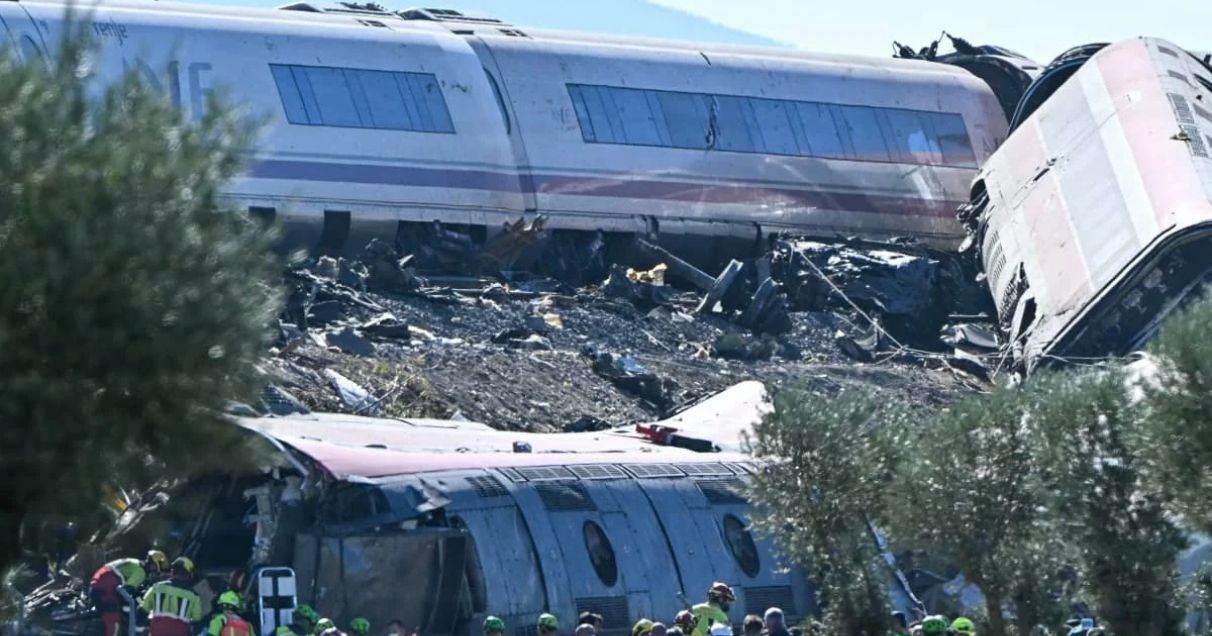
Spanish public broadcaster RTVE reported that the Renfe train struck the stationary Iryo service from behind. The impact derailed two carriages of the Iryo train, sending them down an embankment. Officials warned that the death toll could rise as rescue teams continued searching damaged carriages and recovering victims.
Hospitals in Toledo, Alcazar de San Juan and Ciudad Real were placed on alert to receive the injured. Firefighters, Civil Guard personnel, medical teams and emergency helicopters were deployed to the scene. Regional authorities said injured passengers had been evacuated, while rescue workers continued their efforts amid the wreckage.
Signalling failure under investigation
Investigators are examining whether a problem with the railway signalling system and a possible operational mistake contributed to the collision.
Spanish newspaper El Pais, citing central government sources, reported that authorities were looking into a possible error by an operator at Adif, the state-owned rail infrastructure manager, at its control centre in Madrid’s Atocha station.
According to the report, a malfunction in the main LZB signalling and safety system had forced railway staff to manage train movements using an alternative procedure. The disruption reportedly halted around eight trains in the area on Wednesday morning.
When services were permitted to resume, the Iryo train was still stationary on the track. Investigators are examining whether an Adif operator mistakenly authorised the following Renfe train to proceed, leading to the collision.
The alternative arrangement, known as Lateral Signalling Block, can identify sections of track occupied by trains but does not offer the same continuous monitoring of speed and safe separation as the primary system, RTVE reported.
Adif has said it is reviewing its systems and reconstructing the events preceding the crash. Investigators have yet to establish why the Iryo service remained stationary or how the Renfe train received clearance to move forward.
Emergency response launched as rail services suspended
The collision prompted an extensive emergency response, with damaged carriages scattered across the site. Images shared on social media showed train coaches lying on their sides in a ditch, while footage broadcast by Castilla-La Mancha Television showed a carriage stranded on an elevated stretch of track and twisted metal scattered below.
Mayor Manuel Galan of nearby Urda told Spanish radio network Cadena SER that local authorities had been asked to prepare emergency accommodation, including a sports hall, for passengers and those affected by the disaster.
Rail traffic on the Madrid-Andalusia high-speed corridor was suspended following the crash, disrupting more than 100 services, El Pais reported. Adif confirmed that the suspension followed the rear-end collision.
Renfe and Iryo said they had activated emergency response and victim-assistance procedures. Renfe said its immediate focus was supporting passengers and their families, while Iryo said it was coordinating with authorities to manage the aftermath.
Sanchez cancels engagements, opposition suspends campaign events
Prime Minister Pedro Sanchez expressed shock over the incident and said he was in contact with the transport minister and the regional government to follow developments.
He conveyed his solidarity and support to the victims and their families and cancelled his scheduled engagements for Wednesday. Spain’s opposition People's Party also called off its campaign events, according to a spokesperson.
The accident has renewed scrutiny of the country’s railway infrastructure, safety systems and maintenance arrangements.
Spain's rail network faces renewed scrutiny
The latest collision comes nine months after another deadly crash on the same high-speed railway corridor. In January, 46 people died near Adamuz in Cordoba province when an Iryo train derailed and collided with an oncoming Renfe service.
That disaster prompted debate over railway investment, infrastructure upkeep and maintenance standards in Spain.
The latest crash adds to those concerns as investigators work to establish whether equipment failure, operational decisions or a combination of factors led to Wednesday’s collision.
The incident also comes against a politically sensitive backdrop. A month earlier, Sanchez had called a snap election for November 29 after two government decrees intended to address the housing crisis failed to pass in parliament amid nationwide protests over housing costs.