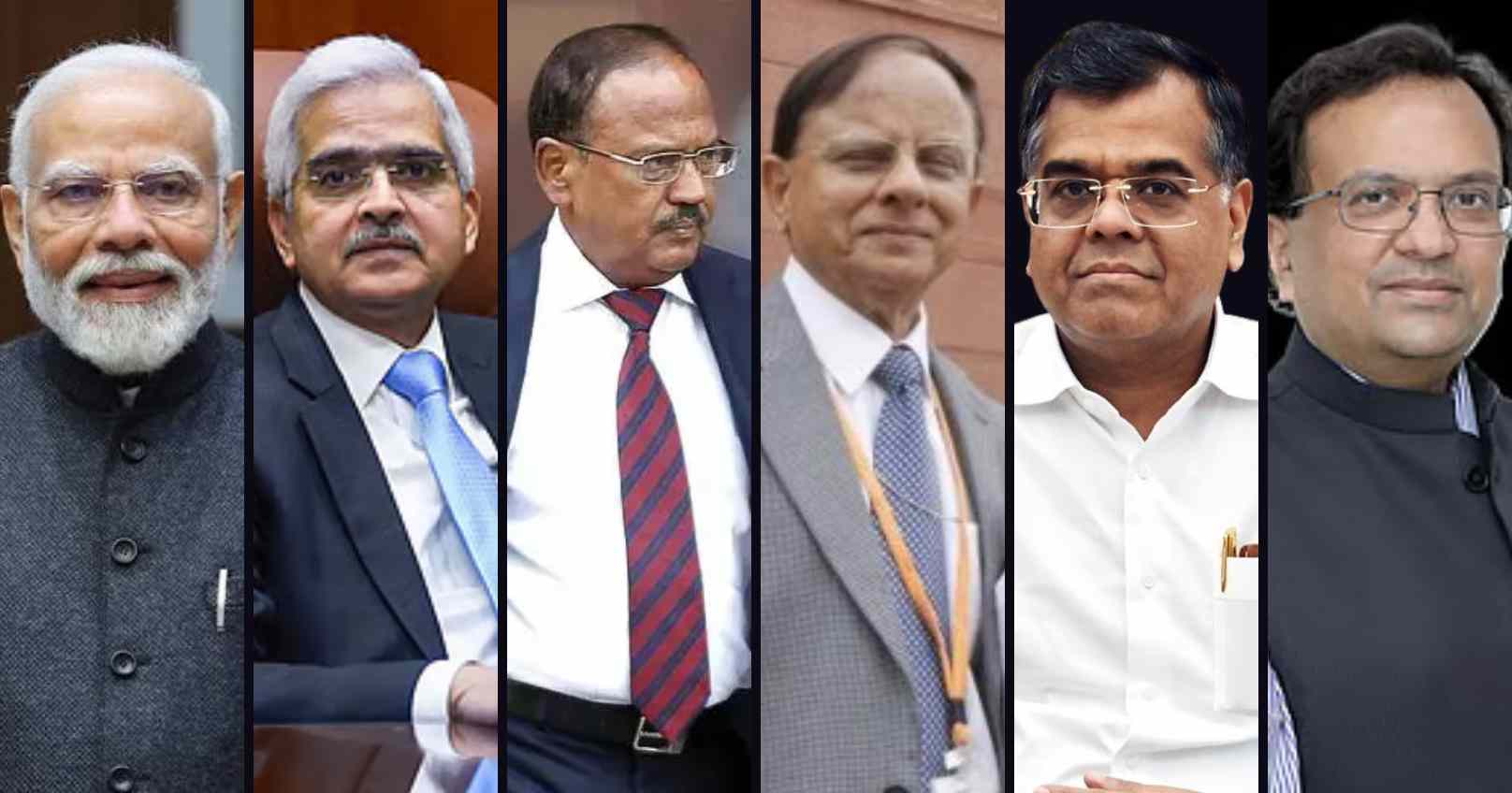
The Modi government has once again underlined its preference for continuity at the highest levels of governance by granting one-year extensions to the country’s two most senior serving civil servants — Cabinet Secretary T.V. Somanathan and Union Home Secretary Govind Mohan. The latest decisions reinforce a growing trend where retirement at 60 has increasingly become a procedural milestone rather than the end of public service for India’s top bureaucrats.
From the Prime Minister’s Office to the Cabinet Secretariat, North Block and South Block, continuity has emerged as the defining principle of governance, with several key officials continuing well beyond their normal retirement age.
This Week’s Key Decisions
The Appointments Committee of the Cabinet (ACC), chaired by Prime Minister Narendra Modi, approved both extensions through orders issued by the Department of Personnel and Training (DoPT) on August 5, 2026.
Cabinet Secretary T.V. Somanathan
A 1987-batch IAS officer of the Tamil Nadu cadre, T.V. Somanathan has been granted a one-year extension beyond August 30, 2026. He assumed office as Cabinet Secretary on August 30, 2024, following the retirement of Rajiv Gauba, for an initial two-year tenure. This marks his first extension.
Union Home Secretary Govind Mohan
Govind Mohan has been granted a second consecutive one-year extension, allowing him to continue as Home Secretary until August 22, 2027, beyond his current tenure ending on August 22, 2026.
A 1989-batch IAS officer of the Sikkim cadre, Mohan was originally scheduled to retire on September 30, 2025. His extensions have been granted by relaxing the provisions of Fundamental Rule 56(d) and Rule 16(1A) of the All India Services (Death-cum-Retirement Benefits) Rules, 1958.
The PMO’s Trusted Core
The Prime Minister’s Office itself reflects this philosophy of continuity.
Dr. P.K. Mishra, Principal Secretary to the Prime Minister, is a retired IAS officer of the Gujarat cadre. He has served continuously in the PMO since 2014, initially as Additional Principal Secretary before becoming Principal Secretary in September 2019. He was reappointed on June 10, 2024, with a tenure co-terminus with the Prime Minister’s term, and enjoys the rank of a Cabinet Minister. He is now serving his eighth year as the Prime Minister’s top aide and thirteenth year in the PMO.
Alongside him is Shaktikanta Das, appointed as Principal Secretary-2 on February 22, 2025, and who assumed office on February 24, 2025.
His appointment marked the first time in Indian history that a Prime Minister has had two Principal Secretaries. The office itself dates back to 1971, when Prime Minister Indira Gandhi appointed P.N. Haksar as Principal Secretary.
A 1980-batch IAS officer of the Tamil Nadu cadre, Das previously served as Revenue Secretary, Economic Affairs Secretary, India’s G20 Sherpa, a member of the Fifteenth Finance Commission, and later completed a six-year tenure as RBI Governor between December 2018 and December 2024—itself a post-retirement appointment. Like P.K. Mishra, his appointment is also co-terminus with the Prime Minister’s tenure. Both Principal Secretaries are Odisha-born.
National Security Leadership
Ajit Doval, a 1968-batch IPS officer, continues as National Security Adviser after being reappointed on June 10, 2024, for a third consecutive term, becoming the first NSA in India’s history to achieve that distinction.
Doval retired as Director of the Intelligence Bureau in 2005 and has served as NSA since May 2014. Like the Principal Secretaries, he holds Cabinet Minister rank and serves on a co-terminus basis with the Prime Minister.
In addition, retired IAS officers Amit Khare (1985 batch) and Tarun Kapoor were also reappointed as Advisers to the Prime Minister in June 2024, again on co-terminus appointments.
Extensions Across Government
The pattern extends well beyond the PMO.
Foreign Secretary Vikram Misri, a 1989-batch Indian Foreign Service officer, received a one-year extension on July 1, 2026, allowing him to continue until July 14, 2027.
Misri assumed office on July 15, 2024, and had already received an extension in November 2024, allowing him to continue beyond his scheduled retirement on November 30, 2024. By the end of his tenure, he will have completed three years as Foreign Secretary, all beyond the normal retirement age.
Defence Secretary Rajesh Kumar Singh, a 1989-batch IAS officer of the Kerala cadre, was appointed with a tenure extending until October 31, 2026, beyond his own superannuation date.
Since May 31, 2026, Singh has also held the additional responsibilities of Secretary, Department of Defence Research & Development and Chairman, DRDO, following the retirement of Dr. Samir V. Kamat, who himself had received two extensions before demitting office.
One Exception
The Intelligence Bureau recently witnessed one of the few departures from this trend.
Tapan Kumar Deka, who had served as IB Director since July 2022 and received two extensions, stepped down on June 30, 2026, after becoming the longest-serving Intelligence Bureau chief since B.N. Mullik.
He was succeeded by Mahesh Dixit, a 1993-batch IPS officer of the Andhra Pradesh cadre, who received a two-year appointment under FR 56(d).
The Legal Framework
The legal basis for these appointments lies in Fundamental Rule 56(d) read together with Rule 16(1A) of the All India Services (Death-cum-Retirement Benefits) Rules, 1958, which permit the Central Government to retain officers beyond the age of 60 years in public interest.
A November 2021 notification significantly expanded these powers by permitting extensions of up to two years for the:
- Cabinet Secretary
- Defence Secretary
- Home Secretary
- Foreign Secretary
- Director, Intelligence Bureau
- Secretary, Research and Analysis Wing (RAW)
Separately, amendments extended the maximum tenure of the CBI Director and Enforcement Directorate Director to five years.
Appointments in the Prime Minister’s Office operate differently. They are made co-terminus with the Prime Minister’s term or until further orders, effectively placing them outside the ordinary retirement framework.
Continuity vs Institutional Renewal
Supporters argue that the government is prioritising continuity at a time of complex domestic and international challenges.
Cabinet Secretary T.V. Somanathan is overseeing administrative and expenditure reforms.
Home Secretary Govind Mohan continues to supervise internal security during a sensitive period.
Foreign Secretary Vikram Misri is managing India’s diplomacy amid developments involving West Asia, Ukraine, China, Pakistan and Bangladesh, while also preparing for India’s forthcoming BRICS Chairmanship.
According to this view, retaining experienced leadership ensures institutional memory and policy continuity.
Critics, however, argue that the repeated extensions have gradually altered the traditional structure of the civil services.
Former Cabinet Secretary Rajiv Gauba served an unprecedented five years, receiving three extensions.
Former Home Secretary Ajay Bhalla received four extensions.
Each extension delays promotions for officers lower in the hierarchy whose own careers are limited by age, raising concerns that institutional succession may increasingly depend on individual confidence rather than established administrative processes.
Ultimately, the debate is not about the competence of the officers involved—few dispute that—but whether a system that repeatedly depends on the same individuals remaining in office beyond retirement reflects institutional strength or institutional dependence.
Numbers That Tell the Story
- 2 — Principal Secretaries in the Prime Minister’s Office, the first time in Indian history.
- 3 — Consecutive terms served by National Security Adviser Ajit Doval, also a first.
- 12 — Years spent continuously by P.K. Mishra inside the Prime Minister’s Office.
- 60 — The statutory retirement age for officers of the IAS, IPS and IFS.