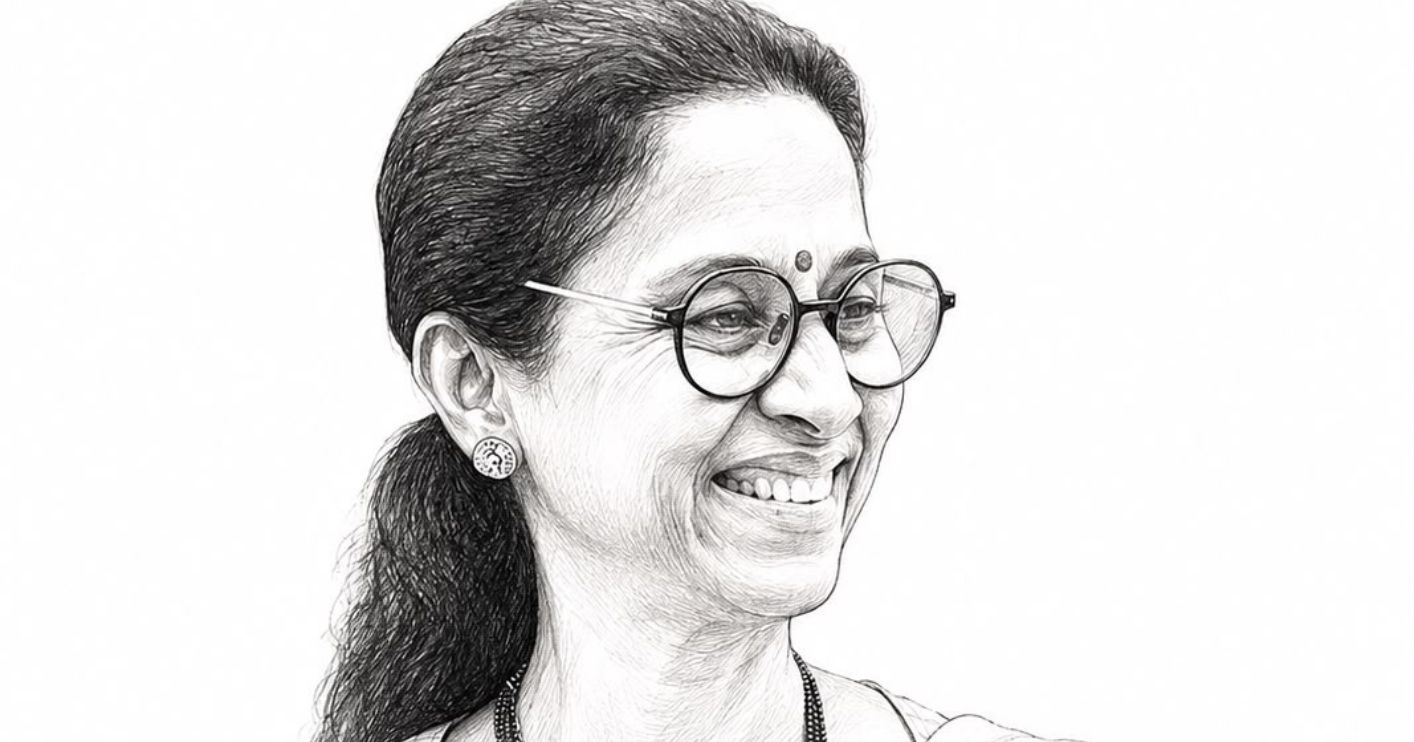
There are politicians who acquire importance through office, and there are others whose importance gradually becomes independent of office. Supriya Sule increasingly belongs to the latter category.
For years, she was inevitably introduced as the daughter of Sharad Pawar, one of the most durable and sophisticated political figures independent India has produced. Today, however, Sule has built a parliamentary identity substantial enough to stand on its own: diligent, accessible, articulate, unusually regular in Parliament and increasingly central to the representation of her party in New Delhi.
The latest addition to the Sule-Pawar family story , the marriage of her daughter Revati Sule to Sarang Lakhani, has inevitably attracted attention far beyond society pages. The marriage has brought together two prominent Maharashtra families: one rooted deeply in politics and public life, the other in business, infrastructure and, more recently, electoral politics. Revati and Sarang married in Mumbai on June 20, 2026. Sarang is the son of Nagpur-based businessman Arun Lakhani, Chairman and Managing Director of the Vishvaraj Group.
Importantly, Supriya Sule herself has been careful to reject attempts to give the marriage a political interpretation. When questions arose because Arun Lakhani had been fielded by the BJP in the Maharashtra Legislative Council election, Sule publicly maintained that the relationship between the children should not be conflated with their parents’ political careers.
Yet the symbolism is impossible for political observers to miss.
A New Family Link Across Maharashtra’s Political Divide
Arun Lakhani is not merely the father of Sule’s new son-in-law. He is a substantial infrastructure entrepreneur. Vishvaraj’s activities have included roads and highways and, increasingly, water and wastewater infrastructure through public-private partnership models. The company’s own material identifies Lakhani as its Chairman and Managing Director, while credit-rating material describes the wider group as active in infrastructure development, particularly roads, highways, water and wastewater projects.
The younger Sarang Lakhani is himself part of the business. He has been described as an Executive Director of the Vishvaraj Group and has spent several years working within the enterprise.
Then came the political twist. The BJP nominated Arun Lakhani for the Maharashtra Legislative Council from the Wardha-Chandrapur-Gadchiroli local authorities constituency, and his route to election became effectively unopposed after rival candidates withdrew.
Thus, purely through a family marriage, rather than any formal political arrangement, the Pawar-Sule family has acquired a close familial connection with a businessman entering the legislature on a BJP ticket.
It is precisely the sort of social cross-current that has always characterised Maharashtra politics, where political rivalry has frequently coexisted with personal warmth, business relationships and family friendships. And perhaps nobody understands that distinction better than Supriya Sule.
Sharad Pawar’s Most Patient Student
Much of Sule’s political method bears the unmistakable imprint of her father.
Sharad Pawar’s politics was rarely built around permanent hostility. He cultivated relationships across parties, industries, regions and institutions. He could disagree sharply in public and continue talking privately. He understood that politics is ultimately the management of people, interests, institutions and possibilities.
Supriya appears to have absorbed precisely that part of his craft. Her style is markedly different from the permanently combative politics that dominates television. She can oppose the government vigorously while retaining working relationships across the aisle. That ability becomes particularly valuable in Delhi, where numbers matter but so do conversations.
Her growing importance was visible again this August when all eight NCP (Sharad Pawar faction) Lok Sabha MPs, led by Sule, met Prime Minister Narendra Modi to raise Maharashtra-related issues.
That meeting captures something important about her present position. She is not merely another Maharashtra MP visiting Delhi. She increasingly functions as the parliamentary face, interlocutor and organiser of her party at the national level.
Delhi Matters, And Sule Understands Delhi
Regional politicians sometimes make the mistake of treating Parliament as an occasional extension of state politics. Sule has done almost exactly the opposite.
She has invested heavily in parliamentary life itself: attending the House, participating in discussions, asking questions, working through parliamentary procedure and maintaining relationships within the political ecosystem of New Delhi. The numbers are striking.
According to PRS Legislative Research, Sule has recorded 97 per cent attendance in the 18th Lok Sabha so far, including 100 per cent attendance in several sessions and 100 per cent in the 2026 Monsoon Session at the time of the data captured. (PRS Legislative Research)
This is not a new habit. During the 17th Lok Sabha, she recorded 93 per cent attendance, participated in 250 debates and asked 629 questions. (PRS Legislative Research)
In the 16th Lok Sabha, her attendance was even higher at 96 per cent, alongside 152 debate interventions and 1,186 questions. (PRS Legislative Research) Across successive Parliaments, therefore, attendance is not an incidental statistic for Sule. It appears to be part of her political philosophy. She turns up. In politics, this simple quality is remarkably underrated.
The Parliamentarian Who Does Her Homework
Sule has also developed a reputation for being prepared. She does not depend solely upon rhetorical flourishes or political theatre. Her parliamentary method relies extensively on questions, interventions, committee work and debates.
Her own parliamentary profile emphasises the use of starred and unstarred questions, Zero Hour interventions and other parliamentary mechanisms to raise issues of public interest.
Her record has repeatedly been recognised by the Sansad Ratna awards framework. Her official profile lists multiple Sansad Ratna honours as well as the Sansad Vishisht Ratna for sustained parliamentary performance. The significance is larger than awards.
Sule represents an older conception of an MP: someone who regards Parliament as a workplace rather than merely a backdrop for politics.
And when she speaks, there is usually an evident familiarity with the subject before the House. She is conversational rather than theatrical, assertive without invariably becoming shrill, and capable of making political criticism without reducing every intervention to confrontation. That makes her especially effective in a House where persuasion sometimes matters as much as volume.
Baramati: The Foundation Beneath the Delhi Profile
Delhi prominence can be deceptive if it is not backed by a constituency. Sule’s strength is that she has both. She has represented Baramati in the Lok Sabha since 2009, succeeding into a constituency inseparably associated with Sharad Pawar’s political legacy. Her most politically significant victory came in 2024, when the Pawar family split turned Baramati into one of India’s most closely watched contests.
Sule defeated Sunetra Pawar, wife of Ajit Pawar, by more than 1.5 lakh votes. That victory changed the way Sule was perceived. Until then, critics could still argue that she was the inheritor of a safe Pawar borough. But 2024 was not an ordinary Baramati election. The family itself was divided, the NCP organisation had fractured, powerful state machinery stood on the opposite side, and voters were being asked, in effect, to choose between competing branches of the Pawar political legacy.
Sule emerged from that contest strengthened. The result demonstrated that her relationship with Baramati was no longer merely inherited. It had become personal. Years of constituency work, repeated visits, accessibility and attention to local concerns had created a political capital of her own. That is perhaps one of Sharad Pawar’s most important lessons to his daughter: Delhi may confer stature, but the constituency confers legitimacy.
Politics Without Burning Bridges
The marriage of Revati Sule and Sarang Lakhani provides an interesting metaphor for Supriya Sule’s wider politics. Her daughter has married into a prominent business family whose patriarch is now associated electorally with the BJP. Yet Sule herself remains one of the principal parliamentary figures of the NCP (SP), a party opposed to the BJP.
There need be no contradiction. Indeed, Sule explicitly separated the personal relationship from political affiliation. That distinction sounds almost old-fashioned in today’s hyper-partisan climate. But it is very Pawar. Politics need not consume every social relationship. Political disagreement need not require personal estrangement. And today’s opponent may still be tomorrow’s interlocutor.
That culture has served Sharad Pawar for more than half a century. Sule appears to have learnt it well.
The Business Connection
The Lakhani connection also expands an already extensive social universe around the Pawar family. Vishvaraj built its business around infrastructure and PPP projects, first in roads and highways before expanding heavily into urban water and wastewater management. Arun Lakhani has led the enterprise for decades.
Sarang represents the next generation of that business family, occupying an executive role in the group. It would be improper to infer any business or political arrangement from a marriage, and Sule herself has rejected precisely such political interpretations.
But socially, the union unquestionably brings together two significant networks: the Pawars’ extraordinary political network and the Lakhanis’ infrastructure-business ecosystem. The wedding itself reflected the breadth of those circles, attracting personalities from politics, business and entertainment.
For a family whose patriarch has always maintained relationships extending from farmers’ cooperatives to corporate boardrooms and from opposition benches to prime ministers, there is something almost characteristically Pawar-like about it.
Supriya Sule’s Quiet Accumulation of Power
Sule’s rise has therefore been unusual. There has been no dramatic coronation. No sudden acquisition of a chief ministership. No spectacular rebellion engineered to capture a party. Instead, she has accumulated political weight slowly. One election at a time. One parliamentary session at a time. One relationship at a time. One constituency visit at a time. That method may ultimately prove more durable.
She today combines several things rarely found together: the Pawar name, her own repeated electoral legitimacy, strong parliamentary credentials, access across political parties, a deep constituency organisation and an increasingly independent national identity. And perhaps most importantly, she possesses patience.
Sharad Pawar’s career has always demonstrated that in politics, survival is itself a form of power. The politician who remains relevant long enough often finds that circumstances eventually move towards them.
Sule appears to understand this instinctively. She rarely appears hurried. She attends Parliament. She asks questions. She speaks. She meets leaders across parties. She returns to Baramati. She tends to her organisation. And she waits. Meanwhile, her political stature continues to compound.
From Pawar’s Daughter to a Power Centre in Her Own Right
There will probably never be a Supriya Sule profile in which Sharad Pawar disappears completely from the story. Nor should he. Few Indian politicians have transmitted such an enormous political inheritance to the next generation.
But inheritance alone cannot explain Sule anymore. A 97 per cent parliamentary attendance record cannot be inherited. (PRS Legislative Research) Hundreds of parliamentary questions cannot be inherited. Repeated electoral victories cannot simply be inherited.
Nor can the ability to lead a delegation of one’s MPs into a meeting with the Prime Minister of India. Those are accumulated credentials. The new marriage alliance adds another fascinating layer to the family’s already extensive network, connecting the Sule-Pawar household with the Lakhani business family and, through Arun Lakhani’s new political role, with a figure now associated with the BJP.
But the larger story remains Supriya herself. She has taken the capital her father gave her, a name, a constituency, relationships and an education in the subtleties of power, and patiently converted it into something distinctly her own.
Sharad Pawar taught Supriya Sule politics. Parliament gave her a stage. Baramati gave her legitimacy. And over nearly two decades, Delhi has begun to recognise her not simply as Pawar’s daughter, but as Supriya Sule, a political centre of gravity in her own right.