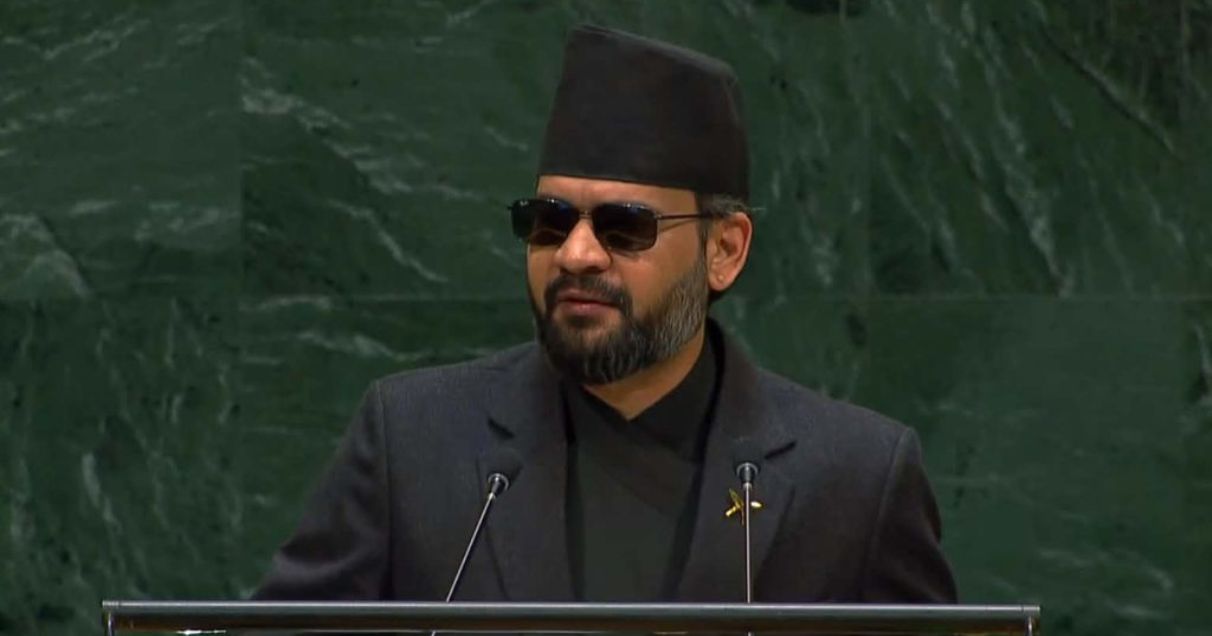
Nepal Prime Minister Balendra Shah, popularly known as Balen Shah, used his first address to the United Nations General Assembly to question a global system that can transport sophisticated weapons across continents but struggles to deliver essential commodities to vulnerable populations.
Addressing the 81st session of the UN General Assembly on September 24, the 36-year-old former rapper and politician drew attention to the consequences of climate change, international conflicts and disrupted supply chains.
Shah argued that the international community had developed highly efficient systems for military operations while failing to establish equally dependable arrangements for supplying food, agricultural inputs and energy to developing nations.
Nepal's Devastating Floods Dominate UN Address
The Nepalese Prime Minister began by drawing international attention to the catastrophic Bhotekoshi-Trishuli floods that struck his country in August.
According to figures presented by Shah, the disaster killed at least 1,400 people, with more than 6,000 still missing. Entire communities suffered extensive destruction as floodwaters swept away homes, roads, bridges, schools and agricultural land.
Shah described the disaster as evidence of the growing threat posed by climate change to Himalayan countries.
He warned that rising temperatures, retreating glaciers and increasingly unstable mountain slopes were creating dangerous conditions across the region.
For developing countries such as Nepal, he argued, climate-related disasters represent more than immediate humanitarian emergencies. They also destroy infrastructure, interrupt economic development and force governments to divert scarce financial resources towards reconstruction.
India, China And Nepal Should Establish Himalayan Climate Protection Mechanism
One of Shah's principal proposals was the establishment of a Himalayan Climate Resilience Mechanism involving Nepal, India and China.
He suggested that the three countries should cooperate on scientific research, disaster preparedness and climate monitoring.
The proposed arrangement would facilitate the exchange of satellite information, monitoring of potentially dangerous glacial lakes and development of coordinated early-warning systems.
It would also allow participating countries to organise cross-border assistance during major natural disasters.
Shah emphasised that the Himalayan ecosystem supports populations extending far beyond the mountain region itself, making its protection an international responsibility.
His proposal reflects Nepal's attempt to promote regional cooperation on environmental threats that cannot be addressed by individual countries acting independently.
Why Can Weapons Travel Faster Than Food?
Beyond climate change, Shah questioned the priorities of the international economic system.
Drawing on Nepal's recent experiences, he described difficulties faced by farmers unable to obtain fertilisers during the planting season, infrastructure projects delayed by shortages of construction materials and households struggling to secure cooking fuel.
He contrasted these shortages with the efficiency of international military supply chains.
According to Shah, sophisticated weapons and military equipment frequently move across international borders with remarkable speed, while essential civilian commodities remain vulnerable to shortages, trade disruptions and logistical failures.
He argued that international cooperation should ensure that countries willing to purchase essential supplies can obtain them when required.
The Prime Minister's criticism was directed at the structure of global trade and supply arrangements rather than any single country.
India And Other South Asian Nations Face Similar Challenges
Shah maintained that Nepal's difficulties were shared by several countries across South Asia.
He specifically referred to India, Bangladesh, Bhutan, Pakistan, Sri Lanka and the Maldives while discussing the combined consequences of climate change and international conflicts.
His central argument was that developing countries frequently bear substantial economic and environmental costs arising from events over which they exercise limited control.
International conflicts can disrupt energy supplies, increase transportation expenses and restrict access to agricultural commodities.
At the same time, extreme weather events threaten food production, infrastructure and economic stability.
Shah called for greater recognition of these interconnected challenges in international policymaking.
Climate Justice Must Go Beyond Financial Assistance
The Nepalese Prime Minister also raised questions about the distribution of responsibility for climate change.
He argued that countries which historically contributed more to global emissions, and those possessing greater financial resources, should assume greater responsibility for addressing the consequences.
However, Shah stressed that climate justice should not be confined to financial compensation.
He called for developing countries to have a meaningful role in international decision-making and for climate policies to reflect the interests of vulnerable communities.
He also highlighted the financial difficulties faced by countries repeatedly forced to rebuild infrastructure following natural disasters.
Shah maintained that the international community must develop arrangements that enable vulnerable nations to invest in long-term development rather than continually diverting resources towards disaster recovery.
Global Conflicts Expose Weaknesses In International Supply Chains
Shah's observations come amid international conflicts that have disrupted energy markets, transportation networks and agricultural supply chains.
The ongoing US-Iran war has brought renewed attention to the vulnerability of countries dependent on imported energy and essential commodities.
For economies with limited financial resources, increases in transportation costs and interruptions in international trade can translate into shortages of fuel, fertilisers and other necessities.
The Nepalese Prime Minister used these challenges to question whether international institutions were adequately protecting the interests of smaller and economically vulnerable countries.
He called for a system of global cooperation that places greater emphasis on essential supplies, climate resilience and economic security.
A Call For A Different Global Order
Shah's maiden UN address combined Nepal's immediate concerns about rebuilding after the August floods with broader questions about international priorities.
His proposals centred on three objectives: strengthening regional cooperation on Himalayan climate risks, improving access to essential commodities and ensuring that developing countries have a greater voice in international institutions.
He also reaffirmed Nepal's commitment to multilateralism, arguing that international cooperation remains necessary to address challenges extending beyond national borders.
For India and China, his proposed Himalayan mechanism presents an opportunity for regional discussions on glacier monitoring, disaster preparedness and environmental information sharing.
The speech placed Nepal's recent humanitarian disaster within a wider debate about the effectiveness of international cooperation and the economic consequences of climate change and armed conflict.