A Number Without a Basis
How the Income Tax Department told every HighCourt in India that Rs 21.34 lakh crore was atrisk, and what its own table actually says
14-09-2026

How the Income Tax Department told every HighCourt in India that Rs 21.34 lakh crore was atrisk, and what its own table actually says
14-09-2026On 20 August 2026 the Income Tax Department placed an affidavit on record. It was not filed in one court. The caption reads“Before All the Hon’ble High Courts of India”, and that is precisely where it went — into every High Court in the country where a batch of reassessment writs was listed for hearing.
The affidavit deposes to a figure. It says that the question before those courts, a narrow, dry question about which officer may issue a notice under section 148 of the Income-tax Act, 1961, carries a revenue consequence of approximately Rs 21,34,215 crore. Twenty-one lakh, thirty-four thousand, two hundred and fifteen crore rupees.
It is worth pausing on what that figure means in context. India’snet direct tax collection for the whole of 2025-26 was Rs 23.40 lakh crore. The Department is therefore telling the constitutional courts of the country that a single procedural question about the identity of an assessing officer places at risk a sum equal toninety-one per cent of everything the Union collects in direct taxes in a year.
That is a remarkable proposition. It is also, on the Department’s own table, not true. Not approximately true, not true with allowances. The figure is built out of components that do not measure what the sentence says they measure, and when the table is read rather than quoted, the defensible number is roughly one-tenth of the headline.
What follows is an examination of how the figure was assembled. Every number used here comes from the Department’s own affidavit. Nothing has been supplied from outside it except public data on what Indian tax demands historically turn into, which is the part of the story the affidavit does not tell.
The affidavit runs to twelve paragraphs and two tables. The first table is year-wise, from assessment year 2016-17 to 2025-26, and it is, in its way, an impressive piece of work. It records, for each year: returns filed, notices issued under section 148, reassessment orders passed, proceedings dropped, cases still pending, income assessed on reassessment, and tax demand raised.
The totals are these:
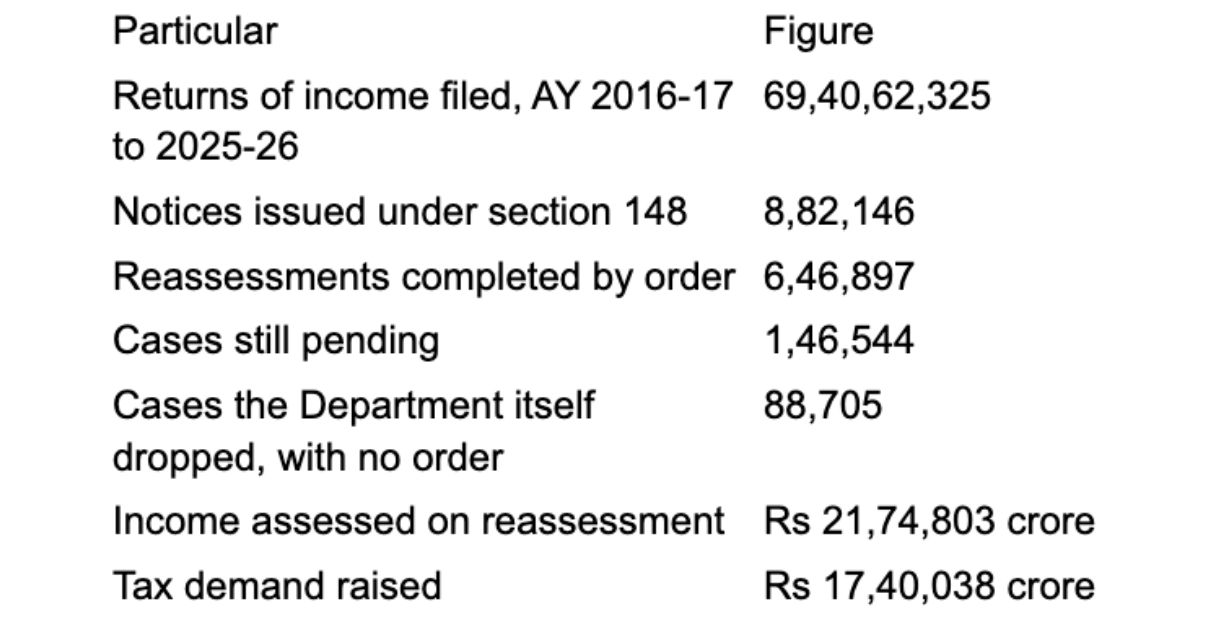
From this, the headline is built in two moves. The first is simply to take the Rs 17,40,038 crore of demand raised in completed reassessments and treat it as being at stake. The second is to divide that demand by the number of completed cases, producing an average of Rs 2.6898 crore per reassessment, and then to apply that single average to every one of the 1,46,544 cases still pending. That yields a further Rs 3,94,177 crore. Add the two and you arrive at Rs 21,34,215 crore.
The arithmetic is correct. Every column sums exactly to its stated total. In each of the ten assessment years, notices issued equal orders passed plus proceedings dropped plus cases pending, with no residue. Whoever prepared the table was careful.
The problem is not the addition. It is everything else.
Begin with the two money columns. Across ten years, the Department reports income assessed on reassessment of Rs 21,74,803 crore and tax demand raised of Rs 17,40,038 crore.
Divide one by the other and you get 80.01 per cent.
There is no rate of tax in the Income-tax Act that produces eighty per cent across a population of 6.47 lakh assessments. The highest rate reachable is the punitive rate on unexplained income, with surcharge and cess, and it applies to a small and specific category. The ordinary corporate and individual rates sit around a third. A blended effective rate of eighty per cent across every reassessment in the country over a decade is not a tax rate. It is a number produced by putting two things in adjacent columns that do not belong in adjacent columns.
The point becomes unanswerable when the table is read year by year:
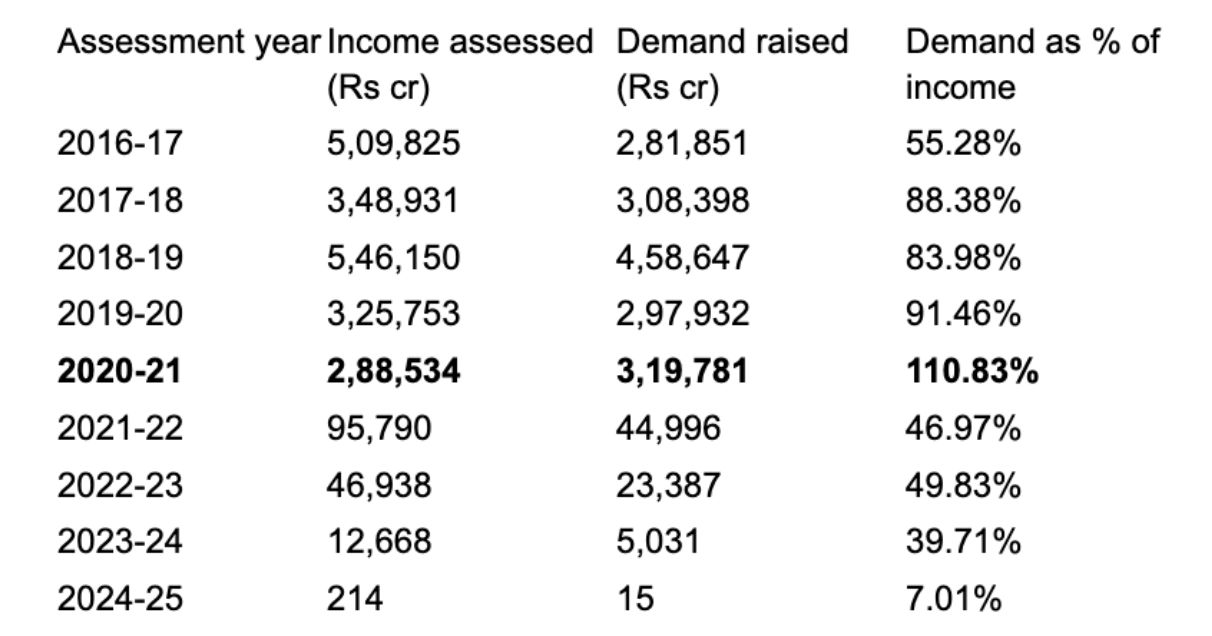
For assessment year 2020-21, the tax demanded exceeds the income assessed. The Department raised Rs 3,19,781 crore of demand on Rs 2,88,534 crore of income.
There are respectable explanations. The demand column almost certainly includes interest under sections 234A, 234B and 234C, which on a reassessment reaching back five or six years can approach or exceed the tax itself, and it may include penalty. Or the two columns may be computed on different bases, one on additions made, the other on total assessed income.
But if either explanation is right, then the column being divided to produce the per-case average is not a measure of tax. And the entire Rs 3,94,177 crore projection rests on that division. A number built by averaging a column that mixes tax, interest and penalty, and then presented to a court as “tax demand at stake”, is not an estimate. It is a category error with a rupee sign in front of it.
The swing across adjacent years, from 7 per cent to 111 per cent, is itself the tell. Whatever these two columns are measuring, they are not measuring it consistently.
Now take the projection. A single blended average of Rs 2.6898 crore is applied to all 1,46,544 pending cases.
An average is only useful if the population it is applied to resembles the population it came from. Here it does not, and the affidavit’s own table says so.
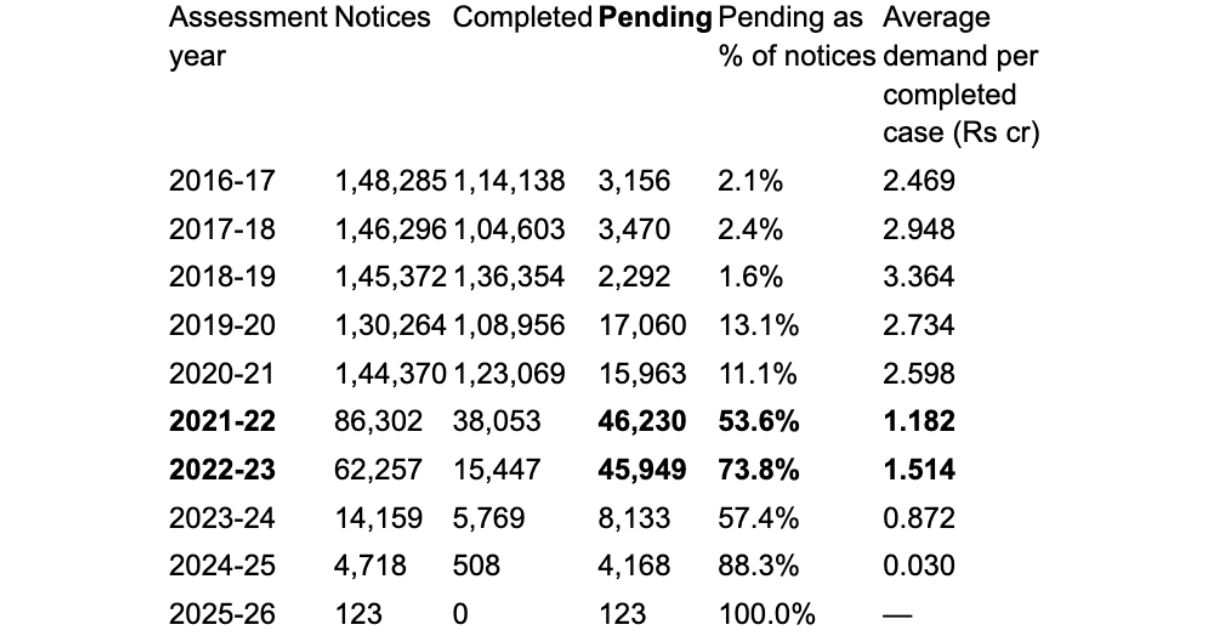
The older years are nearly finished. Assessment year 2018-19 has 1.6 per cent of its cases pending. Those years also carry the big tickets, at Rs 2.5 to Rs 3.4 crore a case.
The pending cases sit almost entirely elsewhere. 1,04,603 of the 1,46,544 — 71.4 per cent — fall in assessment year 2021-22 and later, where the observed average demand runs between Rs 0.03 crore and Rs 1.51 crore.
So the Department has taken an average dominated by the large old cases and applied it to a population dominated by small recent ones. Apply each year’s own observed average to that year’s pending cases, using nothing but the affidavit’s own figures, and the projection falls from Rs 3,94,177 crore to Rs 2,45,309 crore. The single averaging step inflates the number by about sixty-one per cent.
There is a further difficulty the affidavit does not acknowledge. For assessment year 2022-23, only 24.8 per cent of notices have produced an order. For 2024-25, 10.8 per cent. The averages for those years are computed from a quarter and a tenth of the population respectively, and are then made to speak for the remaining three-quarters and nine-tenths. Whether the Department takes up the largest cases first, the simplest first, or the oldest first — and the affidavit does not say — a sample of that size drawn from a live, sequenced process is not a basis for extrapolation. It is simply the part that happens to be finished.
The projection assumes that every one of the 1,46,544 pending cases will end in a demand. Not one is allowed to fail.
Set that against a figure sitting four columns to its left in the very same table. Of the 8,82,146 notices issued, 88,705 were dropped with no order under section 147 at all. Measured against the cases that have actually reached a conclusion, that is a failure rate of 12.06 per cent.
One notice in eight goes nowhere. The Department opened a reassessment, took it through the enquiry, and then found nothing worth assessing.
This is not a minor bookkeeping point. It is the Department’s own admission, on oath, about the accuracy of the risk-management system it is asking the courts to protect. And having admitted it, the affidavit then projects the pending cases forward on the assumption that it will never happen again.
Allow for it at the Department’s own observed rate, and the projection falls again, to Rs 2,15,727 crore.
The largest component of the headline is not a projection at all. Rs 17,40,038 crore of the Rs 21,34,215 crore is demand raised in reassessments that are already complete.
Those assessments are over. In the overwhelming majority, the assessee did not litigate, the appeal periods have run, and the matter is closed. Whatever the courts decide about which officer may issue a notice, those assessments are not reopened by it. They are not at stake in any sense the word ordinarily bears.
The Department’s own table shows what actually remains live: 1,46,544 cases, 16.61 per cent of notices issued. Everything else is history.
Put the four corrections together and the cascade looks like this:
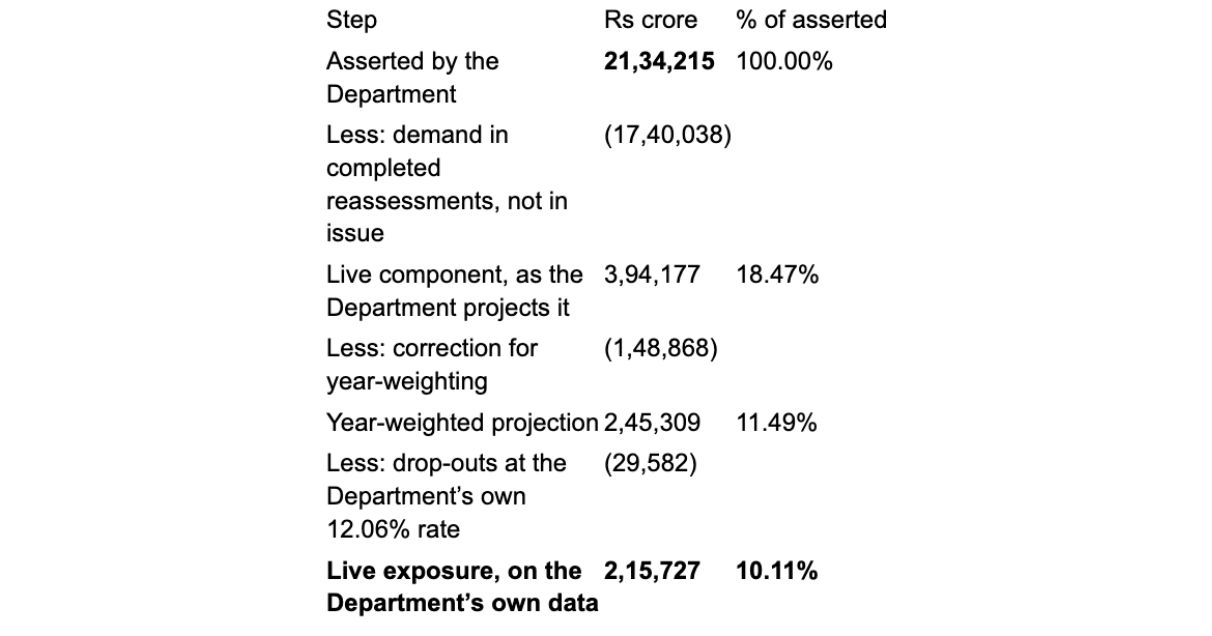
About one-tenth. And that is before the question nobody has yet asked.
Here is the part the affidavit does not touch, and it is the most important part.
The Rs 17,40,038 crore is demand raised. Not demand confirmed. Not demand sustained on appeal. Not demand collected. The affidavit is entirely silent on all three, and the silence is not accidental, because the Department maintains those figures and publishes them.
What the public record shows is this. The Comptroller and Auditor General reported that arrears of direct tax demand rose from Rs 14.94 lakh crore in 2020-21 to Rs 19.35 lakh crore in 2021-22, and that the Department itself indicated more than 97.4 per cent of uncollected demand would be difficult to recover. Net collectible demand out of that Rs 19.35 lakh crore was Rs 51,318 crore, about 2.65 per cent.
This is not a one-year aberration. In 2016-17, arrears stood at Rs 10.4 lakh crore, of which 98.6 per cent was classified as difficult to recover. The proportion has hovered between 96 and 99 per cent for well over a decade. A Parliamentary standing committee was told that pending tax demands had reached roughly Rs 42 lakh crore by October 2024, against about Rs 10 lakh crore five years earlier.
Now hold that against the affidavit. In 2024-25, the Department collected Rs 92,400 crore against arrear demand across the whole country. At that rate, recovering the Rs 17.40 lakh crore asserted in this affidavit would take nearly nineteen years, assuming it collected nothing else at all. The CBDT’s own enforcement drive for 2026-27 targets Rs 2.57 lakh crore of confirmed demand nationally — less than a sixth of the reassessment figure alone.
Apply the CAG’s collectibility ratio of 2.65 per cent to the Rs 17.40 lakh crore and you get roughly Rs 46,000 crore.
So the position is this. A department whose demand register has been described by the national auditor, year after year, as 97 per cent uncollectible, has placed before every High Court in India a figure drawn from that same register, presented as revenue at risk, without disclosing the one fact about it that everybody in the system already knows.
That is the heart of the matter. In Indian direct tax administration,“demand raised” is not a measure of money. It is a measure of activity. The affidavit takes a metric everybody in the building understands to be inflated and hands it to judges who have no reason to know that.
Two more devices deserve notice, because they show the figure was chosen, not merely computed.
The first is the denominator. The affidavit takes care to record that the 8,82,146 notices represent 0.1271 per cent of the 69.40 crore returns filed. The number of returns has no bearing whatever on the question before the courts. It is there to create an impression of restraint — that reassessment touches almost nobody. A count of returns filed is not the relevant population for anything the affidavit is actually about.
The second is the use to which the figure is put in the accompanying written submissions, where it becomes an argument that more than 99.8 per cent of assessees have complied with notices issued in the manner under challenge, and that “a handful of petitioners and counsels” should not be permitted to upset a settled practice.
Set aside that the arithmetic slides between two different denominators. The proposition itself is untenable. Whether a notice was issued by an officer with jurisdiction is not determined by how many people declined to litigate about it. Acquiescence does not confer jurisdiction. If it did, the more widespread an irregularity, the more lawful it would become — which inverts the entire premise of judicial review.
And there is an irony in it. The affidavit’s own table records that in 88,705 cases the Department itself walked away after issuing a notice. Those assessees also complied. Compliance, in this system, tells you rather little about whether the notice should have issued.
The affidavit is dated 20 August 2026. The written submissions it is annexed to were filed in every High Court in the country in the second week of September. The Supreme Court, remitting this batch on 10 April 2026, had asked the High Courts to decide preferably by 30 September.
Nothing in the affidavit assists on the legal question. It says nothing about section 120, or section 144B, or the scheme of March 2022, or which officer the statute authorises. It could not, because it is a systems affidavit sworn by an officer of the Directorate of Systems, deposing to what the database contains.
Its function is different. It is there so that a judge, at the moment of deciding whether a validating provision passes constitutional muster, has a figure in mind of what striking it down might cost. It is addressed less to the High Courts than to the Supreme Court that will hear the appeal, and it is designed to make a ruling against the Department feel expensive.
That is a legitimate thing to want. It is not a legitimate thing to achieve with a number that has not been tested.
Because the difficulty with consequence-based advocacy in a constitutional case is that it has no natural limit. If Rs 21 lakh crore justifies upholding a provision that nine High Courts found defective, then any sufficiently large number justifies any provision. The size of the consequence becomes the test of validity, and legality becomes a function of how much money the executive says is involved. No court can accept that, and none has said it would.
The Supreme Court authorities the Department cites on this point go to something else entirely, whether a retrospective law may extinguish vested rights where the public interest requires it. That is a real doctrine. But the objection the High Court upheld was not about retrospectivity. It was that the validating provision declared a result without curing the defect. The public interest cases do not answer it. They were never about that.
None of this required the Department to say less. It required it to say more.
An affidavit that wanted to inform rather than impress would have disclosed, of the Rs 17,40,038 crore: how much has beenconfirmed on appeal, how much reduced or deleted, how muchstayed, and how much actually collected. All four figures exist. All four are reported internally every quarter. None appears.
It would have disclosed how many of the 1,46,544 pending cases are before a court at all, and how many are simply mid-assessment and unaffected by the outcome.
It would have disclosed how many of those pending cases are loss cases or nil-tax cases, where an addition produces no demand at all. This is not a marginal category. A company carrying forward losses in the thousands of crores can have an alleged escapement of a crore or two and pay nothing whatever. Every such case sits in the 1,46,544 and is credited with Rs 2.69 crore of tax by the averaging method. The Department is the only party that knows how many there are, and it did not say.
And above all, it would have disclosed how many of the 8,82,146 notices were issued in the manner actually under challenge. That is the only subset the litigation can touch. The affidavit measures the entire reassessment programme of the Republic over ten years and offers it as the exposure on a question that concerns a particular procedural defect. Nowhere does it say how many notices carry that defect. The most relevant number in the whole exercise is the one number missing from it.
To its credit, the affidavit does contain its own escape clauses. It says the figures are “subject to reconciliation and may undergo change on account of pending proceedings, rectification, appellate orders, or updation of records”. It says the projections are “not crystallised figures” and are offered “only for the purposes of indicating the magnitude”. It records that the deponent cannot depose to the outcome of any pending proceeding.
Those sentences are the truest in the document. They are also the ones that will not be read out.
There is a reason this matters beyond one batch of tax writs.
An affidavit sworn by a senior officer and filed simultaneously in every High Court of a country is an unusual instrument. It carries the authority of the State in a way that a submission at the bar does not. When such an instrument contains a headline figure that the State’s own auditor has spent fifteen years explaining is not real, something has gone wrong that is larger than the case.
The figure is not a lie. Every component of it can be traced to a database entry, and the addition is exact. It is something more corrosive than a lie: a true number used to say a false thing. Rs 17.40 lakh crore of demand was raised. It is simply not the case that Rs 17.40 lakh crore of revenue turns on this question, and nobody inside the Department could believe that it does.
Courts are not equipped to audit a tax database from the bench. They are entitled to assume that a figure sworn to by a Commissioner and filed in every High Court in the country has been prepared to be relied upon. That assumption is the only thing that makes affidavit evidence work. Spending it to win an argument about consequences, in a case that turns on legislative competence, is a poor trade, and the cost is not borne by the Department. It is borne by the next litigant whose sworn figures a court has reason to doubt.
The honest version of the sentence would have been unremarkable, and would have been harder to answer. Something like: a live exposure of a couple of lakh crore of demand, of which history suggests a small fraction is ever collected, arising in a minority of pending cases, in an unknown proportion of which the defect complained of exists at all.
That is a real submission. It has the additional merit of being true.
All figures attributed to the affidavit are taken from the table extracted in the Department’s written submissions. All derived computations are arithmetic performed on that table and are stated as such. Comparative data on direct tax collections, arrears and recovery is from public reporting of CBDT releases and reports of the Comptroller and Auditor General. Nothing here is legal advice.

From the power and insolvency appeal courts to debt and military tribunals, chairs and member seats
Read More
An estimate of Yes Bank’s liability and capital impact after the Supreme Court’s ruling in Yes B
Read More
When the state wields a sledgehammer against citizens seeking accountability, the Supreme Court’s
Read More