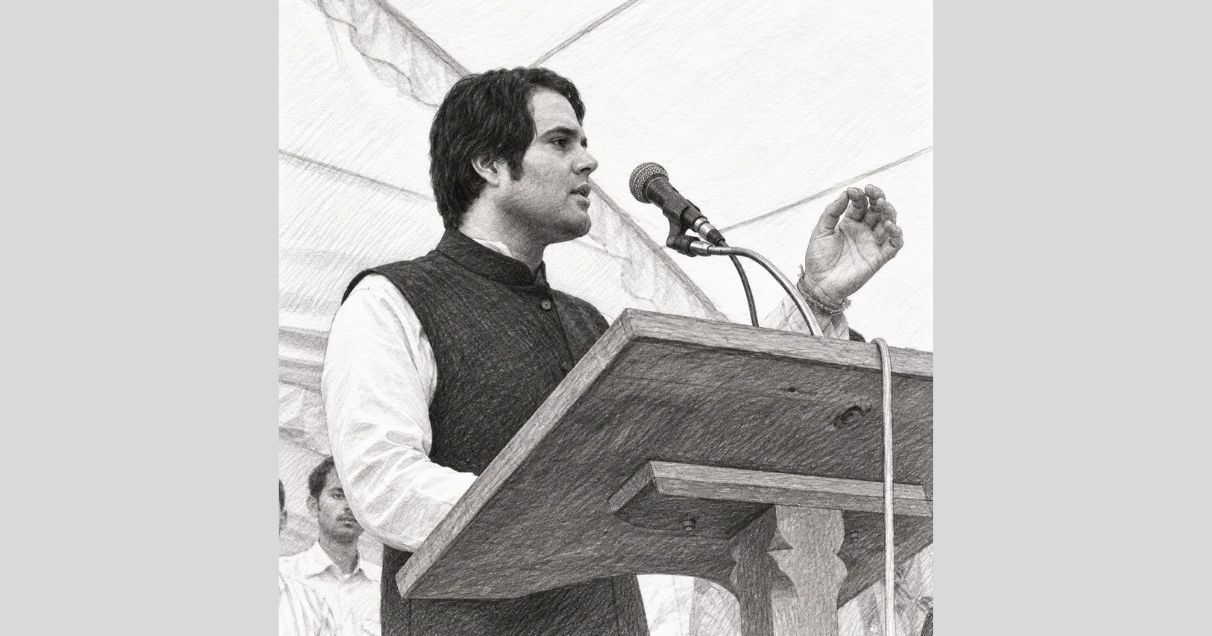
There is a peculiar loneliness in being Varun Gandhi.
He carries perhaps the most recognisable surname in Indian politics, but belongs completely to neither of the political worlds with which that surname is associated.
He is Sanjay Gandhi’s son and Indira Gandhi’s grandson. Yet the Congress party that his grandmother led became the political home of another branch of the family. Varun built his own career in the Bharatiya Janata Party, a party historically opposed to the Congress establishment identified with the Nehru-Gandhi family.
That alone makes his political life unusual. But there is another dimension to Varun Gandhi which is easily lost amid discussions about dynasty, party equations and speculation about his political future. He is still remarkably young by the standards of Indian politics.
Born on March 13, 1980, Varun Gandhi is 46. Yet by the time he was 44, he had already completed three terms in the Lok Sabha. He entered Parliament from Pilibhit in 2009 at just 29, returned to Parliament from Sultanpur in 2014 and won Pilibhit again in 2019. (Digital Sansad)
That combination, relative youth and substantial parliamentary experience, is uncommon.
The Burden Of Sanjay Gandhi
Varun was only a few months old when his father, Sanjay Gandhi, died in a plane crash in June 1980. He therefore inherited something he could never personally have experienced: his father’s political legacy. And Sanjay Gandhi remains one of the most debated figures in modern Indian political history.
For a son, such a legacy can be both inheritance and burden. Varun did not have the opportunity to learn politics from his father, argue with him, reject his ideas or develop under his guidance. Yet his public identity inevitably carried the Sanjay Gandhi name. Then came another historical separation.
Maneka Gandhi and the rest of the Gandhi family went their different ways. Eventually, Indian politics produced an extraordinary situation: Sonia Gandhi, Rahul Gandhi and Priyanka Gandhi became identified with the Congress while Maneka and Varun Gandhi built their careers in the BJP.
For Varun, therefore, there has arguably never been an uncomplicated political inheritance. He has a famous surname without possessing the conventional political home associated with it. That may be the central paradox of his career.
A Politician Who Chose To Write
There is another aspect of Varun Gandhi that deserves more attention. He writes. Not merely the occasional political memoir or collection of speeches that politicians often publish, but large, research-heavy works dealing with public policy.
His 2018 book, A Rural Manifesto: Realising India’s Future Through Her Villages, examined rural India, agriculture, livelihoods and the structural problems confronting villages.
Then came The Indian Metropolis: Deconstructing India’s Urban Spaces, an enormous study of India’s cities examining subjects ranging from housing and transport to healthcare, sanitation, employment and urban governance. The Indian Express described the work as encyclopaedic in breadth and noted the scale of the research underlying it. (National Law School of India University)
Put the two books beside each other and an interesting intellectual project emerges. One studies the Indian village. The other studies the Indian city. In effect, Varun Gandhi has spent years attempting to understand the two great physical spaces in which Indians live. He has also published poetry, including The Otherness of Self and Stillness. (National Law School of India University)
Whether one agrees with his prescriptions or not, this is an unusual body of work for an active Indian politician of his generation.
Three Elections Before 45
Political careers in India can be extraordinarily long. Many leaders arrive at their greatest positions in their sixties and seventies. Some remain active well into their eighties. Against that backdrop, Varun Gandhi’s age changes the perspective through which his present position can be viewed. At 46, he has already fought and won three Lok Sabha elections.
His parliamentary career has included periods when he was firmly inside the BJP establishment and periods when his public interventions put distance between him and the party leadership. He spoke on farmers, unemployment, government vacancies and other economic and social questions, sometimes taking positions that differed from those of his own party’s government. (The Tribune)
Then, in 2024, the BJP did not renominate him from Pilibhit. Jitin Prasada contested the seat instead and won. (The Tribune). For many politicians, losing a parliamentary ticket after three terms could look like the beginning of political decline. Age makes Varun Gandhi’s case different. He has potentially decades of public life ahead of him.
The Photograph With Modi
That is why one photograph in March 2026 attracted disproportionate political attention. Varun Gandhi met Prime Minister Narendra Modi with his wife Yamini and daughter Anasuyaa. It was not presented merely as a formal political call.
Varun subsequently wrote warmly about receiving the Prime Minister’s blessings and guidance and referred to a sense of paternal affection and protection in Modi’s presence. The meeting prompted considerable speculation about whether relations between Varun and the BJP leadership were thawing, although the meeting itself does not establish what political role, if any, may follow. (NDTV India)
The presence of his family made the photograph particularly striking. For a politician whose life has so often been interpreted through family history, here was another family photograph, but this time with the central figure of the political party in which Varun had built his own career.
Its longer-term significance remains unknown. But it ensured that the question of Varun Gandhi’s future returned to political conversation.
More Than A Surname
Perhaps Varun Gandhi’s greatest challenge has always been escaping the question of what his surname means. If he succeeds, he is Sanjay Gandhi’s son. If he disagrees with the BJP, speculation begins about whether he will move towards his cousins.
If he remains within the BJP, his relationship with the leadership becomes the story. The individual politician can disappear behind the family tree. Yet his record provides another way of looking at him: three Lok Sabha victories, sustained engagement with constituency politics, substantial writing on rural and urban policy, and a willingness at various points to articulate positions distinct from his party’s official political messaging.
None of that determines what comes next. It does, however, explain why Varun Gandhi remains a politically interesting figure even without currently holding a parliamentary seat.
The Advantage Of Time
The most important fact about Varun Gandhi’s political future may ultimately be the simplest one. He is only 46. He first entered Parliament at an age when many Indian politicians are only beginning to establish themselves. He has already experienced electoral victories, influence within a national party, disagreement with its leadership, exclusion from an election and life outside Parliament.
That is an unusual amount of political experience to accumulate before 50. And perhaps that is where the loneliness of being Varun Gandhi meets the opportunity of being Varun Gandhi. He cannot recreate his father’s career.
He cannot simply inherit the political position occupied by another branch of the Gandhi family. Nor can a future role within the BJP be assumed merely from one meeting with the Prime Minister. His path, almost by definition, has to be his own.
For someone born into one of India’s most consequential political families, that may be an uncomfortable position. It may also leave him with something unexpectedly valuable in politics: time to write the next chapter himself.