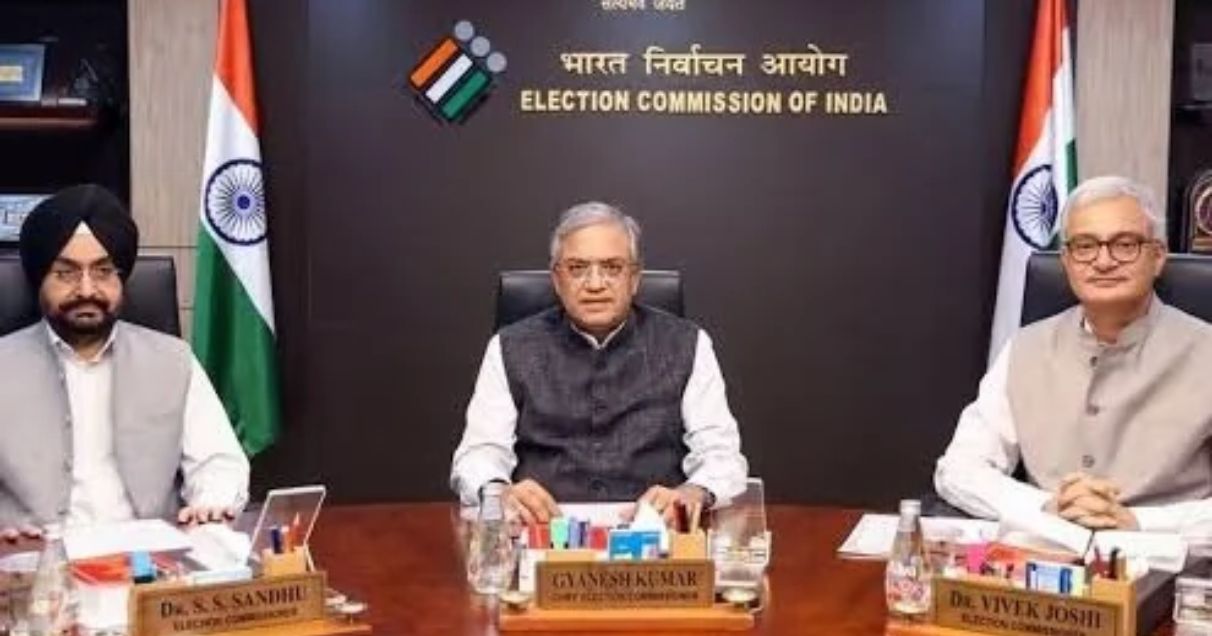
The Election Commission of India (ECI) has defended its decision-making process for the Special Intensive Revision (SIR) of electoral rolls, telling the Supreme Court that the decisions under challenge were taken unanimously and that the petitions against them rely on newspaper reports.
In an affidavit filed before the top court, the poll body maintained that suggestions, questions and differing views expressed by individual commissioners during internal deliberations should not be mistaken for final institutional decisions. It urged the court to dismiss the petitions challenging the process.
The affidavit comes amid reports alleging that Election Commissioners Sukhbir Singh Sandhu and Vivek Joshi were not adequately involved in certain decisions and had raised objections. According to those reports, the two commissioners had also approached the Chief Secretary over the matter.
ECI explains how decisions are approved
The Commission said the three orders concerning the SIR process, issued in June 2025, October 2025 and May 2026, were all approved unanimously.
Explaining its procedure, the ECI said files prepared by the relevant divisions are circulated first to one Election Commissioner, then to the other, and finally to the Chief Election Commissioner. Approved decisions are recorded in the relevant files, signed by the commissioners and subsequently notified and implemented by the Commission's secretariat.
The poll body argued that comments, queries or suggestions made by the Chief Election Commissioner or other commissioners during the examination of a file are part of the deliberative process and do not, by themselves, amount to a formal decision.
Referring to Section 18 of the 2023 Act, the affidavit said such exchanges between commissioners or with officials cannot be treated as decisions of the Election Commission unless they form part of the approved institutional process.
The Commission maintained that the views of all three members are considered before a decision is finalised.
Commission denies changes to voter registration Form 6
The affidavit also addressed allegations concerning Form 6, the statutory document used by eligible citizens to apply for registration as voters.
The ECI said none of its three SIR orders had changed the prescribed Form 6. It clarified that the declaration form used alongside Form 6 is a separate document introduced for the revision exercise.
By distinguishing between the statutory voter registration form and the declaration required under the SIR process, the Commission rejected claims that its orders had altered the established form for enrolling new voters.
The issue has become part of the broader legal and political dispute over the revision of electoral rolls and the manner in which the exercise is being conducted.
Multiple petitions challenge poll panel's functioning
The Supreme Court is scheduled to hear a batch of petitions on the controversy, with seven matters listed, including pleas filed by Congress leader Rahul Gandhi, opposition leader Digvijaya Singh, AIMIM chief Asaduddin Owaisi and others.
The petitions raise questions about the Commission's decisions and the manner in which the poll body, led by Chief Election Commissioner Gyanesh Kumar, has handled the process. Some petitioners have sought action against Kumar, including his suspension.
The case has attracted attention amid opposition protests against the SIR exercise and demands for greater scrutiny of the Commission's functioning.
On October 5, the Supreme Court issued notices on the initial petitions. The judges had said that they could not pass an order solely on the basis of a newspaper report and would first need to hear the responses of the parties concerned.
The court also indicated that it would intervene if any decision by the Election Commission was found to be contrary to law, stating that such a decision could be annulled.
The upcoming hearing is expected to examine the challenges to the SIR process alongside the issues raised about the Commission's internal decision-making and the legal basis of its orders.