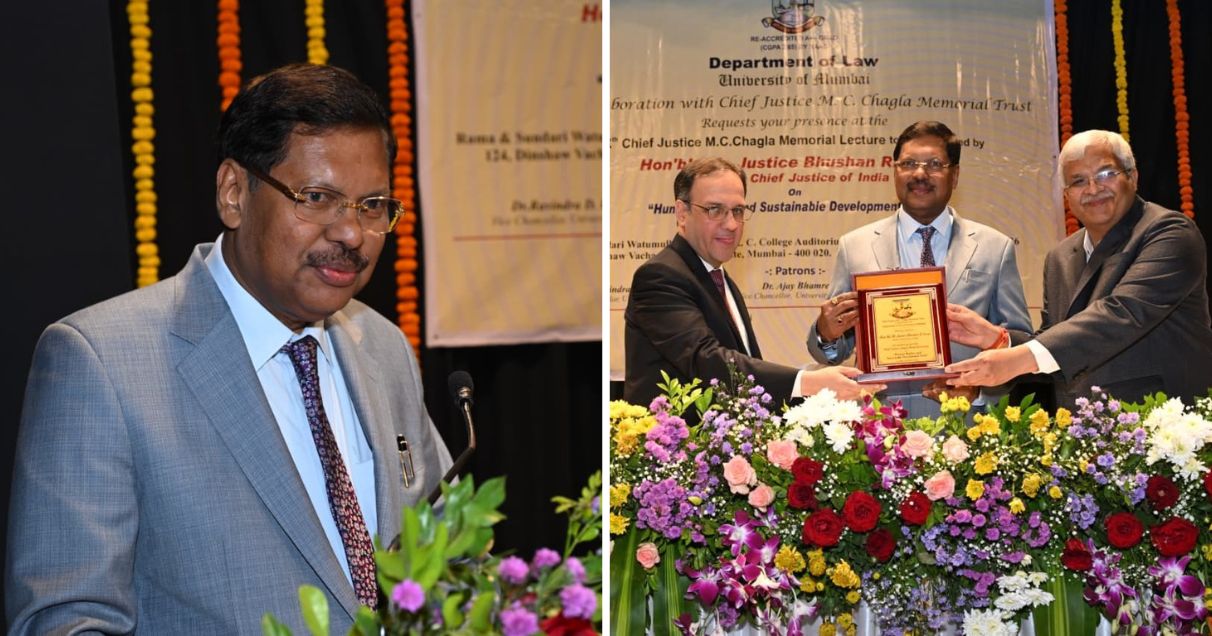
Esteemed faculty members and my dear students, I am honoured to address you today at the 9th M.C. Chagla Memorial Lecture on the title “Human Rights and Sustainable Development Goals”.
Before turning to the substantive theme of my address, I would like to say a few words about Justice Chagla and pay tribute to his remarkable legacy.
Justice Chagla occupies a central place in the history of India. His life in public service and his work as a lawyer and judge reflected his faith in the constitution and the rule of law.
He studied at St. Xavier’s School in Bombay before going to Oxford University, where he studied at Lincoln College. He was called to the Bar in 1922 and returned to Bombay to begin what would become an extraordinarily distinguished legal career.
His early years at the Bar were formative. He practised before the Bombay High Court for 19 years before being appointed as a judge, and was associated with some of the leading lawyers of his time.
He also taught law at the Government Law College, where he worked alongside Dr B.R. Ambedkar. In addition to these responsibilities, he was the Honorary Secretary of the Bombay Bar Council from 1933 to 1941, as well as the President of the Bombay Branch of the Royal Asiatic Society. A few years later, at the moment of India's Independence, he became the first Indian Chief Justice of the Bombay High Court.
He also received the offer of appointment to the Supreme Court by Justice Kania. However, he forewent the offer despite the higher salary and other benefits the position would offer to continue as the Chief Justice of the Bombay High Court. Although Supreme Court judges such as Justice M.C. Mahajan expressed their dismay over Justice Chagla’s decision, his choices highlighted his strong commitment to Bombay High Court, as well as to justice and the tenets of liberty and equality.
Even after his retirement, Justice Chagla continued his work in public service. He was a judge at the International Court of Justice from 1957 to 1960, and India’s ambassador to the United States, Mexico, and Cuba between 1958 and 1961. He was later appointed as India’s High Commissioner to Britain and Ambassador to Ireland.
Upon his return to India, Justice Chagla received a letter of appreciation from then Prime Minister Jawaharlal Nehru for his distinguished service – a testament to his uncanny ability to excel in each role.
He was later appointed as a Union Minister and held the portfolios of Education and External Affairs under the governments of Jawaharlal Nehru, Lal Bahadur Shastri and Indira Gandhi. He resigned in 1967 and returned to practice at the Supreme Court.
I must emphasise here that Justice Chagla’s legacy cannot be understood just through the offices he occupied, but through the constitutional values that guided his public life.
He consistently upheld the rule of law, maintained a deep faith in democracy and advocated for civil liberties. He spoke against discrimination of Indians in South Africa. During the Emergency, he was among the most vocal critics of the concentration of constitutional power and the erosion of democratic freedoms. Justice Chagla’s life therefore reflected a continuing concern with the relationship between State power and individual liberty.
His interpretation of the Constitution centred around human dignity. This was especially evident in his writings where he stated, and I quote, “Freedom in this sense is meaningless if it prevents the achievement of economic and social justice. To a hungry man or to a man who is denied human dignity political freedom is an empty word.”
His words are significant because they emphasised that political liberty alone cannot constitute freedom. His words drew attention to a truth which lies at the very heart of constitutional democracy: political rights and socioeconomic conditions are inextricably intertwined.
This understanding bears resonance with Dr Ambedkar’s conception of democracy. While discussing the foundations of parliamentary democracy, Dr Ambedkar warned that political rights must not be treated as sufficient in themselves. He said, “Political democracy cannot succeed where there is no social and economic democracy… Social and economic democracy are the tissues and the fibre of a political democracy. The tougher the tissue and the fibre, the greater the strength of the body.”
Both Dr Ambedkar and Justice Chagla’s words present the same insight: freedom cannot be separated from the social conditions in which it is experienced.
The relationship between freedom and social conditions was also central to the development of the modern international human rights framework. The experience of the Second World War had demonstrated the consequences that could follow when the dignity of the individual ceased to be regarded as a matter of common concern.
It was against this background that the Charter of the United Nations was adopted in 1945. The Charter reaffirmed faith in fundamental human rights, in the dignity and worth of the human person, and in the equal rights of men and women. Three years later, in 1948, the Universal Declaration of Human Rights (UDHR) gave more concrete expression to these principles.
What is particularly important for our discussion today is the breadth of the conception of human rights embodied in the UDHR. It recognised rights that we ordinarily describe as civil and political rights, including equality before the law, freedom of expression, freedom of conscience and the right to participate in government. But it did not stop there.
The UDHR also recognised the right to work, the right to education and the right to an adequate standard of living. The international human rights project therefore did not conceive freedom merely as protection against State interference. It recognised that the effective enjoyment of freedom also depends upon the social and economic conditions in which an individual lives.
This understanding was subsequently developed through the two International Covenants adopted in 1966: the International Covenant on Civil and Political Rights and the International Covenant on Economic, Social and Cultural Rights. Together, these instruments reflected a broader understanding of human freedom. Civil and political rights, on the one hand, and social and economic rights, on the other, may have developed through different legal frameworks, but they ultimately share a common concern: the dignity of the human person.
This brings us back to the insight expressed by Justice Chagla. A person may formally possess political liberty, but the substantive value of that liberty is diminished when that person is deprived of food, education, healthcare, livelihood or the basic conditions necessary for a dignified existence.
Rights, therefore, cannot exist merely as abstractions. They must have substantive content. Human rights thus cannot be separated from questions of social and economic development.
Yet, this proposition leads us to another question. If development is necessary for the enjoyment of human rights, what kind of development should we pursue? Is every form of economic growth necessarily consistent with human well-being? What happens when the benefits of development are enjoyed by some while its social or environmental costs are borne by others?
We must therefore ask ourselves: when we speak of development, who is this development for? Development towards what end? And development at whose cost?
These questions bring me to the other part of the subject of my address today: sustainable development and the goals attached to it.
The idea of Sustainable Development Goals (SDGs) is often presented as a relatively recent concept. The expression may be relatively recent, but the underlying questions are much older. Allow me, therefore, to briefly trace how this second strand of thinking evolved.
The SDGs draw upon several strands of international thought, including human rights, social and economic development, and environmental protection. They bring these concerns into a common framework, linking the well-being of people living today with our responsibilities towards future generations.
The roots of the SDGs can be tracked back to the United Nations Conference on the Human Environment, held in Stockholm in 1972. As the first world conference to make the environment a major issue, it brought international attention to the relationship between environmental protection and human well-being.
This was followed by the Brundtland Commission’s Report, “Our Common Future”, in 1987, which gave the concept of sustainable development its most influential formulation. It defined sustainable development as “a development that fulfils the needs of current generations without compromising the ability of future generations to fulfil their own needs”.
The significance of this formulation lies partly in its emphasis on “needs”. The report gave priority to the essential needs of the world’s poor. Environmental protection and the struggle against deprivation were thus integral to the same conception of development. Its concern extended both to those whose basic needs remained unmet and to those who would inherit the consequences of present choices.
The Rio Earth Summit of 1992 developed this understanding further. It emphasised that environmental protection must form an integral part of the development process, and that development must equitably address the needs of present and future generations.
At the turn of the millennium, the international community sought to translate its developmental commitments into measurable goals. In September 2000, world leaders gathered at the United Nations Millennium Summit and adopted the Millennium Declaration. The eight Millennium Development Goals emerged from these commitments, setting targets to be achieved by 2015. They addressed extreme poverty and hunger, primary education, gender equality, child and maternal health, major diseases, environmental sustainability, and global partnership for development.
The MDGs helped focus international attention and resources on basic human needs. However, progress remained uneven across countries and communities, and significant deprivation persisted. As their 2015 deadline approached, the challenge was both to complete this unfinished work and to develop a framework that more fully connected poverty reduction with inequality, environmental protection and institutional accountability.
An important step came at the Rio+20 Conference in 2012, where countries agreed to begin a process for developing Sustainable Development Goals. This process subsequently converged with discussions on the development agenda that would succeed the MDGs. In September 2015, the United Nations adopted the 2030 Agenda for Sustainable Development, comprising seventeen Goals and 169 targets.
The transition represented a broadening of both scope and responsibility. The SDGs retained the concern with poverty, hunger, education and health, while giving greater prominence to inequality, sustainable consumption, climate action, peace and access to justice. They also established a universal agenda applicable to all countries. Development was thus framed as a shared responsibility to advance human well-being while protecting the environmental conditions upon which it depends. The language of the SDGs speaks of both protection of people as well as the environment.
Sustainable development consequently requires us to consider two dimensions of justice. The first is intragenerational equity: how fairly are the benefits and burdens of development distributed among people living today? The second is intergenerational equity: what consequences will our choices have for those who come after us?
These dimensions must be considered together. We cannot pursue present prosperity by exhausting the ecological foundations of future well-being. Equally, we cannot ask those living in poverty today to bear an unfair share of the costs of protecting the future. Sustainable development requires justice within generations as well as across them.
This is also indicative of the central pledge of the United Nations, i.e., “Leave No One Behind”. The 2030 UN Agenda goes further by committing to reach those furthest behind first. This requires attention to people whose exclusion may remain concealed beneath improvements in national averages.
This historical journey brings us to a deeper philosophical question: by what standard should development be judged? Indicators such as Gross Domestic Product, national income, investment and production tell us much about the scale of economic activity. By themselves, however, they cannot tell us whether its benefits are fairly distributed, whether people enjoy greater freedom, or whether economic activity is undermining the environment upon which their lives depend.
Philosopher John Rawls offers an important starting point. In his book “A Theory of Justice”, his conception of justice as fairness challenges the assumption that greater benefits for society as a whole can justify every sacrifice imposed upon particular individuals. The rights and freedoms of some cannot simply be traded away to increase the advantages enjoyed by others.
Applied to development, this insight requires us to look beyond aggregate gains and examine how those gains are secured. A project may generate wealth, employment and infrastructure. Yet its assessment must also account for the people who lose their homes, livelihoods or access to natural resources. Their losses raise questions of justice that an increase in overall prosperity cannot, by itself, answer.
This is also where development connects with environmental and climate justice. We must ask whose surroundings are polluted, whose livelihoods are placed at risk, and whose voices are heard when decisions are made. We must also consider whether those bearing the greatest burdens have the resources and institutional support necessary to protect themselves.
Especially in a country like India, the sad reality is that it is invariably marginalised groups, including low income groups, women and Adivasis who bear the brunt of climate change and environmental degradation.
Our own philosopher Amartya Sen approaches the question of development through the idea of freedom. In his book, “Development as Freedom”, he notes that, “Development requires the removal of major sources of unfreedom: poverty as well as tyranny, poor economic opportunities as well as systematic social deprivation, neglect of public facilities as well as intolerance or overactivity of repressive states.”
This understanding changes the standard by which progress is assessed. Income remains important, but its significance lies in what it enables people to do. The central question becomes whether individuals possess genuine opportunities to obtain an education, enjoy good health, secure a livelihood and participate in the life of their community.
Economic growth can help create these opportunities by generating employment and resources for public services. Its value must therefore be assessed by how effectively those resources expand human freedom. The existence of wealth in a society tells us too little unless we also examine the lives that people are actually able to lead.
Martha Nussbaum develops a distinctive account of the capabilities approach, placing human dignity at its centre. In her work “Creating Capabilities”, she asks the fundamental question: “What is each person actually able to do and to be?”
The emphasis on each person is significant. It directs our attention to the opportunities available to individuals whose circumstances may be obscured by a society’s overall achievements. Her account encompasses life, bodily health and integrity, the development of thought and imagination, emotional life, relationships with others and with nature, and participation in shaping one’s political and material environment.
These philosophical perspectives offer different but complementary ways of examining development. Rawls directs attention to fairness and the protection of basic liberties. Sen asks whether development expands substantive freedom. Nussbaum asks whether each person has the capabilities necessary for a life of dignity.
Together, they help us understand why economic growth, in itself, is an insufficient measure of human progress.
Sustainable development adds a further responsibility to this inquiry. The conditions that support dignity and freedom must endure across generations. Education, health, livelihood and participation depend upon social institutions, but they also depend upon clean air, adequate water, functioning ecosystems and a habitable planet.
The philosophical questions we have considered find a powerful expression in the Indian Constitution. Fairness, freedom and the conditions necessary for human dignity are central to its vision of the Republic.
Long before the adoption of the Sustainable Development Goals, the Indian Constitution brought together political freedom, social equality and economic justice. As Dr. Ambedkar stated in his last address to the Constituent Assembly, “We must make our political democracy a social democracy as well. Political democracy cannot last unless there lies at the base of it social democracy.”
He further stated that: “In politics we will be recognizing the principle of one man one vote and one vote one value. In our social and economic life, we shall, by reason of our social and economic structure, continue to deny the principle of one man one value. How long shall we continue to live this life of contradictions? How long shall we continue to deny equality in our social and economic life?”
The Preamble commits the Republic to social, economic and political justice, alongside liberty, equality and fraternity.
Fraternity adds a further dimension to this inquiry. It asks us to recognise that the dignity of another person is a matter of shared concern.
Articles 14, 15 and 17 establish guarantees of equality, prohibit specified forms of discrimination and abolish untouchability. These guarantees are complemented by the Directive Principles concerning welfare, livelihoods and distribution of resources under Articles 38 and 39, the advancement of weaker sections under Article 46, nutrition and public health under Article 47, and equal justice and legal aid under Article 39A. Together, they provide a constitutional foundation for inclusive development, requiring attention both to the distribution of opportunities and to the barriers that prevent disadvantaged communities from enjoying them.
This relationship between freedom and social transformation runs through the Fundamental Rights and the Directive Principles. Their legal operation differs. Fundamental Rights are judicially enforceable, while Article 37 makes the Directive Principles non-enforceable by courts but fundamental to governance. The State has a duty to apply them in making laws.
The significance of this arrangement lies in the relationship between the two parts. Though prior to 1973, the Supreme Court was of the view that the Fundamental Rights would prevail over the Directive Principles and wherever there was a conflict between the two, the Directive Principles will have to give way to the Fundamental Rights. However, the Constitution Bench of 13 Judges in the case of Kesavananda Bharati v. State of Kerala and Anr. resolved this conflict and recognised the harmony and balance between Fundamental Rights and Directive Principles as an essential feature of the Constitution.
Environmental responsibility subsequently received express constitutional recognition through the Forty-second Amendment of 1976. Article 48A directs the State to protect and improve the environment and safeguard forests and wildlife. Article 51A(g) places a corresponding duty upon citizens concerning the natural environment and compassion for living creatures.
The distinction in chronology matters. The Constitution’s original commitments to freedom, equality and social justice were later strengthened by explicit environmental provisions. Through constitutional amendment and judicial interpretation, the relationship between human dignity and the natural world became more fully articulated.
Many concerns now expressed through the Sustainable Development Goals therefore have deep roots in our constitutional framework. The correspondence is not exact, and the SDGs have their own international history and policy framework. Nevertheless, both direct attention to the conditions in which people live and to the institutions responsible for improving those conditions.
Sustainable development in India must consequently be examined through constitutional standards. International goals can guide policy and help measure progress. The Constitution supplies obligations against which the exercise of public power must be assessed. A development target cannot, by itself, justify a violation of constitutional rights.
Let me now turn to the role of the Supreme Court in giving practical meaning to this relationship. Through its interpretation of Article 21, the Court has examined how the protection of life extends to the conditions necessary for living with dignity and environment protection. The significance of this jurisprudence becomes clearer when we consider the human circumstances behind individual cases.
In Olga Tellis v. Bombay Municipal Corporation, the Court considered the position of pavement and slum dwellers facing eviction in this city. It recognised livelihood as an integral component of the right to life because deprivation of the means of subsistence could make life itself impossible. At the same time, the judgment did not establish an unrestricted right to occupy public pavements. Its reasoning brought livelihood and fair procedure into the constitutional assessment of eviction.
The case remains important for thinking about urban development. A settlement might appear in an administrative plan as an obstruction or an unauthorised occupation. But for residents of that settlement, its location may determine whether they can reach their workplace, send their children to school or sustain networks of mutual support. A constitutional assessment must take these human consequences seriously.
This connects the right to livelihood with the wider aspiration of sustainable and inclusive cities. Infrastructure has to serve the people who inhabit a city, including those whose work sustains it but whose housing remains insecure. The quality of urban development must therefore be assessed partly by what happens to those with the least power to influence its design.
In Paschim Banga Khet Mazdoor Samity v. State of West Bengal, an injured person was unable to obtain treatment at several government hospitals. The Court held that the failure to provide timely medical treatment violated Article 21. It recognised the State’s obligation to provide adequate medical services and directed measures to improve emergency care. Although these facilities required financial resources, the constitutional obligation could not simply be avoided on that account.
The connection with development is immediate. A health system must ultimately be judged by whether a person in need can obtain appropriate care. The existence of hospitals and the allocation of funds are important, but the experience of the patient reveals whether those arrangements fulfil their purpose. Constitutional dignity directs our attention to that experience.
The same constitutional approach can be seen in relation to education. In Mohini Jain (Miss) v. State of Karnataka and Ors. and Unni Krishnan v. State of Andhra Pradesh, the Court read Article 21 alongside the Directive Principles and recognised a right to free education up to the age of fourteen. Beyond that age, the obligation was understood in relation to the State’s economic capacity and development. The judgment demonstrated how social objectives could inform the substantive meaning of a Fundamental Right. The subsequent insertion of Article 21A expressly guaranteed free and compulsory education for children between six and fourteen years, in the manner determined by law. This constitutional development reinforces the relationship between education and equal citizenship.
Taken together, these decisions reveal a common concern with the substantive conditions of dignity. They also demonstrate why the different dimensions of development are interconnected. Loss of livelihood can undermine access to food and shelter. Ill health can interrupt education and employment. A failure in one sphere can diminish freedom in several others.
Environmental degradation makes this interdependence particularly clear. The protection of health depends upon the quality of air and water. Livelihoods can depend upon fertile soil, forests and functioning ecosystems. The security of a home can depend upon the surrounding environment. Environmental protection consequently enters the constitutional discussion through its relationship with the conditions of human life.
In Subhash Kumar v. State of Bihar, the Court recognised the right to enjoy pollution-free water and air as part of the right to life under Article 21. This principle changes how we should assess the costs of economic activity. Pollution has consequences that may be borne by people who receive little of the income generated by the activity causing it. When we ask whether development advances human well-being, we must include those consequences in our assessment. Otherwise, apparent prosperity may conceal the transfer of costs to others.
In Vellore Citizens’ Welfare Forum v. Union of India, the Court confronted pollution caused by tanneries. It acknowledged the industry’s economic importance while insisting that development must be compatible with environmental protection. The Court recognised the precautionary principle and the polluter-pays principle as essential features of sustainable development and as part of Indian environmental law.
These principles give practical content to responsibility. Precaution requires action to anticipate and prevent environmental harm, with scientific uncertainty providing no justification for postponing measures where serious or irreversible damage is threatened. The polluter-pays principle places responsibility for compensating affected persons and restoring environmental damage upon the polluter.
Their significance extends to the distribution of development’s burdens. Prevention asks whether harm can be avoided before lives and livelihoods are disrupted. Responsibility for restoration asks who should bear the costs when damage occurs. Both questions connect environmental protection with fairness.
This provides a foundation for thinking about environmental justice and climate justice. Environmental justice requires us to examine the distribution of environmental benefits and harms, and the opportunities people have to influence decisions affecting their surroundings. Climate justice adds questions about responsibility for emissions, unequal vulnerability and the allocation of the costs of mitigation and adaptation.
A constitutional approach to these questions must also examine the consequences of proposed solutions. Measures to protect forests, expand clean energy or transform cities should account for affected livelihoods and communities. Their design should include effective participation, fair procedures and appropriate support for those required to bear significant costs. The pursuit of environmental sustainability must remain attentive to social and economic justice.
The role of courts is important within this larger responsibility. Courts can enforce rights, scrutinise unlawful decisions and require public authorities to discharge their duties. Durable progress also depends upon legislation, public investment, capable institutions and democratic participation. The implementation of rights requires sustained work across all these spheres.
The jurisprudence we have considered therefore offers a way of thinking about development. It asks us to examine what public decisions mean for the person seeking treatment, the child seeking an education, the worker protecting a livelihood and the community dependent upon its environment. These experiences help reveal whether the promise of development is being fulfilled.
The Sustainable Development Goals provide a framework with a target year of 2030. The constitutional pursuit of justice continues beyond that horizon. Its demands must guide how we respond to emerging environmental pressures, changing economic conditions and the needs of generations yet to come.
Economic growth must contribute to human dignity. Environmental protection must sustain the conditions of life across generations. Public institutions must enable people to participate in these choices and seek remedies when their rights are violated. Bringing these commitments together is the constitutional responsibility that belongs to all of us.
Thank you.