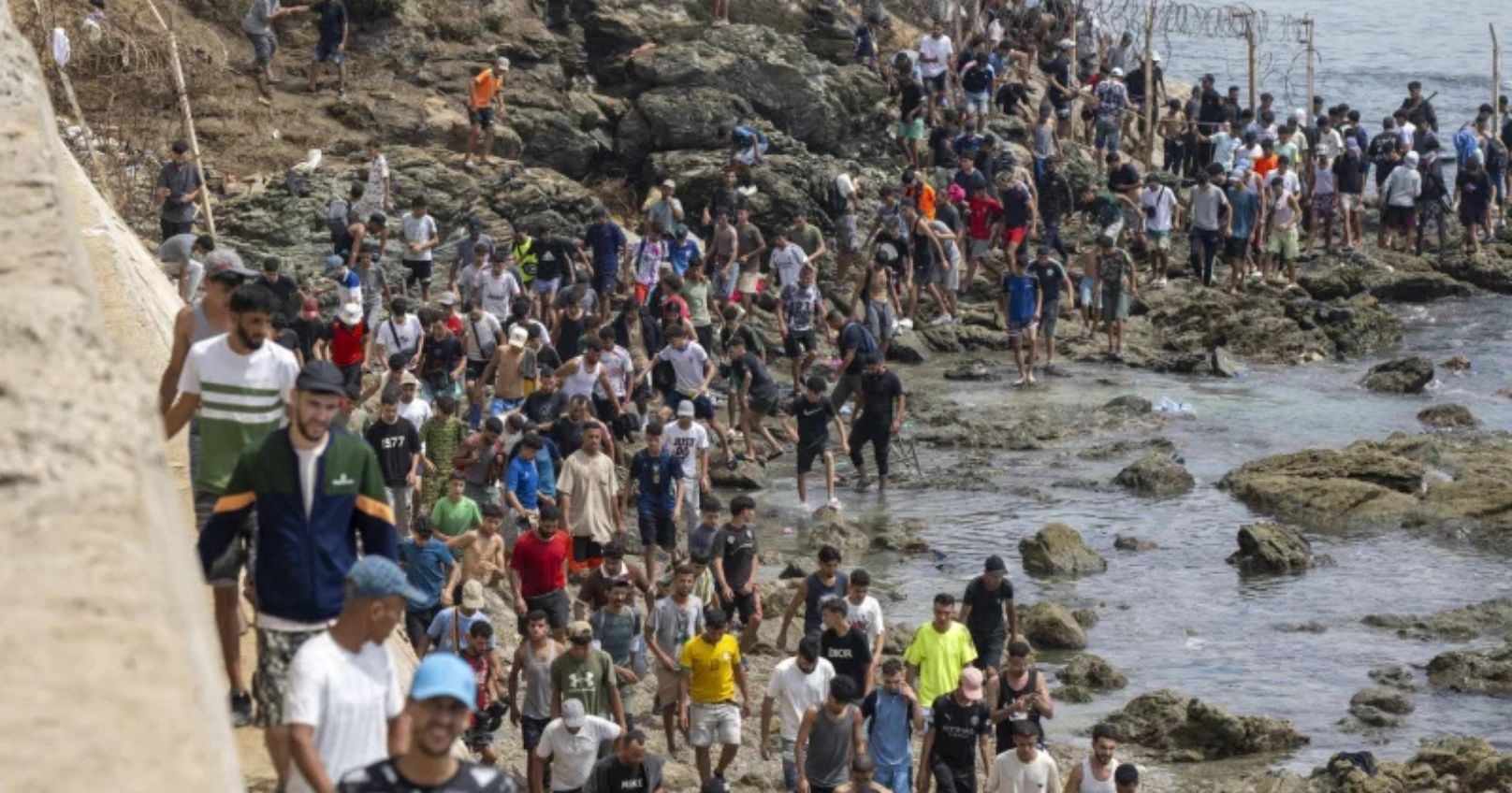
Spain's North African enclave of Ceuta witnessed an extraordinary migration surge this week as nearly 60,000 people attempted to enter the territory from neighbouring Morocco within just two days, overwhelming border infrastructure and triggering a political storm across Europe.
Thousands of migrants swam across the sea, scaled border barriers and gathered along the coastline in one of the largest mass movements ever seen at the frontier separating Africa from the European Union. Spanish authorities said that by Friday evening, more than 48,000 people had already been sent back or had voluntarily returned to Morocco.
The scale and speed of the exodus have raised a crucial question: how did so many people arrive at one of Europe's most fortified borders almost simultaneously?
Social media played a key role
Investigations and eyewitness accounts suggest that online networks were instrumental in mobilising the migrants. In the days leading up to the crossing, social media groups circulated information about sea conditions, routes to Ceuta and legal developments in Spain.
Posts in Arabic reportedly included maps showing access points, while users exchanged tips on equipment such as flippers and wetsuits. Some migrants even prepared for weeks by learning to swim specifically for the journey.
As rumours spread that reaching Spanish territory could improve their chances of staying in Europe, thousands began heading north by car, bicycle and public transport.
Conflicting accounts about Moroccan authorities
Several migrants claimed that Moroccan police officers directed them towards Ceuta instead of stopping them.
One migrant told international media that security personnel repeatedly pointed towards the Spanish enclave and encouraged people to move in that direction.
However, there were also reports of Moroccan authorities attempting to prevent the crossings. Images from border areas showed security forces dispersing crowds and using water cannons near the town of Fnideq, close to Ceuta. In some cities, authorities allegedly stopped people from boarding trains headed north.
Morocco had not officially commented on the allegations by Friday.
A dangerous crossing turns deadly
What began as a desperate attempt to reach Europe soon turned tragic. Strong currents and overcrowding turned the sea route into a death trap.
Reports suggest that dozens of people died while trying to swim to Ceuta, although the exact death toll remains unclear. Some estimates put the number of fatalities at more than 50.
Migrants described seeing bodies in the water as they struggled to reach shore. Many arrived with injuries after being thrown against rocks by powerful waves.
The crisis has placed enormous pressure on Ceuta, a territory with a population of around 83,000 people. Local authorities described the situation as unsustainable, with reception centres quickly running out of capacity.
Why were thousands willing to risk their lives?
For many of those who attempted the crossing, economic hardship was the driving force.
Young migrants cited unemployment, lack of opportunities and hopes for a better future in Europe as their primary motivations. Morocco continues to face high youth unemployment, despite strong economic growth in recent years.
Spain's immigration policies may also have contributed to the rush. Earlier this year, Madrid announced measures allowing more migrants to regularise their status, while recent court rulings sparked speculation online that people intercepted at sea could not be immediately deported.
Many migrants believed that simply reaching Spanish soil would open the door to life in Europe.
Ceuta is not a gateway to mainland Europe
Despite widespread perceptions, arriving in Ceuta does not automatically grant access to mainland Spain or the rest of the European Union.
Although Ceuta is Spanish territory and part of the Schengen zone, travellers still face strict identity checks before entering mainland Europe. Spanish officials confirmed that none of the recent arrivals had been transferred to other EU countries.
Most migrants found themselves stranded in overcrowded facilities or waiting under police supervision before being returned to Morocco.
Diplomatic tensions add another dimension
The mass migration has also intensified speculation about the role of regional politics.
Analysts have pointed to Spain's improving ties with Algeria as a possible factor behind the crisis, given Morocco's longstanding rivalry with its neighbour. Experts believe diplomatic tensions may have influenced the broader context, although no direct evidence has emerged linking the crossings to political decisions.
Meanwhile, European leaders have responded sharply. Spanish Prime Minister Pedro Sánchez visited Ceuta and ordered additional security forces to the border, while several European governments demanded stricter immigration measures.
For the migrants who risked everything to reach Ceuta, however, geopolitics was far from their minds.
Many arrived exhausted, hungry and uncertain about what lay ahead, only to discover that the gateway to Europe they had imagined was, in reality, a dead end.