India Didn't Earn These Dollars. It Rented Them
The $57 billion propping up the reserve number is a loan with a maturity date. The rupee already knows
21-08-2026

The $57 billion propping up the reserve number is a loan with a maturity date. The rupee already knows
21-08-2026India's foreign exchange reserves stood at $707.0 billion in the week ended 7 August 2026, up $14.14 billion on the week. The week before that they rose $10.51 billion to $692.87 billion, the sharpest weekly gain since the end of January. Five consecutive weeks of accretion, the longest such run since April 2025. Governor Sanjay Malhotra has told the country that reserves remain adequate on standard metrics, with import cover above ten months and external debt cover of 90.8 per cent.
All of that is true. None of it means what the headlines suggest.
Because over the same stretch, the rupee has gone essentially nowhere. It closed near 95.6–95.8 to the dollar in the third week of August, against a record low of 96.844 printed on 20 May and a level near 89.86 at the start of January. Reserves up $35 billion in five weeks; currency up perhaps one per cent from its worst-ever level.
That combination is not a paradox to be explained away. It is the mechanism working exactly as designed, and the design deserves scrutiny it has not received.
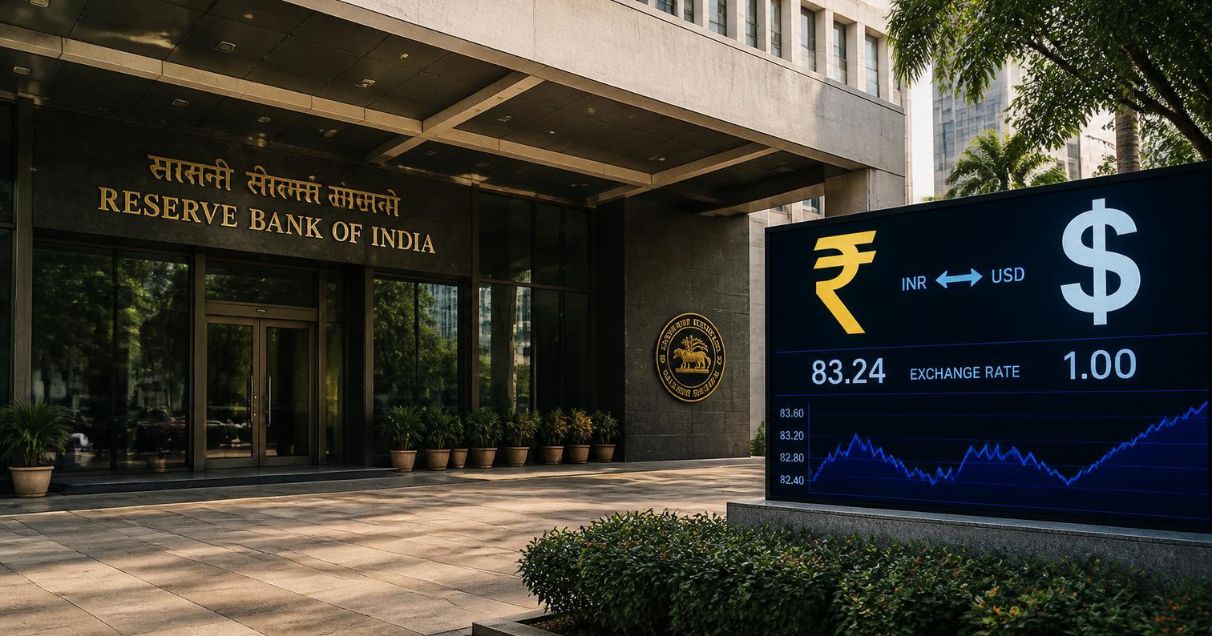
On 5 June 2026 the RBI announced a capital-inflow package; the operational circular followed on 8 June. Authorised dealer banks were permitted to raise fresh or renewed FCNR(B) deposits of three to five years’ tenor and swap the dollar proceeds directly with the Financial Markets Operations Department of the central bank.
The structure is a par swap. The bank sells dollars to the RBI at the prevailing FBIL spot rate and receives rupees. At maturity the transaction reverses at the same rate. The bank's currency risk is zero. The RBI's currency risk is one hundred per cent.
Two further sweeteners were bolted on. Deposits mobilised under the window were exempted from CRR and SLR, so banks could deploy the entire corpus rather than sterilising a slice of it. And the swap, once executed, is non-cancellable regardless of what happens to the underlying deposit.
Do the arithmetic from the bank's side. Before the window, hedging a dollar deposit in the forward market cost roughly 280–300 basis points a year. A bank lending at 9–10 per cent in rupees and spending 3 per cent on the hedge could offer a non-resident depositor 2–4 per cent — uncompetitive against a US Treasury yielding around 4.5 per cent. Remove the hedging cost and the same bank can offer 6.5–7.1 per cent. Which is precisely what happened; headline FCNR(B) rates went to 7.1 per cent within days.
The money came. Including external commercial borrowings and overseas foreign currency borrowings, total inflows under the facility reached $56.85 billion.
Now trace those dollars. They are on the RBI's balance sheet as spot reserves, which is why the weekly statistical supplement is climbing. Against them sits an obligation to deliver dollars back, at a fixed rate, in three to five years. The RBI's net forward book stands near $103.3 billion.
The asset is published. The liability is disclosed, but not in the number anyone quotes. India has not accumulated reserves. It has leased them, and prepaid the rent in the form of hedging cost absorbed by the public balance sheet.
This is the section most commentary skips, and it is the one that matters. The RBI released balance-of-payments data for April–June 2026 on 14 August. The current account deficit was $3.1 billion, against $2.9 billion in the same quarter a year earlier. Essentially unchanged. On any historical comparison, trivially small for an economy of this size.
The overall balance of payments recorded a deficit of $8.1 billion, against a surplus of $4.5 billion a year earlier. Read those two numbers together. The current account barely moved. The BoP swung by nearly $13 billion. The entire deterioration came from the capital account — a sharp reversal in portfolio flows.
The merchandise gap did widen, to $85.7 billion from $68.9 billion, and the reason was price, not appetite: the crude import bill rose 26 per cent year-on-year to $49 billion even as import volumes fell 18 per cent. India paid a quarter more for a fifth less oil. The Strait of Hormuz disruption did that, and no domestic policy lever touches it.
But the offsets held. Services earnings, remittances and FDI all performed. The invisible account is doing its job, as it has for a decade. The rupee's problem in 2026 is not that India is buying too much from the world. It is that the world has stopped wanting to hold rupee assets. That is a very different disease, and the FCNR(B) window treats the symptom.
A great deal of published commentary, including forecasts from serious institutions, still describes the rupee as labouring under a 50 per cent US tariff. That is stale.
The 50 per cent rate took effect on 27 August 2025 as 25 per cent reciprocal plus a 25 per cent penalty tied to Russian crude purchases. The penalty was withdrawn by executive order following Indian commitments on oil sourcing. Under the interim agreement announced on 6 February 2026, the reciprocal rate itself came down to 18 per cent. Six months on, 18 per cent is the number an Indian exporter actually pays, though sector-specific MFN duties still stack on top of it and the full first-phase bilateral agreement, market access, digital trade, non-tariff barriers, remains unsigned.
This correction cuts against the consensus narrative, and it should be uncomfortable for policymakers rather than reassuring.
*The rupee hit its all-time low on 20 May 2026 — three and a half months after tariff relief.* If a 32-point tariff reduction on the country’s largest trading partner could not arrest the slide, then trade policy is not the binding constraint on the currency. Oil price and capital flight are. Every rupee of RBI balance-sheet risk taken on since June has been deployed against a problem that a trade deal was never going to solve.
That the misconception persists in bank research eight months later is itself a data point about the quality of India's external-sector communication.
Gold revaluation. Gold holdings rose $3.995 billion in the single week to 7 August, reaching $108.74 billion, up from around $84 billion a year earlier. That is a mark-to-market gain on metal India already owned. It finances nothing. It reflects a global bid for gold that is itself a comment on stress in the dollar system, which is not obviously good news for a large dollar debtor.
This is a rebuild, not a build. Reserves peaked at $728.49 billion in the week ended 27 February 2026. They then bled for weeks as the RBI sold dollars defending the currency through the Hormuz episode. At $707 billion, India is still $21 billion below February. A substantial share of the celebrated inflow has simply replaced ammunition already fired.
The forward book. Gross reserves of $707 billion against a net forward short position near $103 billion. Any counterparty running a sovereign risk model already nets these. Only the domestic press doesn't.
None of this is hidden. ICICI Bank's market research, published in June, laid out the official logic with unusual candour. India's current account deficit is projected at 1.8 per cent of GDP in FY27, up sharply from 0.6 per cent ($25 billion) in FY26. On that trajectory, and with the capital account behaving as it did in Q1, the balance of payments would have printed a deficit in excess of $40 billion.
Instead, the expectation is a BoP surplus of $15 billion, a swing of some $55 billion. The stated source of that swing is $75–80 billion of inflows from two policy measures: the expansion of government securities under the Fully Accessible Route for foreign portfolio investors, and the concessional FX swap schemes.
Set aside whether the forecast is right. Consider what it concedes. India's external accounts in FY27 balance because of two administrative measures, one of which transfers currency risk to the central bank and the other of which invites hot money into the sovereign bond market. Neither generates a dollar of export earnings. Both are reversible by the counterparty and not by India.
The par swap means the RBI returns dollars at the rate at which it received them. If USD/INR is at 95 when the swap is struck and 108 when it unwinds in 2030, the central bank delivers dollars purchased at 108 for rupees received at 95. The difference is a realised loss on the RBI’s balance sheet, which flows through to the surplus transferable to the government, which is a fiscal number.
This is not a criticism of the instrument, central banks exist to absorb risks the private sector will not price. It is an observation that a contingent fiscal liability has been created without ever appearing in a Budget document, and that its size scales with exactly the outcome the policy is meant to prevent. If the rupee holds, the cost is small. If the rupee slides, the cost is large and arrives precisely when fiscal space is tightest.
The correlation is the problem. Insurance that fails in the state of the world it insures against is not insurance.
Meanwhile the external debt stock has been moving the wrong way independent of all this. Total external debt reached $762.8 billion at end-March 2026, up $26.3 billion, with the debt-to-GDP ratio rising to 20.8 per cent from 19.8 per cent. Strip out the valuation effect of dollar appreciation and the underlying increase was $51.0 billion, not $26.3 billion. Short-term debt on a residual maturity basis reached 42.9 per cent of total external debt and 47.3 per cent of foreign exchange reserves, up from 45.4 per cent a year earlier.
That last ratio is the one that matters in a stress scenario, and it deteriorated before $57 billion of new three-to-five-year foreign currency liabilities were added.
The RBI has run this play before. The 2013 FCNR(B) swap window, deployed during the taper tantrum, mobilised roughly $34 billion and added about $12 billion to reserves. It worked. It is remembered as a circuit breaker. Three differences deserve attention.
First, in 2013 banks still bore a 3.5 per cent hedging cost even with the subsidy. In 2026 the RBI has taken the entire currency risk at par. The 2026 window is materially more generous and therefore materially more expensive to the public balance sheet.
Second, 2013 was a crisis measure taken from a position of weakness, reserves were thin and the rupee was in free fall. 2026 is different, and officials have said so: the RBI entered this episode with $682.3 billion in reserves and described them as adequate. The stated objective was not to plug a reserve shortage but to attract capital and strengthen the balance of payments. A crisis tool has been deployed as a routine financing tool. That changes what it can be used for next time.
Third, and most important: 2013 was followed by adjustment. Rate action, fiscal consolidation, import compression on gold, and eventually a favourable oil shock. The window bought time and the time was used. In 2026, the window has bought time and the time has so far been used to buy more time.
The sequence from here is fixed and short.
– 31 August 2026 — last date for a fresh FCNR(B) deposit to qualify for the swap facility.
– 11 September 2026 — deadline for banks to execute eligible swaps with the RBI.
– October–December 2026 — the ECB and OFCB swap schemes remain open into December; the FCNR(B) access window runs to 16 October.
– 5–7 October 2026 — next MPC meeting. The repo rate has been held at 5.25 per cent since the easing cycle ended, most recently on 5 August, with a neutral stance, FY27 growth revised up to 6.7 per cent and CPI to 5 per cent. Headline inflation is expected to peak in Q3 on food and fuel.
– Late Q3 onward — the first clean read on the balance of payments without engineered inflows.
Natixis expects the RBI to be forced into 50 basis points of tightening before year-end, taking the repo to 5.75 per cent and to 6.00 per cent in 2027, on the argument that rates may have to rise to restore confidence in the currency and stop inflation expectations unanchoring. If that call is right, the swap window will have bought four months at the cost of a tightening cycle into a tariff-damaged export sector.
The forecast consensus, meanwhile, sees nothing: a 16-provider survey puts USD/INR at roughly 95.25 in late 2026, 95.64 in early 2027 and 95.72 in late 2027. Flat. But the dispersion is the real signal — Goldman, Danske and MUFG cluster at 95–97 on structural grounds; Bank of America and ING sit at 86–87 on the expectation that capital returns. A ten-rupee spread on the same economy is not a forecast. It is an admission that everything hinges on decisions not yet taken.
1. Publish the net reserve number, weekly, as the headline
Report gross reserves alongside the net forward position as a single figure. A headline that omits $103.3 billion of forward obligations is not disclosure, it is marketing, and every sophisticated counterparty already nets it. Voluntary transparency costs nothing that has not already been priced, and it buys credibility that cannot be purchased any other way. Adopt the IMF reserve template presentation prominently rather than in an annexe.
2. Publish the maturity ladder of the swap book before the window closes
$57 billion of three-to-five-year swaps struck within a four-month window will mature within a four-month window. Concentrated maturities are the standard mechanism by which manageable positions become crises. Disclose the ladder now, while the RBI still controls the narrative, and pre-commit to a staggered roll-off framework. The market will price a disclosed cluster far more cheaply than a discovered one.
3. Quantify and disclose the contingent fiscal cost
Publish the RBI's mark-to-market exposure on the par swaps at a range of terminal exchange rates, say 95, 105, 115. Put it in the Economic Survey. A liability whose size correlates with the very outcome it is meant to prevent should not be invisible to Parliament.
4. Stop treating a financing measure as a policy fix
The window addresses the financing of the deficit, not the deficit. On present data the current account is not the problem, $3.1 billion in Q1 FY27 is not a crisis number. The problem is a capital account that reversed by $13 billion year-on-year. Ask why foreign capital is leaving an economy growing at 6.7 per cent with inflation near 5 per cent, and fix that. Borrowed dollars do not answer the question; they postpone it.
5. Correct the tariff record, publicly and loudly
The applied reciprocal rate has been 18 per cent since February. Global bank research is still modelling 50 per cent. That gap is worth basis points on every Indian borrower's spread and is entirely self-inflicted. Issue a standing, dated external-sector fact sheet. Also stop invoking the tariff as the currency's cause — the record low came after the relief, and the argument no longer holds.
6. Name the target, or genuinely float
"We do not target any specific level, we only smooth volatility" is not credible when the currency has traded a two-rupee band for four months. Either announce a corridor and defend it explicitly, accepting the reserve cost, or let the rate clear and let exporters have the relief. The current ambiguity gives away optionality to the market for nothing and invites every trader to test where the line actually sits.
7. Attack the oil exposure as a currency policy, not an energy policy
A 26 per cent rise in the crude bill on 18 per cent lower volume is a pure price shock and it drove the entire widening of the trade gap. Strategic reserve capacity, long-dated crude hedging by the oil marketing companies, and diversification of transit routes away from Hormuz are exchange-rate instruments. They are cheaper than defending the rupee after the fact and they do not accrue as foreign currency debt.
8. Treat the FAR gilt expansion with more suspicion than the swap window
Of the two measures financing FY27, the swap at least has a lock-in and a fixed maturity. Index-driven flows into government securities can leave in a week and have done so in every comparable episode. Monitor the FAR stock as a share of the outstanding, publish it, and be honest about the fact that inviting hot money to fix a hot-money problem is a bet, not a strategy.
9. Decide what the reserves are actually for
Ten months of import cover is a solvency metric, not a strategy. If the reserves exist to defend a level, say so and accept they will be spent. If they exist as crisis insurance, stop spending them on a slow grind. Attempting both simultaneously is how a country arrives at the adjustment late — and in a single move rather than continuously.
The rupee's problem was never a shortage of dollars. It was a shortage of reasons for anyone to want rupees. Borrowed dollars do not create those reasons. They buy silence, and the silence has a maturity date.


From the power and insolvency appeal courts to debt and military tribunals, chairs and member seats
Read More
An estimate of Yes Bank’s liability and capital impact after the Supreme Court’s ruling in Yes B
Read More
When the state wields a sledgehammer against citizens seeking accountability, the Supreme Court’s
Read More