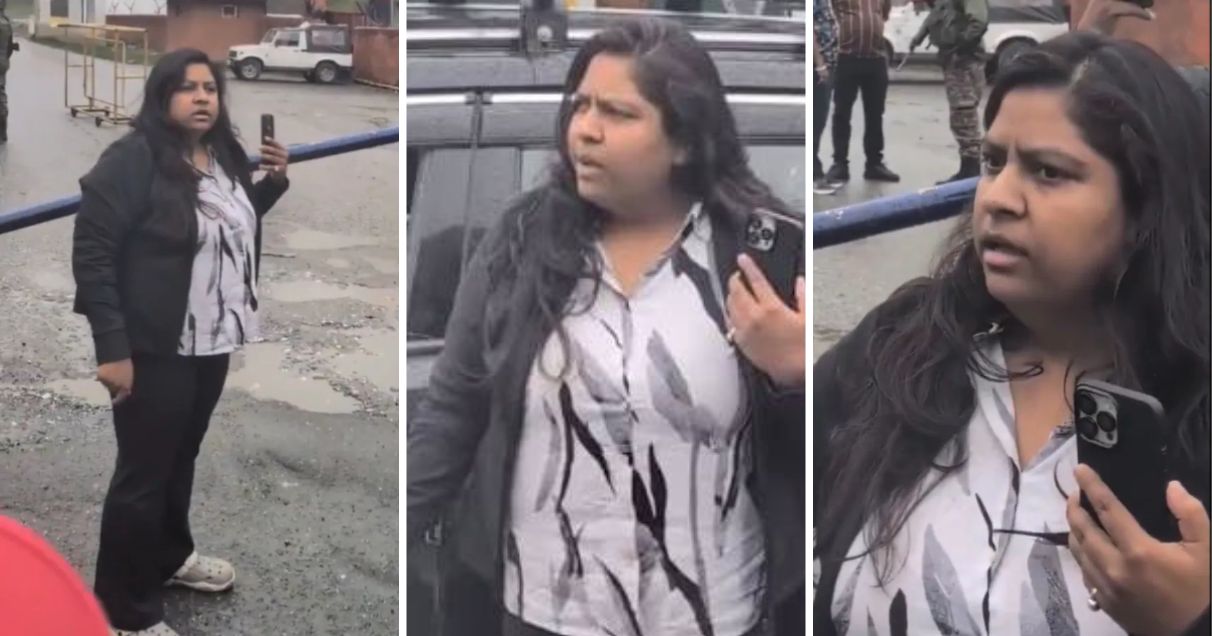
The young woman at the centre of a viral Ladakh confrontation has publicly apologised to the Indian Army, Jammu and Kashmir Police and Ladakh Police, saying she deeply regrets the language she used during the incident.
In her first interview since the video spread widely online, the 25-year-old said she had been travelling from Ladakh towards Delhi when the road was closed because of a VIP movement. According to her account, she and other travellers were left waiting for several hours without receiving clear information about when they would be allowed to proceed.
She said a security personnel initially told them that the wait would last another hour. When that period passed without the road reopening, frustration among those waiting began to grow.
What happened at the Ladakh checkpoint?
According to Ladakh Police, the incident took place around Kargil Vijay Diwas on July 26, when security restrictions were imposed near the Minimarg check post in the Dras region.
The road connecting Minimarg, Zoji La and Sonamarg was temporarily restricted as part of security arrangements. A number of tourists and other travellers were consequently held up in the area.
As the wait continued, tensions reportedly increased. The viral footage shows the woman confronting security personnel and questioning why some individuals, including a minister, appeared to have been permitted to travel while other people remained stranded.
Several tourists can be seen supporting her during the confrontation.
The woman later told NDTV that the widely circulated clip did not capture everything that had happened before the exchange.
‘We had already waited for hours’
She said the group had spent around six hours waiting by the time they heard that an altercation had allegedly taken place further ahead involving members of the public, police and security personnel.
She said she moved towards the area and became involved in the tense situation.
According to her account, she was also dealing with health-related discomfort and was frustrated because the prolonged stoppage had left travellers without access to basic facilities.
She said her comments about paying taxes and being unable to continue their journey came out during an emotionally charged moment.
The woman now says she accepts that some of the words used during the confrontation were inappropriate.
‘What I said was wrong’
In the interview, she acknowledged that her conduct in the video was not appropriate and said she regretted what she said.
She also strongly denied that she had deliberately attempted to insult the Army or create publicity for herself.
The woman said she has immense respect for the Indian armed forces and never imagined that her remarks would cause hurt to personnel.
She also apologised to people across the country and specifically named the Indian Army, J&K Police, Ladakh Police and Jammu and Kashmir Chief Minister Omar Abdullah.
She said the intense criticism that followed the video's circulation had taken a severe emotional toll on her.
Describing herself as an ordinary 25-year-old, she said she had never anticipated that a short video recorded during an argument would spread so widely.
Why did she say ‘We are Gen Z’?
Another part of the video that attracted significant attention was her reference to “Gen Z”.
The woman said she had not planned to make any broader political or generational statement through the phrase.
She explained that people around her were encouraging her during the confrontation and telling her that similar situations were something locals faced regularly. In the heat of the moment, she said, the words simply came out.
She now says she did not realise the phrase would be interpreted in the context of the wider discussion around Gen Z-led protests.
Viral clip, different aftermath
The incident has since become a wider social media debate about tourist grievances, security restrictions, accountability and the conduct of people during confrontations with security personnel.
The woman, however, says the experience has been deeply upsetting and that she never intended to become the focus of such intense public attention.
Her latest statement is an attempt to put her side of the incident on record while accepting responsibility for the language she used.
She has reiterated that her anger was directed at the circumstances of the prolonged wait and not at the Indian Army or police forces themselves.